Colorado Supreme Court orders Boulder County Clerk to cease issuance of same-sex marriage licenses

The Colorado Supreme Court on Tuesday ordered Boulder County Clerk Hillary Hall to stop issuing marriage licenses to same-sex couples after more than a month of doing so. In that time, at least 199 licenses were issued to gay or lesbian couples.

Colorado Attorney General has spent weeks attempting to stop Hall from issuing licenses through his own directives and lower state courts, to no avail.

The Boulder County Clerk began issuing same-sex marriage licenses on June 25, when the 10th Circuit Court of Appeals struck down Utah’s ban on same-sex couples’ marriages as being unconstitutional.

As the state of Colorado is also under jurisdiction of the 10th Circuit Court, Hall began issuing licenses that day, after consulting her county attorney.

Texas Attorney General Greg Abbott uses failed “procreation” tactic in 5th Circuit Court appeal

Texas Attorney General Greg Abbott says marriage should only be about procreation

Despite the fact that two federal appeals courts have rejected procreation as a legal reason to deny same-sex couples the right to marry, Texas Attorney General Greg Abbott has chosen to use that very argument (creative) in his filing to the Fifth Circuit Court of Appeals.

From the Statesman:

“By recognizing and encouraging the lifelong commitment between a man and woman — even when they do not produce offspring — the state encourages others who will procreate to enter into the marriage relationship,” Abbott said in the state’s first brief, filed late Monday at the 5th U.S. Circuit Court of Appeals.

Promoting opposite-sex marriages “increases the likelihood that children will be born into stable environments where they are raised by their mother and their father,” Abbott argued.

Such family structures are good for the children’s well being and good for the state because they increase the likelihood that parents, not society, “will bear the cost of raising these children,” the brief said.

“Because same-sex relationships do not naturally produce children, recognizing same-sex marriage does not further these goals to the same extent that recognizing opposite-sex marriage does,” Abbott said.

The legal landscape has significantly changed since February, when U.S. District Judge Orlando Garcia ruled that the Texas ban on same-sex marriage is unconstitutional because it relegates gay couples to “second-tier status” and demeans their dignity for no legitimate reason.

Garcia, who also tossed out Texas’ ban on recognizing same-sex marriages legally performed in other states, was the fourth federal judge to make a similar ruling since late December, following jurists in Utah, Oklahoma and Virginia.

Federal judges in 10 other states have overturned same-sex marriage bans saying the laws violate the US Constitution.

Plus, two federal appeals courts have upheld such rulings. The 4th U.S. Circuit Court of Appeals issued a ruling yesterday that Virginia’s ban prohibited same-sex couples “from participating fully in our society.” And the 10th U.S. Circuit Court of Appeals agreed in similar rulings for Utah and Oklahoma.

Both the 4th Circuit and the 10th Circuit specifically addressed the issue that procreation is no justification for discriminating against gays and lesbians.

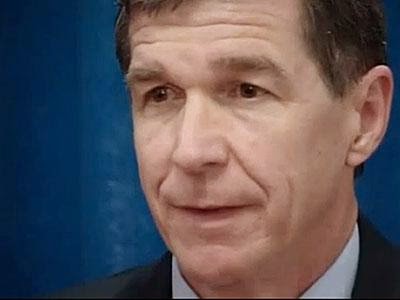
North Carolina Attorney General Roy Cooper announces the state will not oppose same-sex marriage cases

North Carolina Attorney General Roy Cooper

In light of the Fourth Circuit Court’s ruling which found Virginia’s marriage ban is unconstitutional, North Carolina’s attorney general said he will stop defending his state’s ban in court:

“After reviewing the 4th Circuit decision and consulting with attorneys here, I have concluded that the State of North Carolina will not oppose the cases moving forward.

“In addition, the State of North Carolina will acknowledge the 4th Circuit opinion that marriage is a fundamental right and that our office believes that the judges are bound by this 4th Circuit decision.

“In all these cases challenging state marriage laws, our office along with other attorneys general and state attorneys across the country have made about every legal argument imaginable.

“Since the US Supreme Court ruled in the Windsor case, all the federal courts have rejected these arguments each and every time. So it’s time for the State of North Carolina to stop making them.” – North Carolina State Attorney General, Roy Cooper

Today’s Virginia ruling sets precedent for not only that state, but all states in the court’s jurisdiction which includes North Carolina.

South Carolina’s AG, Alan Wilson, issued a statement saying he intends to continue defending his state’s same-sex marriage ban.

(via Advocate.com)

Virginia: Fourth Circuit Court of Appeals rules same-sex marriage ban unconstitutional

This began in February when U.S. District Judge Arenda Wright Allen ruled that Virginia’s same-sex marriage ban violates equal protection and due process guarantees, and therefore unconstitutional.

Two circuit court clerks whose duties include issuing marriage licenses appealed.

Now, a three-judge panel at the 4th Circuit Court of Appeals has upheld that ruling.

From the American Foundation for Equal Rights:

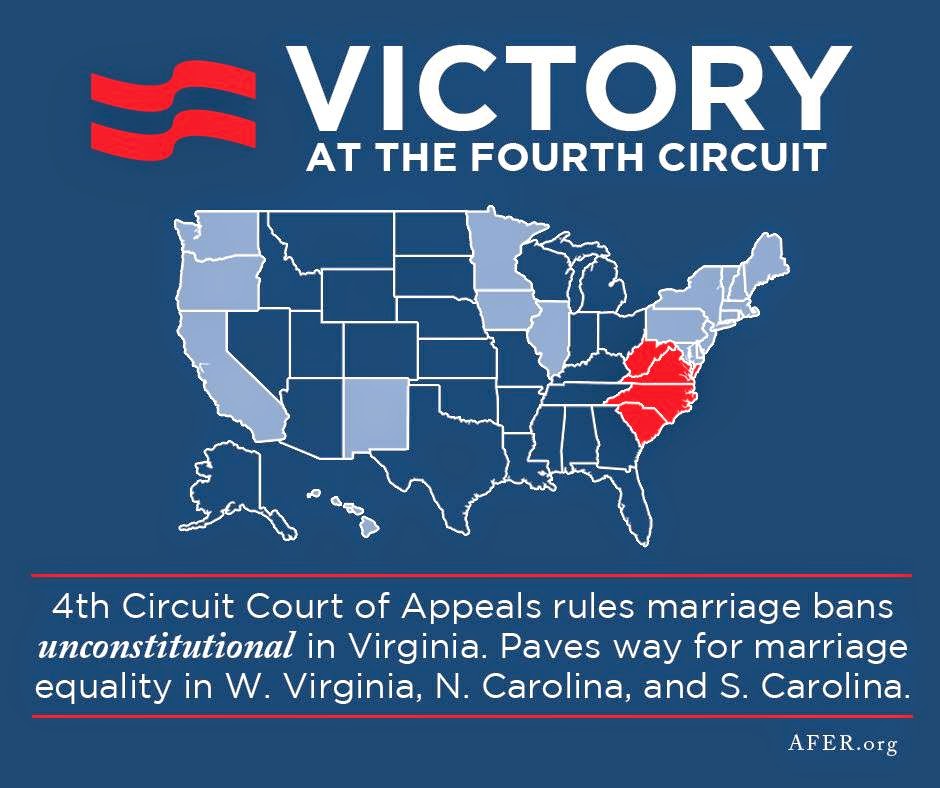
The U.S. Court of Appeals for the Fourth Circuit has affirmed that Virginia’s marriage ban is unconstitutional because it violates the Equal Protection and Due Process Clauses of the Fourteenth Amendment to the United States Constitution. Today’s decision sends the message that loving couples like our plaintiffs – Tim Bostic & Tony London and Carol Schall & Mary Townley – are entitled to the same basic rights and protections as every other American.

Hollingsworth v. Perry, the AFER-led challenge to California’s Proposition 8, was the first lawsuit in which a federal court of appeals ruled in favor of marriage equality.

Today’s decision is monumental as it also paves the way for West Virginia, North Carolina, and South Carolina to strike down their marriage bans as those states fall under the jurisdiction of the U.S. Court of Appeals for the Fourth Circuit.

This ruling sets a high-court precedent, meaning that judges who hear subsequent marriage challenges in North Carolina, South Carolina and West Virginia (the other states covered by the Fourth Circuit) should apply the precedent.

Marriage equality has been legal in Maryland, the fifth state in the Fourth Circuit, since January, 2013.

This marks the 29th court ruling in favor of marriage equality since SCOTUS struck down Section 3 of DOMA in June of 2013.

Freedom To Marry issued this statement:

“It was in a case out of Virginia that the Supreme Court ended race discrimination in marriage. And today, in another Virginia marriage case, a federal circuit court ruled against discrimination in marriage, affirming the freedom to marry for loving and committed gay couples.

“The Fourth Circuit’s ruling echoes what over 25 other federal and state courts have held: same-sex couples deserve the dignity of marriage, and anti-marriage laws are indefensible.

“Every day of denial is a day of injustice and tangible harms. It’s time for the Supreme Court to bring the country to national resolution and secure the freedom to marry for all.”

Florida’s same-sex marriage ban ruled unconstitutional – AGAIN – by second state court

Judge Sarah Zabel of the Eleventh Judicial Circuit Court has struck down the state’s ban on same-sex marriage, making for the second ruling against the law within the span of two weeks.

From the ruling:

The flood of cases that have come out since Windsor amply demonstrates this truth as not one court has found a same-sex marriage ban to be constitutional. As case after case has come out, unified in their well-reasoned constitutional condemnation of the deprivation of one class of person’s right to marry, the answer to the question of whether it is constitutionally permissible to deprive same-sex couples of the right to marry has become increasingly obvious: Of course it is not.

Preventing couples from marrying solely on the basis of their sexual orientation serves no governmental interest. It serves only to hurt, to discriminate, to deprive same-sex couples and their families of equal dignity, to label and treat them as second-class citizens, and to deem them unworthy of participation in one of the fundamental institutions of our society.

The journey of our Nation towards becoming “a more perfect Union” does not stop at any particular generation; it is instead a fluid process through every generation.

The Court, therefore, foresees a day when the term “same-sex marriage” is viewed in the same absurd vein as “separate but equal” and is thus forsaken and supplanted by ordinary “marriage.”

[snip]

Florida’s same-sex marriage bans violate the Due Process and Equal Protection Clauses of the United States Constitution, and they also offend basic human dignity.
The Plaintiff’s Motion for Summary Judgment is therefore GRANTED.

The ruling is stayed “pending the outcome of expected appeals.”

Read the decision here.

Colorado Court of Appeals denies state AG’s request to stop issuance of marriage licenses to same-sex couples

Boulder County Clerk Hillary Hall can still issue marriage licenses to same-sex couples in light of the latest ruling by the Colorado Court of Appeals which denied Attorney General John Suther’s emergency motion to stop such licenses while the case is currently being appealed.

Boulder District Judge Andrew Hartman on July 10 denied a request by Suthers to grant an injunction to prevent Hall from issuing the licenses, saying the state could not prove Hall’s action harmed the state. He re-affirmed that ruling this week.

Suthers filed an appeal with the Colorado Court of Appeals, and asked that a stay be issued stopping Hall pending the hearing of the appeal.

Hall started issuing marriage licenses to same-sex couples June 25 after the 10th U.S. Circuit Court of Appeals ruled Utah’s ban unconstitutional. Her office had issued 183 as of this afternoon.

Hall is currently the only county clerk in the state issuing marriage licenses to same-sex couples.

(via Boulder County News)

Colorado’s same-sex marriage ban repealed

U.S. District Judge Raymond P. Moore has ruled Colorado’s ban on same-sex marriage unconstitutional.

He has stayed his ruling until Monday, August 25th..

State Attorney General John Suthers had asked for the ruling, in an unusual tactic, to get county clerks across the state to stop issuing marriage licenses to same-sex couples. Included in his request was that the ruling be stayed until the issue reached it’s ultimate conclusion.

Boulder County Clerk Hillary Hall has been issuing marriage licenses to same-sex couples since last month, when the 10th Circuit agreed with a lower court that Utah’s same-sex marriage was unconstitutional.

Hall has stated that the 10th Circuit’s stay in the Utah case only applies to Utah, BUT the ruling against marriage bans applies to the whole Circuit, which includes Colorado.

More to come as details are available.

(via ThinkProgress)

Louisiana: Federal judge doesn’t need any more briefs to reach ruling

A federal judge in Louisiana says he doesn’t need any more briefs or arguments to make his decision in a same-sex marriage case.

From The Republic:

U.S. District Judge Martin Feldman has already heard arguments regarding Louisiana’s refusal to recognize the unions of gay couples legally married in other states. At the end of that hearing he asked for briefs on related issues — including whether the state’s refusal to let same-sex couples marry in Louisiana is constitutional. Feldman said he didn’t want to make a piecemeal ruling on the gay marriage issue.

Feldman this week issued an order stating that he has studied the briefs in the case and found that no further briefs or arguments are needed. He gave no indication when he will rule.

Florida Judge rules state ban on same-sex marriage

A judge in the Florida Keys has ruled that the state’s ban on same-sex marriage is unconstitutional.

The ruling was issued Thursday by Circuit Judge Luis M. Garcia and applies only to Monroe County, which covers the Keys.

The lawsuit contended that the same-sex marriage ban approved by voters in 2008 violated the U.S. Constitution’s guarantee of equal protection under the law. The judge says licenses could be issued starting Tuesday.

Attorney General Pam Bondi and ban supporters argued that the referendum vote should be respected and that Florida has sole authority to define marriage in the state. The Florida amendment defined marriage as a union between one man and one woman.

The state of same-sex marriage ban appeals in the US

With all the rulings, I thought I’d post a round up of where we are with same-sex marriage rulings and appeals so far:

The Seventh Circuit Court of Appeals has announced it will hear arguments regarding Indiana and Wisconsin’s marriage ban cases on August 13th.

A week before that the 6th Circuit Court of Appeals will will arguments regarding bans in Kentucky, Michigan, Ohio and Tennesee.

The 10th Circuit Court has already decided Utah’s ban is unconstitutional and that state’s AG has announced they are heading to SCOTUS for final appeal.

We expect to hear any day now the verdict from the 4th Circuit Court in Virginia’s same-sex marriage ban case.

Hawaii, Idaho and Nevada get their day with the 9th Circuit Court in September.

And finally, Texas has filed an appeal with the 5th Circuit Court on that state’s marriage ban but no date for arguments has been scheduled at this time.

So – got all that?