SCOTUS sees more requests for same-sex marriage appeals from Oklahoma and Virginia

Plenty of requests for the US Supreme Court regarding marriage equality today.

Lawyers for Oklahoma couple Mary Bishop and Sharon Baldwin have filed a request for SCOUTS to take up their case. The couple successfully sued Tulsa County Clerk Sally Howe Smith for refusing to issue a marriage license due to a state ban on same-sex marriage.

Last month the 10th Circuit Court of Appeals upheld a federal judges ruling that Oklahoma’s ban on marriage equality is unconstitutional.

Smith’s lawyers have already filed a similar appeal to SCOTUS earlier this month.

Over in Virginia, the American Foundation for Equal Rights have filed what is now the third request to SCOTUS regarding that state’s same-sex marriage ban.

“Forty-seven years ago, Mildred and Richard Loving passionately argued that the Supreme Court must end the unjust laws that dare to tell us who we can and cannot love,” said Plaintiffs’ lead co-counsel Ted Olson.

“Today, almost half a century later, it is time thousands of gay and lesbian couples across America are extended that same promise of equality and freedom that the Supreme Court granted to the Lovings. Our plaintiffs have already fought for, in two separate courts, a constitutional promise they have been denied. Now, the Supreme Court must take up the Bostic case, answer once and for all the surpassingly important constitutional question of marriage equality, and rule decisively in favor of the fundamental right to marry for every same-sex couple.”

Virginia Attorney General Mark Herring and the Alliance Defending Freedom (acting for the Norfolk County Clerk) had both recently filed similar requests for review.

Virginia: Norfolk County Clerk files appeal to SCOTUS on same-sex marriage ban ruling

SCOTUSblog reports that George E. Schaefer III, county clerk for Norfolk, Virginia, has filed a request for SCOTUS to rule on the constitutionality of the Commonwealth’s same-sex marriage ban.

This filing takes the approach that lower Federal courts have “subverted” United States v. Windsor, arguing that the decision put the power to decide marriage laws in the hands of states:

The new Virginia petition by clerk Schaefer put its strongest emphasis on state sovereignty, arguing that the Supreme Court’s decision fourteen months ago in United States v. Windsor embraced the power of the states to define for themselves who may marry. (The Windsor decision struck down a key part of the federal Defense of Marriage Act, citing — among other reasons — its interference with same-sex marriages that were legal under state law.)

The filing contended that the core issue that is now reaching the Court is who decides the question. “The controversy concerns whether the issue will be decided by state citizens or by judges.”

[snip]

A series of lower federal court decisions against state bans are “mistaken,” the petition asserted, because “the Fourteenth Amendment does not override state sovereign choices about whether to adopt same-sex marriage.”

SCOTUS issues stay on 4th Circuit Court ruling on Virginia’s same-sex marriage ban

(image via Buzzfeed)

As expected, the US Supreme Court has issued a stay on the 4th Circuit Court of Appeals ruling which struck down Virginia’s same-sex marriage ban.

The application for stay was filed with Chief Justice John Roberts who referred the request to the entire Court.

More from Chris Geidner at Buzzfeed:

Notably, the court stated that the stay will “terminate automatically” if it does not take and denies certiorari in the case — which is the process by which the court formally takes cases. If it grants certiorari, then its stay ends when it “send[s] down … the judgment of this Court.”

Sadly, this again postpones the equal rights of gay and lesbian couples in the Commonwealth of Virginia. Justice delayed is justice denied.

The question now is: Which state’s case will SCOTUS take this fall? We shall see…

Virginia: American Foundation for Equal Rights asks SCOTUS to not stay same-sex marriage ruling

Lawyers for AFER filed their official response with Chief Justice John Roberts regarding a stay on the recent same-sex marriage ruling in the 4th Circuit Court:

Today, lawyers representing the plaintiffs in the Bostic case responded to a petition by defendants seeking a stay of the United States Circuit Court for the Fourth Circuit’s decision that found Virginia’s marriage ban unconstitutional by urging the Supreme Court not to delay the issuance of marriage licenses for same-sex couples in Virginia.

The American Foundation for Equal Rights is the primary sponsor of the Bostic case.

“Virginia’s exclusion of gays and lesbians from the fundamental right to marriage causes painful, irreparable, and immeasurable injury to large numbers of its citizens every day and every moment it remains in existence, and humiliates and stigmatizes these individuals and their children in ways too numerous to enumerate,” said Ted Olson, lead co-counsel for the Bostic plaintiffs. “Courts all over the country are overwhelmingly and with an unprecedented degree of unanimity recognizing that there is no legal basis for continuing to impose this kind of harm on our fellow citizens. There is no justification for staying the effect of the Fourth Circuit’s decision upholding the rights of Virginians to marry the person they love.”

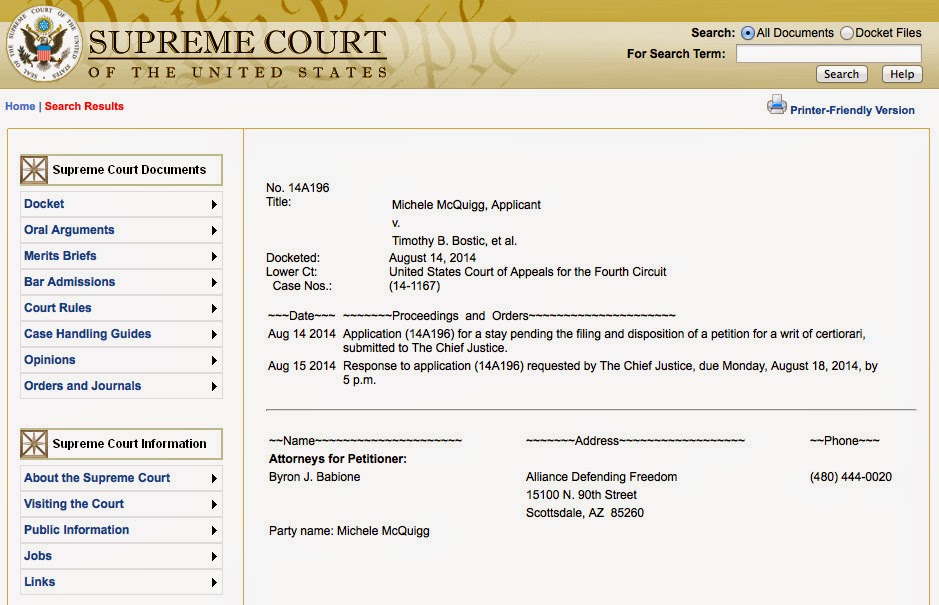
Prince William County Clerk Michèle McQuigg filed her petition to stay the Fourth Circuit Court’s mandate on Thursday, August 14, 2014.

Should Chief Justice Roberts, the U.S. Supreme Court Justice responsible for emergency petitions made within the Fourth Circuit, deny the stay request, marriages for gay and lesbian couples would be set to begin at 8 a.m. on Thursday, August 21, 2014.

I would be very happy but stunned if Chief Justice Roberts were to deny the request for stay.

(via press release)

Chief Justice John Roberts asks Virginia plaintiffs for response to 4th Circuit stay on marriage equality

US Supreme Court Chief Justice John Roberts received a request from the anti-gay Alliance Defending Freedom yesterday asking him to stay the recent decision by the 4th Circuit Court of Appeals upholding the ruling which declared Virginia’s same-sex marriage ban unconstitutional.

Today, Chief Justice Roberts has given the plaintiffs in the case until Monday at 5pm to respond to the request of stay.

Should Roberts NOT stay the ruling, marriage equality would come to Virginia next Thursday, August 21st at 8am.

I would be very surprised if Roberts did NOT issue a stay.  Other states have asked and received similar stays while same-sex cases work their way to SCOTUS.

Virginia: Alliance Defending Freedom asks SCOTUS to stay 4th Circuit’s same-sex marriage ruling

And… right on cue, the viciously anti-gay Alliance Defending Freedom has filed an official request asking the US Supreme Court to stay the 4th Circuit of Appeals ruling which says Virginia’s same-sex marriage ban is unconstitutional.

The request is predicated on the idea that there is a “fair prospect” that SCOTUS will overturn the Fourth Circuit and so, no marriages should take place until that happens.

Or else there will be “irreparable harm.” See the full brief below.

Should SCOTUS does not act on this request, same-sex marriages will begin next Thursday in Virginia at 8AM.

Fourth Circuit Court of Appeals denies stay on same-sex marriage ruling

Unless the U.S. Supreme Court intervenes, gay and lesbian couples in Virginia will be able to marry on Monday after a ruling today from the Fourth Circuit court of appeals.

On July 28th, the 4th Circuit Court affirmed a lower courts ruling that Virginia’s same-sex marriage ban is unconstitutional.

The court has now denied, by a vote of 2-1, a stay on the ruling, meaning marriage equality will begin as soon as Monday if SCOTUS doesn’t intervene.

More from the AP.

See the order from the 4th Circuit below:

Virginia takes marriage equality appeal to US Supreme Court

Click image to enlarge

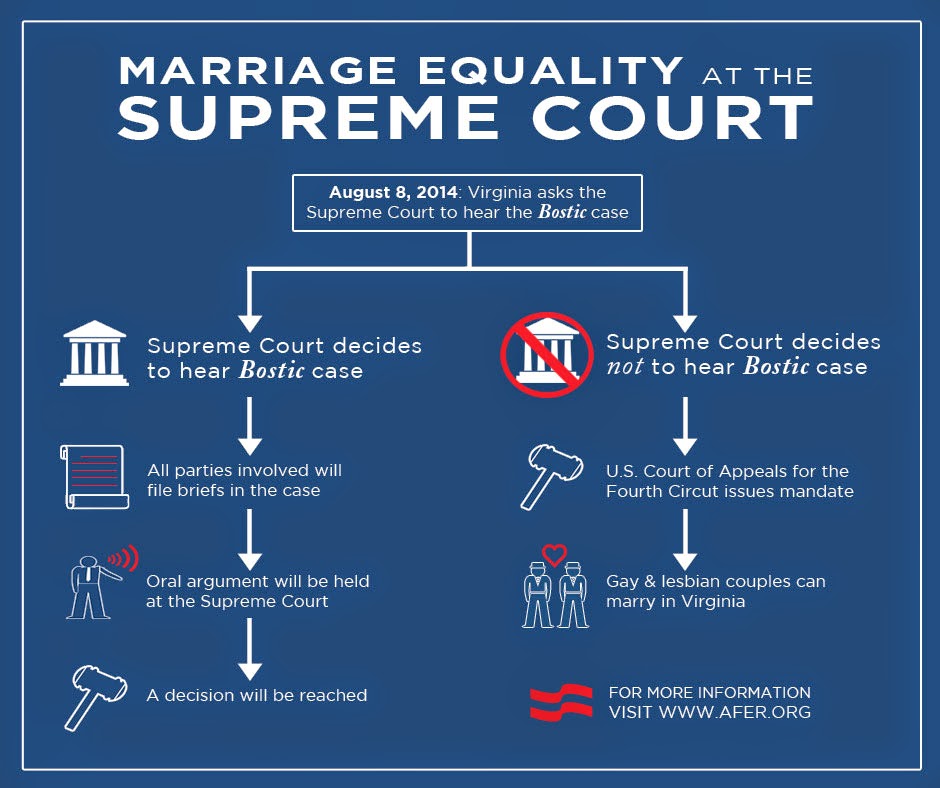
On Friday, August 8, 2014 the Commonwealth of Virginia asked the United States Supreme Court to review the federal appeals court ruling in Bostic v. Schaefer (docketed as Rainey v. Bostic) that found Virginia’s discriminatory Marriage Amendment unconstitutional.

Virginia’s Marriage Amendment has been ruled unconstitutional twice: first in a U.S. District Court and then by the U.S. Court of Appeals for the Fourth Circuit.

Defendants’ request for Supreme Court review, known as a petition for a writ of certiorari, is only granted upon an affirmative vote of four Supreme Court Justices.

The next Supreme Court term will begin in late September, 2014. A Supreme Court Term usually runs until late June or early July. Of the approximately 8,000 cases that appear on the Court’s docket each Term, the Justices hear and decide only between 70 and 80 cases after full briefing and oral argument.

(via American Foundation for Equal Rights)

Virginia announces marriage equality appeal to SCOTUS

Just hours after Utah announced it’s intention to ask the US Supreme Court to rule on the recent overturn of that state’s ban on same-sex marriage, Virginia’s Attorney General has followed suit:

Virginia Attorney General Mark Herring says he will ask SCOTUS to review the recent ruling by the 4th Circuit Court of Appeals which upheld the state’s ban unconstitutional.

On Friday, Herring, a Democrat who has said the Virginia ban is unconstitutional, will file a petition for writ of certiorari asking the nation’s highest court to hear Virginia’s marriage equality case and definitively settle the constitutional issues it raises.

Bostic v. Schaefer was originally filed on behalf of two same-sex couples in July 2013 by the legal team that challenged California’s Proposition 8, including the American Foundation for Equal Rights (AFER) along with attorneys Ted Olson and David Boies. The American Civil Liberties Union (ACLU) and Lambda Legal joined the case in March on behalf of all of Virginia’s same-sex couples.

[snip]

“Throughout this case, I have fought for the fundamental rights of Virginians and the quickest possible resolution,” Herring said in a statement. “I believe the district and appeals courts ruled correctly in striking down Virginia’s discriminatory marriage ban, but it has long been clear that the Supreme Court will likely have the final word. I want that decision to come as soon as possible and I want the voices of Virginians to be heard. This case has moved forward at an incredibly swift pace, and I look forward to a final resolution that affirms the fundamental right of all Virginians to marry.”

Clearly, lawyers in both states (and on both sides of the issue) are looking to get to SCOTUS first in what will clearly be a historic court decision.

More at MetroWeekly.