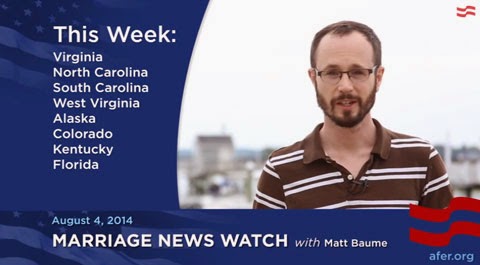
The fourth circuit has upheld a ruling that the Virginia’s marriage ban is unconstitutional.
There’s been immediate fallout from that ruling in several nearby states.
Pus, new southern polling, and a victory in Alaska, but only for dead people.
LGBTQ news and entertainment
The fourth circuit has upheld a ruling that the Virginia’s marriage ban is unconstitutional.
There’s been immediate fallout from that ruling in several nearby states.
Pus, new southern polling, and a victory in Alaska, but only for dead people.

This began in February when U.S. District Judge Arenda Wright Allen ruled that Virginia’s same-sex marriage ban violates equal protection and due process guarantees, and therefore unconstitutional.
Two circuit court clerks whose duties include issuing marriage licenses appealed.
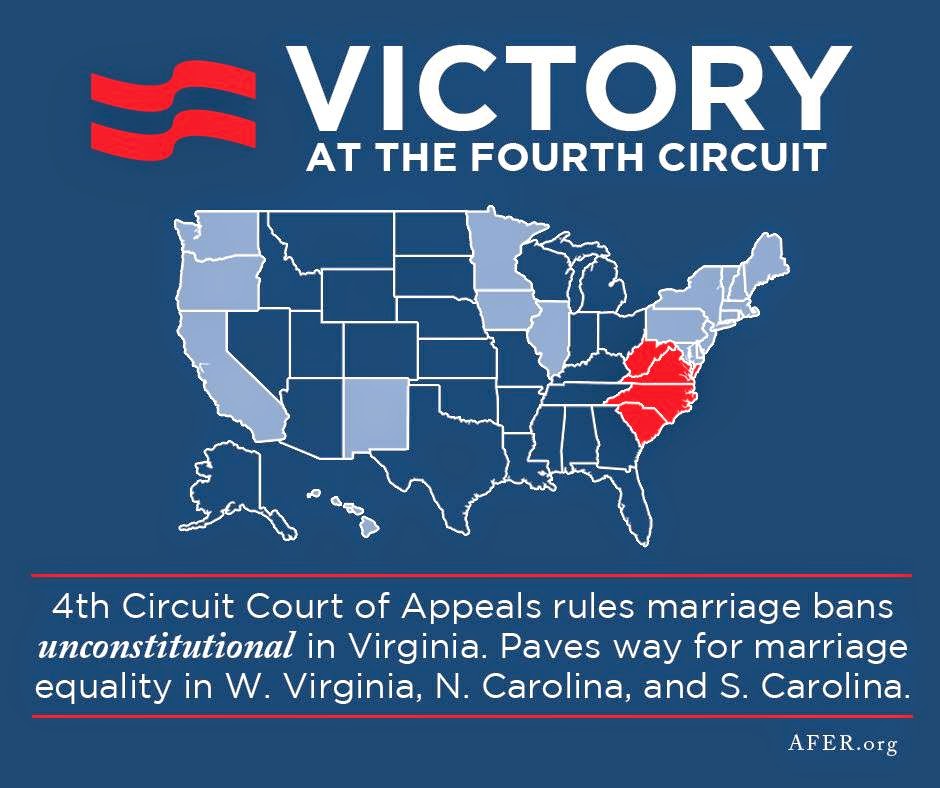
Now, a three-judge panel at the 4th Circuit Court of Appeals has upheld that ruling.
From the American Foundation for Equal Rights:
The U.S. Court of Appeals for the Fourth Circuit has affirmed that Virginia’s marriage ban is unconstitutional because it violates the Equal Protection and Due Process Clauses of the Fourteenth Amendment to the United States Constitution. Today’s decision sends the message that loving couples like our plaintiffs – Tim Bostic & Tony London and Carol Schall & Mary Townley – are entitled to the same basic rights and protections as every other American.
Hollingsworth v. Perry, the AFER-led challenge to California’s Proposition 8, was the first lawsuit in which a federal court of appeals ruled in favor of marriage equality.
Today’s decision is monumental as it also paves the way for West Virginia, North Carolina, and South Carolina to strike down their marriage bans as those states fall under the jurisdiction of the U.S. Court of Appeals for the Fourth Circuit.
This ruling sets a high-court precedent, meaning that judges who hear subsequent marriage challenges in North Carolina, South Carolina and West Virginia (the other states covered by the Fourth Circuit) should apply the precedent.
Marriage equality has been legal in Maryland, the fifth state in the Fourth Circuit, since January, 2013.
This marks the 29th court ruling in favor of marriage equality since SCOTUS struck down Section 3 of DOMA in June of 2013.
Freedom To Marry issued this statement:
“It was in a case out of Virginia that the Supreme Court ended race discrimination in marriage. And today, in another Virginia marriage case, a federal circuit court ruled against discrimination in marriage, affirming the freedom to marry for loving and committed gay couples.
“The Fourth Circuit’s ruling echoes what over 25 other federal and state courts have held: same-sex couples deserve the dignity of marriage, and anti-marriage laws are indefensible.
“Every day of denial is a day of injustice and tangible harms. It’s time for the Supreme Court to bring the country to national resolution and secure the freedom to marry for all.”
Buzzfeed reporter Chris Geidner has posted an in-depth report of today’s oral arguments at the 4th Circuit Appeals Court regarding Virginia’s appeal of the recent ruling that struck down the state’s ban on marriage equality.
Just part of Geidner’s take on the hearing:
Two of the court’s three judges appeared ready to strike down the ban Tuesday at oral arguments in Richmond — the third federal appellate hearing on the question currently winding its way through federal and state courts throughout the nation. Judge Paul Niemeyer was the only judge hearing the arguments who pressed heavily on the side of the state’s ban, saying that same-sex couples are creating a “brand new relationship” and that “it takes a male and female to have a child, to have a family.”
The “core of a family” is the mother-father relationship, Niemeyer told Ted Olson, who was arguing for same-sex couples fighting the 2006 marriage ban. Describing that relationship as “A” and same-sex couples’ relationships as “B,” Niemeyer said that “the state can redefine it and call it marriage,” but that wouldn’t change the fact that “these are two different relationships.”
Although arguments about defining fundamental rights and the level of scrutiny to be used in reviewing the 2006 amendment — the questions central to the briefs in the case — were discussed during the hour, Niemeyer’s focus at times seemed out of place, echoing as it did a Kentucky Court of Appeals opinion from 1973 that dismissed a same-sex couple’s attempt to get a marriage license because “what they propose is not a marriage.”
Read the full breakdown at Buzzfeed.

Attorney General Mark R. Herring attended oral arguments today before the 4th Circuit in the appeal of the recent ruling striking down Virginia’s ban on same-sex marriage.
The Commonwealth argued in favor of upholding the ruling of the district judge who reached the same conclusion as Attorney General Herring regarding the constitutionality of the ban.
In a terrific speech, Herring said he found the anti-gay side to have “wholly unpersuasive” arguments.
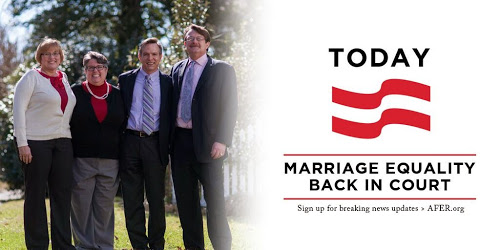

Today, in a historic milestone for the marriage equality movement, the United States Court of Appeals for the Fourth Circuit will hear oral argument for the first time on the constitutionality of whether gay and lesbian couples have the right to marry.
The United States District Court for the Eastern District of Virginia ruled in February in Bostic v. Schaefer that laws prohibiting gay and lesbian couples from marrying the in state are unconstitutional as they violate the Equal Protection and Due Process Clauses of the Fourteenth Amendment to the United States Constitution.
The case will be heard by a three-judge panel including: Judge Henry F. Floyd, appointed by President Barack Obama, Judge Roger L. Gregory, first appointed in recess by President Bill Clinton then renominated by President George W. Bush, and Judge Paul V. Niemeyer, appointed by George H.W. Bush.

Virginia Attorney General Mark Herring has filed a brief with the Fourth Circuit Court of Appeals in support of AFER’s marriage equality lawsuit.
One of the key tenets of Herring’s brief focuses on the fact that “heightened scrutiny” should be applied in deciding the case. From his brief:
Virginia’s same-sex-marriage ban violates the Due Process and Equal Protection clauses of the Fourteenth Amendment. Because the ban substantially interferes with the right to marry, it is subject to strict scrutiny.
The ban also discriminates on the basis of gender and sexual orientation, triggering at least heightened scrutiny.
All of the considerations apply here for the judiciary to be suspicious of laws that discriminate against gay people. And the Clerks’ claim that the ban treats men and women equally is like saying that interracial-marriage bans treat blacks and white equally, an argument rejected by the Supreme Court.
Like many AG’s across the country, Herring has refused to defend the law on the basis that he feels it is unconstitutional.
(via JMG)
By a vote of 100-0, the Virginia House of Delegates has agreed with the state Senate and passed legislation that eliminates an unconstitutional sodomy ban than made oral and anal sex illegal.
From Think Progress:
After years of unsuccessful attempts to repeal the law, in 2003, the U.S. Supreme Court’s Lawrence v. Texas ruling held that states may not ban private non-commercial sex between consenting adults. Virginia’s Crimes Against Nature statute, which made oral sex (even between consenting married couples) a felony, was clearly the sort of legislation the Court was referencing. But a year later the Republican-controlled state legislature killed a bill to update the law and remove the statute’s consensual sodomy provisions. Virginia’s leading anti-LGBT forces opposed the update.
Last year, the federal courts overturned the conviction of a man charged, under Virginia’s Crimes Against Nature law, of soliciting a 17-year-old female for oral sex — a felony under the statute. Because that law — first enacted in 1950 to prohibit oral and anal sex, as well as bestiality — had not been updated, the court ruled it was unenforceable, putting the convictions of other sexual offenders and child predators at risk.
The bill now heads to Gov. Terry McAuliffe’s desk for his signature.
A decade after the SCOTUS ruling at least a dozen US states still have anti-sodomy laws on the books.

Late Thursday night, a federal judge in Norfolk struck down Virginia’s ban on same-sex marriage, saying it violates the constitution’s 14th Amendment guarantee of equal protection:
“The Court finds Va. Const. Art. I, § 15-A, Va. Code §§ 20-45.2, 20-45.3, and any other Virginia law that bars same-sex marriage or prohibits Virginia’s recognition of lawful same-sex marriages from other jurisdictions unconstitutional. These laws deny Plaintiffs their rights to due process and equal protection guaranteed under the Fourteenth Amendment of the United States Constitution.”
District Federal Court Judge Arenda L. Wright Allen had stated earlier that she would to rule quickly after hearing arguments in Norfolk on Thursday in one of two challenges to Virginia’s ban.
From the Washington Post:
Wright Allen opened her decision with a quote from Mildred Loving, who was at the center of the Virginia case that the Supreme Court used in 1967 to strike down laws banning interracial marriage.
Wright Allen added: Tradition is revered in the Commonwealth, and often rightly so. However, tradition alone cannot justify denying same-sex couples the right to marry any more than it could justify Virginia’s ban on interracial marriage.
Virginia Attorney General Mark R. Herring recently changed the state’s legal position on the issue and joined two gay couples in asking the ban be struck down.
Herring said the state will continue to enforce the ban until the legal process is over.
This victory makes Virginia the fifth state in recent weeks where courts have ruled in favor of marriage equality.
Human Rights Campaign released this statement:
Yet another court has upheld the fundamental idea that gay and lesbian Americans are entitled to full equality under the law. Nearly fifty years ago, another Virginia case struck down bans on interracial marriage across the country, and now this commonwealth brings renewed hope for an end to irrational barriers to marriage for loving and committed couples across the country.
“Following recent decisions in Utah, Oklahoma, Ohio and Kentucky this Virginia ruling proves that marriage equality is once again on the fast track to the United States Supreme Court. From the South to the Midwest, this historic progress sends a message that no American should have to wait for equality, no matter where they live. “Right now this nation is divided into two Americas—one where full legal equality is nearly a reality, and the other where even the most basic protections of the law are nonexistent for loving gay and lesbian couples. We cannot and will not tolerate that patchwork of discrimination, and we won’t stop fighting until fairness and dignity reaches each and every American in all 50 states.”

The first hearing in the Virginia marriage equality case of Bostic v. Rainey will be held at the U.S. District Court for the Eastern District of Virginia before Judge Arenda L. Wright Allen at 10am.
The Bostic Plaintiffs’ lawsuit – first filed in July 2013 in Norfolk – argues that the Virginia Marriage Amendment and laws banning same-sex marriage are unconstitutional because they violate the Equal Protection Clause of the Fourteenth Amendment of the United States Constitution, violate Due Process, and single out gays and lesbians for a disfavored legal status, thereby creating a category of “second-class citizens.”
Virginia Attorney General Mark Herring will attend the morning’s hearing.
Virginia Solicitor General Stuart Raphael will argue on behalf of the Commonwealth.
More info here.
|
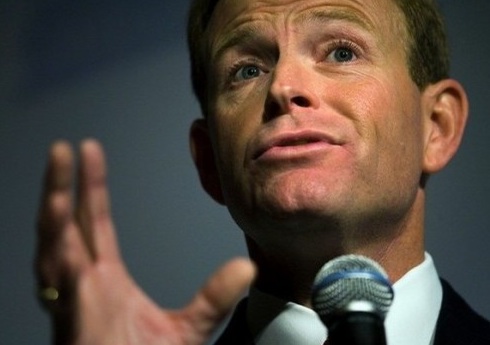
| Hate group leader Tony Perkins |
Hate group leader Tony Perkins is still stuck in 2006, a world away when it comes to political issues and an America that has seen a seismic change in attitudes over marriage equality.
In response to the Virginia Attorney General’s announcement that he would not be defending the state’s ban on same-sex marriage, having found it unconstitutional, Tony Perkins had this to say:
Like a majority of states, Virginia had overwhelming support (57%) to pass its marriage amendment in 2006. Now, under the new regime of Democratic Governor Terry McAuliffe and Attorney General Mark Herring, the democratic process has been tossed out the window — along with the votes of 1,328,134 Virginians.
Note – Perkins mentions the legislation being passed in 2006. As anyone who is paying attention to the issue, same-sex marriage has evolved very, very quickly for many Americans who once opposed these rights. To not acknowledge that 2014 is a different political landscape from 2006 is to be blind to what is happening in the world around him. Society evolves.
According to a Christopher Newport University poll this past October, a majority of Virginians support a repeal of the state’s ban on same-sex marriage. The poll found that 56 percent of likely voters oppose the ban on same sex marriage, compared to 36 percent who favor it.