Indiana State Senator: “Second Sentence” issue dead – no public vote on anti-gay marriage referendum in 2014

https://twitter.com/MikeDelph/status/434037631131742208

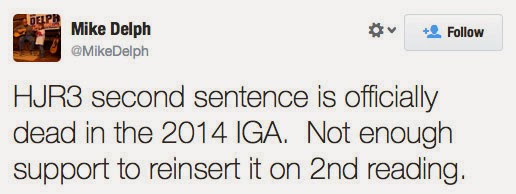
Indiana State Senator Mike Delph just tweeted the message above: “HJR3 second sentence is officially dead in the 2014 IGA. Not enough support to reinstate it on 2nd reading.”

As the debate continues today in Indiana, this would be good news for the LGBT community.

Constitutional amendments must pass in consecutive General Assemblies with identical language before going to the voters. By removing the “second sentence” (which bars ANY kind of legal relationship “identical or substantially similar” between same-sex couples), the bill will need to pass again in the next legislative session.

The state House removed the sentence earlier this year when approving the measure. LGBT opponents needed the Senate to restore the language and then fight to keep it in during a “conference” debate with House and Senate.

This means the issue won’t reach voters until 2016 at the earliest. And with marriage equality support growing every day, hopefully this won’t even be an issue by then.

Hurray!

Celebrate!  Happy Dance!

(h/t Good As You)

Indiana: State Senate to vote on anti-gay marriage bill today

The full Indiana Senate is set to hear and vote on HJR3, the bill that would place a ban on same-sex marriage into the state constitution.

The Senate Rules Committee approved an amended version of the bill which does not include a ban on civil unions – and therefore does not match the version passed by the last legislature.

IF the amended version passes today, the earliest a ban could be placed on the public ballot will be 2016.

Republicans hold a large majority over Dems (37-13) in the Senate, so passage of the bill is fairly assured. Best hope is for the amended ban to pass.

Stay tuned.

Indiana: State Senate committee moves anti-gay marriage amendment to full Senate by vote of 8+4

As expected, the Indiana state Senate Rules and Legislative Procedure Committee approved HJR-3, the current legislation which would allow for a statewide referendum to write a ban on marriage equality into the state’s constitution.

All eight Republicans voted for the measure, all four Democrats voted against.  From IndyStar.com:

The decision came with no discussion by committee members about whether to restore the amendment’s second sentence, which would also ban civil unions and similar arrangements. The House removed that provision before sending the amendment to the Senate.

Instead, the Senate will likely take up the question of whether to restore the second sentence when the measure comes up for second reading before the full 50-member Senate. That could happen as early as Thursday.

The “second sentence” issue adds complications for the legislation as constitutional amendments have to be passed in their original form in two successive state legislatures. By changing the language of the original resolution, the second sentence must either be restored before going to voters for 2014 OR must be voted on by the next state congress before heading to voters in 2016.

Considering the quickly changing landscape of marriage equality, the longer it takes to get to voters – where polls show the electorate split – the tougher it will be for anti-gay marriage proponents to see their amendment passed.

Indiana House passes anti-gay marriage constitutional amendment 57-40

The Indiana House on Tuesday approved a proposal to change the state constitution to ban same-sex marriage. The vote on House Joint Resolution 3 was 57-40.

The bill now moves to the Senate, which must approve the amended language. Yesterday, a sentence that banned ANY legal relationship that is “identical or substantially similar” to marriage was removed from the amendment.

If the Senate approves the bill as passed today, it will not go to the ballot in 2014.

A constitutional amendment needs to pass two consecutive, separately-elected General Assemblies and be approved by a voter majority in a public referendum before becoming part of the constitution.

Indiana: When public politics become personal

Chris Smith via his Facebook page

Openly gay Chris Smith, son of state Rep. Milo Smith who chairs Indiana’s House Elections and Apportionment Committee, shared his feelings about his father advancing an anti-gay marriage bill on the Facebook page of the LGBT advocacy group Indiana Equality this past Saturday, days after his father’s committee passed the ban.

“I’m not here to badmouth my dad,” he wrote. “I’m terribly disappointed in his decision and beliefs, but he’s not going to change them now if he hasn’t after all these years of knowing I am gay. I am here to support you and my friends who remain in Indiana. They are my extended family.”

On Sunday, he wrote on his own Facebook page, “My stand puts me in clear conflict with my own father, who is a state legislator and has voted to pass the resolution out of his committee and onto the full House for a vote.”

Additionally, speaking to Nuvo, a weekly publication in Indianapolis, Chris Smith said he resides in California and is in a domestic partnership. He said overall, he felt “really sad.”

“I’m embarrassed. I’m really disgusted by the whole thing. I’m confused as to what I should do,” he said, noting his father had not given him a heads up about the legislation or how he would vote.

A spokeswoman for Indiana state House Republicans, Tory Flynn, said she spoke with Milo Smith after his son’s post went up. “He stated that he loves his son very much and this is a personal issue,” she said.

The House Elections and Apportionment Committee was never even supposed to vote on HJR-3, which would amend the state constitution to ban same-sex marriage. The measure was originally set to receive a vote in the House Judiciary Committee, but after backers realized there weren’t enough votes for it to pass — several Republicans had expressed concerns — House Speaker Brian Bosma (R) moved the measure at the last minute to Smith’s committee, which was considered more conservative.

More at Huffington Post.

Indiana House changes anti-gay marriage bill language possibly postponing vote on civil rights in 2014

Today, the Indiana House changed the language of anti-gay marriage House Joint Resolution 3 by a 52-43 vote. Amending the language of the bill could very well prevent state lawmakers from sending the constitutional ban on same-sex marriage to the ballot in 2014.

As was being contemplated last week, the change removed the second sentence of the amendment, which would have banned any recognition of legal status for same-sex couples like domestic partnerships or civil unions. Some lawmakers had expressed concern that such an extreme law could inhibit companies from being able to attract the best and the brightest if such benefits were legally banned from being extended at corporations or universities, for example.

Should HJR 3 pass the House its new form, it cannot be sent to voters this year. Amendments to the Indiana State Constitution must pass in the same exact form in two consecutive legislative sessions before being sent to the ballot box.

HJR 3 was first passed in 2011, but it now becomes a new amendment, which — presuming the new form passes the House and then the Senate — must itself be approved in a second legislative session, meaning the earliest voters would see it on the ballot is probably 2016.

Originally passed in 2011, with this amendment HJR 3 theoretically becomes a new amendment which would then have to be passed in the next legislative session. That timeline makes 2016 the soonest voters might possibly see this on the ballot.

If you factor in rapidly changing sentiment on the issue of marriage equality PLUS the fact that at least three states – Nevada, Oklahoma and Utah – may see same-sex marriage cases land in the US Supreme Court, it’s very possible this could signal Indiana’s last gasp at marriage equality bigotry.

Freedom to Marry‘s Evan Wolfson issued this statement:

Today’s vote to remove some of the extremist language in the proposed constitutional ban on marriage in Indiana is a welcome step back from the brink. This offers the possibility that Indiana’s families will not be subjected to a harsh campaign and offensive ballot-measure that would add cruel and unconstitutional language to Indiana’s state constitution.

The support that we saw today from Indiana legislators—including Republicans—and the success in achieving this vote reflected the growing momentum for the freedom to marry the person you love, and a repudiation of the effort to strip gay Hoosiers and their families of all legal protection and respect.

(source)
Indiana House members split on legislation to ban marriage equality

The Indianapolis Star has polled the members of the Indiana House and it looks like the vote, which could come as early as Monday, is much tighter than anyone imagined.

Of the 100 House members, 38 plan to vote for the measure, while 38 plan to vote against it. The other 24 said they were undecided (13) or declined to comment (11).

That gives opponents a better shot than most anyone expected just weeks ago, but they still need to woo 13 non-committed lawmakers — including at least 11 Republicans — to kill the ban.

“Everyone assumed it would be closer this time than in 2011,” said Andy Downs, director of the Mike Downs Center for Indiana Politics at Indiana University-Purdue University Fort Wayne. “But this is a lot closer than I think people would have expected.

“If I were leadership at this time,” he said, “I’d be pretty nervous right now.”

One tactic to help get the bill over the goal line would be to delete the second sentence of the legislation, which also would ban civil unions and other similar arrangements.

That sentence looks to be a a bridge too far for many lawmakers.

Rep. Kevin Mahan, R-Hartford City, who voted yes in 2011, said the second sentence, “gives me heartburn and gives many of my constituents heartburn.”

Rep. Dan Leonard, R-Huntington, who plans to vote “no” because of the sentence, said he would be surprised if any Republican proposes a change, given the pressure from the leadership to pass it as is.

Social conservatives don’t want any changes to the resolution because it would require another, separately elected legislature to approve the revised amendment and would delay a public vote for at least another year.

Read more at IndyStar.

Indiana: House committee approves marriage equality ban in 9-3 vote

After moving the bill to a more conservative committee, the Speaker of the House got his anti-gay bill to the floor.

Freedom Indiana issued this statement:

We’re disappointed, but we’re more disappointed in the jury-rigged process than the outcome today.

The traditional legislative path for this divisive amendment was completely upended when Speaker Bosma decided he had to switch committees to shore up enough Republican votes to move it to the floor. But we are not deterred, and we will continue our fight against HJR-3 for as long as it takes to defeat this harmful amendment.

Lawmakers heard today from Hoosiers whose lives will be directly and negatively affected if this language is enshrined in our Constitution, and those voices will only grow stronger the longer the issue of protecting our friends, neighbors and families is up for debate.

Indiana: Gay Republican quits GOP over “committee surfing” of anti-marriage equality bill

Earlier today I reported on the Indiana Speaker of the House’s “highly unusual” tactic of moving the current anti-marriage equality bill to a new committee because it looked like it might not pass in it’s initial committee.

In light of that move, Andrew Markle, a gay Republican running for the Indiana state House, has announced on Facebook that he is ending his campaign and quitting the Republican Party due to the “committee surfing” of the anti-gay bill:

It deeply saddens me to see the state that I have called home for the past 8 years plunge into a debate over a minority group’s civil rights.

It is with a heavy heart but with a clear conscience that I announce the end of my run for Indiana State House of Representatives, District 99, as a Republican. With today’s announcement by House Speaker Brian Bosma, that he is using extraordinary and unprecedented rules to change House Joint Resolution 3’s committee assignment, I have no choice but to resign my candidacy as a Republican.

As an openly gay male and a conservative, I find it deplorable that the state would choose to take such extraordinary measures to disenfranchise me and my fellow LGBT brothers and sisters. In an era where my party declared that it was the party of “small government” and “less intrusion”, it has been confirmed that it is not the party of small government or less intrusion.

I am not leaving the Republican Party; the Republican Party has left me.

(via Bilerico)

Indiana House Speaker moves anti-marriage equality bill to different committee

Indiana House Speaker Brian Bosma has taken an unusual move and transferred the “currently under consideration” same-sex marriage ban to a different committee — where it looks to have a better chance of passing — after the measure appeared to stall.

He said the proposed amendment to the state constitution, known as House Joint Resolution 3, will be moved from the House Judiciary Committee to the Elections and Apportionment Committee.

Democrats called the move “embarrassing.”

“This is what happens when you have a really bad idea and get over committed to it,” Democrat and Judiciary Committee member Rep. Ed DeLaney said. “You start breaking the procedures. You start attacking the structure of the system. That’s what the speaker has done.”

Senate Democratic Minority Leader Tim Lanane, D-Anderson, said, “Instead of letting hours of testimony and the democratic process play out, the Speaker of the House has decided to start the clock over.

“Sometimes the legislative process does not garner the expected result, but that does not mean one gets to change the rules in the middle of the game,” he added.

The measure had a hearing last week in the Judiciary Committee, but House Republican leaders decided against bringing it to a vote amid concerns that three GOP lawmakers might vote against it and kill the amendment.

Asked if he was worried about the perception of moving the bill because it might have been defeated, Bosma said he is more concerned about the questionable path the bill appeared to be taking in committee.

Read more at IndyStar.com