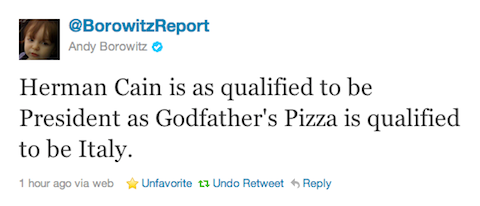
Another analysis of Herman Cain’s 9-9-9 Plan shows tax increase on lower and middle Americans

Click pic to view larger

As Herman Cain has surged in the polls, his 9-9-9 plan is getting more and more scrutiny, and it’s not working out the way Mr. Cain says it will.  Many accounting firms have taken on the job of analyzing the plan, and in each approach – other than Mr. Cain’s – it works out as a tax increase for lower and middle income Americans.

The Tax Policy Center, for example, has a new analysis out of the distributive consequences of Herman Cain’s 9-9-9 tax plan. The Tax Policy Center models 9-9-9 as catchy new slogan for a de facto national consumption tax, and consequently constitutes a tax increase on most Americans but a tax cut for high income people who engage in a lot of savings and investment.

As you can see, you actually need two charts to illustrate this properly because the magnitude of the tax change for the highest income segments is very large. But basically you’re talking about a nice tax cut for the $200k-$500k crowd and a really big tax cut for people who earn more than that, plus mid-sized tax hikes for everyone else.
(via ThinkProgress)

Analysis of Herman Cain’s 9-9-9 Plan

According to analysis by the Citizens for Tax Justice, under presidential hopeful Herman Cain’s 9-9-9 Plan, the richest one percent of taxpayers would each pay $210,000 less in annual taxes on average, while the poorest 60 percent of taxpayers would each pay about $2,000 more in annual taxes on average, than they do now.

Moreover, under the 9-9-9 plan, the United States government would collect about $340 billion less in revenue in 2011 alone.

9% Individual Flat Tax: The nine percent individual tax would apply to “gross income less charitable deductions” and would exempt capital gains. This individual tax would:
• generate much less revenue than the existing federal income and payroll taxes
• especially benefit the richest taxpayers, who currently pay effective tax rates much higher than nine percent and receive most capital gains
• result in a big tax increase on the poorest Americans, who would lose the benefit of existing tax breaks like the Earned Income Tax Credit and the Child Tax Credit

9% Business Flat Tax: The nine percent business tax would apply to a business’s “gross income less all investments, all purchases from other businesses and all dividends paid to shareholders.” As a result, it appears that there would be nothing left of a business’s revenue to tax other than the revenue going towards wages.

9% National Sales Tax: Cain’s plan would introduce, for the first time, a broad-based national sales tax, with a rate of nine percent. Replacing the remaining federal taxes (estate and gift taxes, tobacco taxes, gas taxes) with the nine percent sales tax will result in a tax increase for all income groups. This would be a national sales tax ON TOP OF each state’s current state sales taxes. For instance, in Las Vegas, we have a sales tax of 8.1%. Added to Herman Cain’s 9% national sales tax, most purchases would then have a 17.1% sales tax.

Many in political circles feel Herman Cain began his “presidential aspirations” as a way to raise his profile and perhaps get a FOX News TV show or a political radio show or a platform to sell his book and raise his “inspirational” speaking fees.  With reports out in the media world that he does not have a staff or network to actually see a presidential bid to it’s conclusion, I’m inclined to believe that.  I think this has all taken Herman Cain off-guard that he’s being taken “seriously.”

Time will tell how the country takes him.

Read the entire analysis here.

Herman Cain’s “9-9-9” Plan

2012 GOP presidential hopeful Herman Cain has been trumpeting the supposed benefits of his “999″ economic plan, which would implement a 9 percent flat-tax on personal income and corporate income, along with a 9 percent national sales tax, while scrapping the rest of the tax code (including all of the deductions and all of the taxes on investment income such as capital gains).

Cain claims that his 9-9-9 plan would not be “regressive on the poor,” but economists disagree due to the imposition of a national sales tax that would wallop the poor significantly harder than the rich. Center for American Progress Director of Tax and Budget Policy Michael Linden ran the numbers on Cain’s plan, and it turns out that it wouldn’t be deficit-neutral — not even close (all calculations are based on 2007 tax data, the last year before the Great Recession):

– For the income tax portion: In 2007, total Adjusted Gross Income on all income tax returns was $8.7 trillion. Cain’s plan would exempt investment income, but would have no other deductions. That brings taxable income down to $7.4 trillion. A flat 9 percent tax would therefore have yielded about $665 billion in income tax revenue.
– For the corporate tax portion: In 2007, there was a total of $1.3 trillion in reported corporate income subject to tax. A flat 9 percent would have yielded $112 billion in revenue.
– For the sales tax portion: I used generally accepted estimates of the revenue generated from a value-added-tax. Those estimates suggest that a broad-based 5 percent tax on goods and services would generate about 2 percent of GDP in revenue. That implies that a 9 percent tax in 2007 would have generated about $500 billion.
– Together, then, the 9-9-9 plan would have generated a bit less than $1.3 trillion in total federal tax revenue. That’s only 9.2 percent of GDP. In 2007, we collected 18.5 percent of GDP in tax revenue. In other words, the 9-9-9 plan would cut federal revenue in half!
“Even if we reduced federal spending to the ‘historical average’ (when the population was younger and health care cost much less) it would still leave us with deficits over 11 percent of GDP (bigger than any deficit since WWII, including the deficits of the past three years),” Linden noted.

Linden also found that someone in the bottom quintile of earners — who currently pays about 2 percent of his or her income in federal taxes — would pay about 18 percent under Cain’s plan (9 percent on every dollar they make, plus 9 percent on every dollar they spent, which would likely be close to all of them). A middle-class individual would see his or her taxes go from about 14 percent to about 18 percent. But someone in the richest one percent of Americans would see his or her tax rate fall from about 28 percent to about 11 percent.

So Cain’s plan — which has earned accolades from the likes of supply-side guru Art Laffer — would explode the deficit, while increasing taxes on the poor to pay for a giant tax cut for the rich. As Center for American Progress Vice President for Economic Policy Michael Ettlinger put it, the plan “would be the biggest tax shift from the wealthy to the middle-class in the history of taxation, ever, anywhere, and it would bankrupt the country.”

Herman Cain is proud of the fact that his plan is “simple and transparent.”

The problem with that approach is, with the USA being the most important economic power in the world, “simple” hardly describes the answer to the problem. It’s a great catch-phrase, but if “simple” were the answer – it would have been implemented long ago.

Our problems are not “simple.” They are complex, especially in light of how intertwined the US economy has become with the rest of the world. What happens elsewhere affects us. To pretend that “simple” is the answer only appeals to those who think our problems are “simple” – which they are not.

Herman Cain believes sexuality is a choice

Watching things like this, I don’t know whether to laugh or cry.

Joy Behar has it right when she asks why anyone would choose to be gay when the amount of vilification that comes with such a choice is insane.

I’d also like to know if Herman Cain remembers when he “chose” to be heterosexual, IF sexuality is a choice.

If it weren’t for the fact he won’t get the nomination – let alone win the election – he would be dangerous.

For now, he’s just selling his book.

Herman Cain wins Florida straw poll

From the StarTribune: Business entrepreneur Herman Cain shocked the political world by winning the Florida GOP’s influential presidential straw poll Saturday, while Minnesota Republican Michele Bachmann finished dead last in the field of eight candidates.

Cain, the former Godfather’s Pizza CEO who appears to have caught fire in recent weeks, topped the GOP field with 37.1 percent of the 2,657 votes cast.

Texas Gov. Rick Perry, the current leader in most polls, finished second with 15.4 percent of the delegates’ votes in Florida, edging out former Massachusetts Gov. Mitt Romney, who won 14 percent.

Michele Bachmann’s poor showing in Florida – receiving only 40 ballots, or 1.51 percent of the vote, seemed to further diminish the fast-waning luster of her campaign.

Unlike the Ames Straw Poll in Iowa, nearly all candidates running were included on the Florida ballot, and delegates representing counties throughout the state paid their own way to the event. The last three Florida GOP straw poll winners have become their party’s nominee.

Among the rest of the field, Texas Congressman Ron Paul, a perennial favorite among grass-roots GOP activists, came in fifth behind former Pennsylvania Sen. Rick Santorum, each receiving a little more than 10 percent of the vote.

Former U.S. House Speaker Newt Gingrich finished sixth at 8.4 percent, and former Utah Gov. Jon Huntsman finished seventh with 2.2 percent.