A long-time friend of mine married his terminally ill boyfriend last year.
Since they lived in Las Vegas, they traveled to California for the legal ceremony and license.
Sadly, the husband lost his battle in March of this year.
Adding to the sadness of the loss, my friend had to battle with his deceased husband’s family who never approved of the same-sex marriage. The family apparently fought to keep the body of the deceased from my friend.
Eventually, in order to have a respectful service and burial, my friend went to court to have a judge rule that he was the “surviving spouse,” and to indicate that on the death certificate issued by the state of Nevada.
As I saw my friend recently and were talking about the sad episode, I began to wonder: was this the first instance of the state of Nevada recognizing a same-sex marriage?
We’ve seen legal wrangling in Ohio, Indiana and Arizona regarding recognition of same-sex marriages from other states due to terminal illness, etc. I’m wondering if this has already quietly happened in Nevada?
Nevada does have domestic partnerships that grants “…the same rights, protections, benefits, responsibilities, obligations and duties as…parties to any other civil contract….” But, couples legally married in other states don’t automatically gain this status. Couples married elsewhere must complete and file a notarized Domestic Partnership Declaration form with the Secretary of State’s Office. I asked my friend if they had done this and he said they were in the process of getting that done when his husband suddenly died.
See the death certificate above that lists the deceased as “Male” and the Surviving Spouse as “Michael.” (I’ve blurred the details for now for privacy’s sake).
Experts – chime in and let me know what you think.
Now it’s just getting embarrassing for the ironically named National Organization for Marriage.
After getting a big NO from the 9th Circuit Court of Appeals after trying to insert themselves in Oregon’s marriage equality decision, NOM is now asking the 9th for an “en banc” reviews of it’s request.
Despite a string of legal defeats, the National Organization for Marriage is continuing its battle against the May 19 federal court decision overturning Oregon’s ban on same-sex marriage.
Two weeks after a three-judge panel of the Ninth Circuit Court of Appeals rejected the group’s attempt to intervene in the case, the National Organization for Marriage on Wednesday asked the full Ninth Circuit Court to reconsider the decision.
The group — which has waged a legal battle against same-sex marriages throughout the country — had earlier lost several attempts to insert itself in the Oregon case.
In June, the U.S. Supreme Court denied a request by NOM to halt same-sex marriages in Oregon, which began after U.S. District Judge Michael McShane ruled that the ban unconstitutionally discriminated against gay and lesbian couples.
My guess is NOM needs SOMETHING to put in their email money begs to justify why anyone should send them a dime.
The US Supreme Court has officially added requests for review from 5 states – Utah, Oklahoma, Virginia, Indiana and Wisconsin – regarding marriage equality to the justices’ conference agenda on September 29th.
This will be the first opportunity for the nine justices to review requests from those states who have seen their same-sex marriage bans ruled unconstitutional.
However, the justices may or may not decide to take up one, many or none of the cases immediately. Considering other developments currently being considered on the issue, in the 9th and 6th Circuit Courts of Appeal for example, the justices may take additional time before choosing whether or not to add any of the cases to the immediate docket which begins October 6th.
Left to right: Sara Geiger, Megan Lanz, Peter Renn, Thomas Wheatley, Marek Bute, Kelly Dove
Last night I attended a “Send Off” event here in Las Vegas for the plaintiffs in Nevada’s same-sex marriage appeal to be heard in the 9th Circuit Court of Appeals in San Francisco Monday.
Several of the plaintiffs were in attendance including Megan Lanz & Sara Gieger, Fletcher Whitwell & Greg Flamer and Antioco Carrillo & Theodore Small.
Freedom To Marry‘s Thomas Wheatley moderated the event meant to catch the Las Vegas LGBT community up to date on how Nevada got to this point in the marriage equality timeline. Lawyers Peter Renn from Lambda Legal and Marek Bute & Kelly Dove of Snell & Wilmer provided facts, figures and their thoughts on the outcome of the 9th Circuit appeal.
Clearly the team and plaintiffs are very upbeat about the case. The energy in the room was relaxed, confident and positive. No lawyer-esque kind of false posturing.
Peter Renn recapped the history of the case and explained that even though the plaintiffs lost in 2012, he considered the ruling at the time an outlier that is even more antiquated today in light of over 30 rulings in favor of marriage equality across the country. That thinking was that if same-sex marriage were allowed, heterosexual couples would cease to marry because the union had been “devalued.” As we all know, that reasoning has lost over and over again.
Megan Lanz, when asked why she chose to be a part of this lawsuit said, “I wanted to speak up for what’s right. I want to be a good example for our daughter, and to represent others who may feel they don’t have a voice.”
Snell & Wilmer’s Kelly Dove explained the legal team’s satisfaction with the three judges selected for the 9th Circuit panel and recapped their past rulings which would seem to bode well for the LGBT community.
Of the three judges, Judge Reinhardt has the richest history of the three when it comes to LGBT cases. Reinhardt wrote the 2012 opinion that upheld district judge Vaughn Walker’s ruling that found California’s Proposition 8 unconstitutional. And, he also wrote the opinion in SmithKline Beecham v. Abbott Labs which ruled that discrimination against LGBT people is subject to heightened scrutiny.
Judge Berzon joined with Reinhardt on the SmithKline ruling. Plus, her court history shows a progressive bent in her rulings.
Judge Gould is credited with ruling on a major LGBT case regarding heightened scrutiny involving Maj. Margaret Witt, a former Air Force flight nurse who was discharged under DADT. Gould wrote the 9th Circuit opinion that a discharge under DADT must be subject to heightened scrutiny.
So, the panel looks fairly positive for the plaintiffs.
The legal team did note that since the governor of Nevada and the Attorney General have both decided not to defend the marriage ban, only the Coalition for the Protection of Marriage (who initiated the ban in the first place) are the only opposition to the appeal.
Referencing Hollingsworth v. Perry, where SCOTUS ruled that backers of a ballot measure did not have a legal right to be in court to defend the proposition, Dove expressed confidence that if the ban is struck down at the 9th Circuit, no appeal can be made by the Coalition due to lack of standing, and marriage equality could come to Nevada fairly quickly.
Also attending was legendary LGBT activist Cleve Jones, who expressed his thanks to the plaintiffs for coming forward and working through the lengthy life disruption to raise their voices for so many gay and lesbian couples in Nevada.
And with that, we look to Monday and the oral arguments that will be held at 1pm. The hearings will be streamed and you can watch by going to www.ca9.uscourts.gov and click on the link under the beige-colored bar labeled “Live Oral Arguments.”
The state of Florida has announced it will appeal a federal judge’s ruling that found the state’s ban on same-sex marriage to be unconstitutional:
Attorney General Pam Bondi’s office filed the notice Thursday on behalf of Surgeon General Dr. John H. Armstrong, Secretary of Management Services Craig J. Nichols and Washington County Clerk of Court Harold Bazzell.
U.S. District Judge Robert L. Hinkle in Tallahassee ruled on Aug. 21 that the ban violates the 14th Amendment’s guarantees of equal protection and due process. Hinkle issued a stay delaying the effect of his order, pending possible appeals.
Make no mistake, the responsibility for today’s appeal belongs to Gov. Scott. This appeal would not be moving forward without his full support. The Governor’s continued strategy of trying to hide behind the attorney general and even his own employees is a shameful display of election year cowardice. The responsibility is his and so is the remedy.
Gov. Scott can still use the power of his office and call for an end to the these costly and hopeless appeals and allow Florida’s ban on marriage equality to end this month. If Gov. Scott insists continuing his crusade to keep people who love each other from marrying, he should stop mumbling and hiding and take full responsibility for the continued suffering the ban inflicts every day it remains in place.
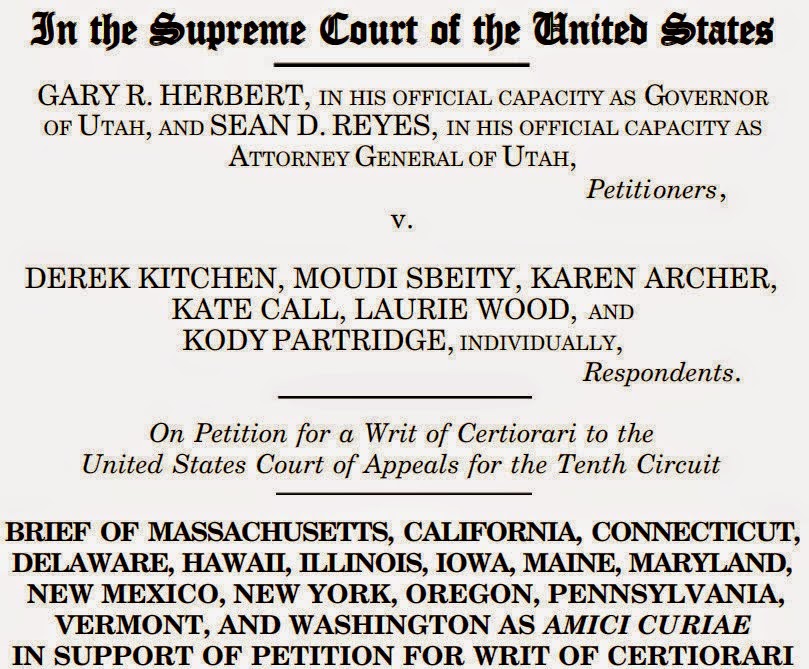
ABC News is reporting that attorneys general from 32 states have filed two separate amicus briefs with the US Supreme Court asking the court to weigh in on the constitutionality of same-sex marriage bans:
Fifteen states that allow gay marriage, led by Massachusetts, filed a brief asking the justices to take up three cases from Virginia, Utah and Oklahoma and overturn bans. And 17 other states, led by Colorado, that have banned the practice asked the court to hear cases from Utah and Oklahoma to clear up a “morass” of lawsuits, but didn’t urge the court to rule one way or another.
Massachusetts Attorney General Martha Coakley wrote that the experience of her state — the first to legalize the freedom to marry — proves that marriage equality strengthens the institution of marriage and helps families. Signing on to Massachusetts’s brief were the marriage equality states of California, Connecticut, Delaware, Hawaii, Illinois, Iowa, Maine, Maryland, New Mexico, New York, Oregon, Pennsylvania, Vermont, and Washington.
Colorado’s brief, which was joined by Alabama, Alaska, Arizona, Georgia, Idaho, Louisiana, Mississippi, Missouri, Montana, Nebraska, North Dakota, Oklahoma, South Carolina, South Dakota, West Virginia and Wisconsin, says that only the Supreme Court can resolve the question of marriage equality. It also claims, according to the AP, that “without a Supreme Court decision, states defending bans could be liable for huge legal bills from future lawsuits if they are overturned.”
In what is now the fourth appellate ruling in favor of marriage equality, a panel of 3 federal judges for the 7th Circuit Court of Appeals has ruled unanimously that the same-sex marriage bans in Wisconsin and Indiana unconstitutional
According to the 40-page unanimous ruling authored by Judge Richard Posner, who was nominated to the federal bench by President Ronald Reagan, “discrimination against same-sex couples is irrational, and therefore unconstitutional even if the discrimination is not subjected to heightened scrutiny.”
Ruling in two cases, the court found the governments of Indiana and Wisconsin have given no reason to think they have a “reasonable basis” for forbidding same-sex marriage.
“Discrimination by a state or the federal government against a minority, when based on an immutable characteristic of the members of that minority (most familiarly skin color and gender), and occurring against an historical background of discrimination against the persons who have that characteristic, makes the discriminatory law or policy constitutionally suspect,” the ruling states.
Oral arguments were heard before the 7th Circuit Court of Appeals last week in Chicago.
According to Gallup Polls, 55% of Americans support marriage equality. A recent ABC News/Washington Post poll showed 77% of Americans under the age of 30 are in favor of same-sex marriage.
Same-sex couples can legally marry in nineteen states and the District of Columbia.
Hot on the heels of the Louisiana ruling today against same-sex marriage (the first since June of 2013), NOM president Brian Brown claimed the “house of cards” that is the marriage equality movement is “collapsing:”
“Here we see the house of cards collapsing that supported the myth that redefining marriage is inevitable,” said Brian S. Brown, president of the National Organization for Marriage. “This decision by Judge Feldman in Louisiana is a great win for the cause of marriage, coming as it does on the heels of other pro-marriage court victories, that puts the lie to the claim that it is inevitable the US Supreme Court will redefine marriage. To the contrary, we believe they will leave this issue with the states.”
“Judge Feldman has authored a powerful opinion that points the US Supreme Court in the direction of upholding state marriage laws and constitutional amendments,” Brown said. “He finds what should be obvious to everyone, that states have a legitimate concern in ‘linking marriage to children with intact families.’ It is perfectly appropriate for voters to determine if they wish to decide for themselves whether they wish to redefine this age-old institution that has served society so well. Overwhelmingly, voters have rejected redefining marriage, and we expect the US Supreme Court to do so as well.”
Regarding a “house of cards,” it should be noted that Judge Feldman’s ruling is the first against same-sex marriage by a federal judge since the Windsor decision by SCOTUS in June of 2013.
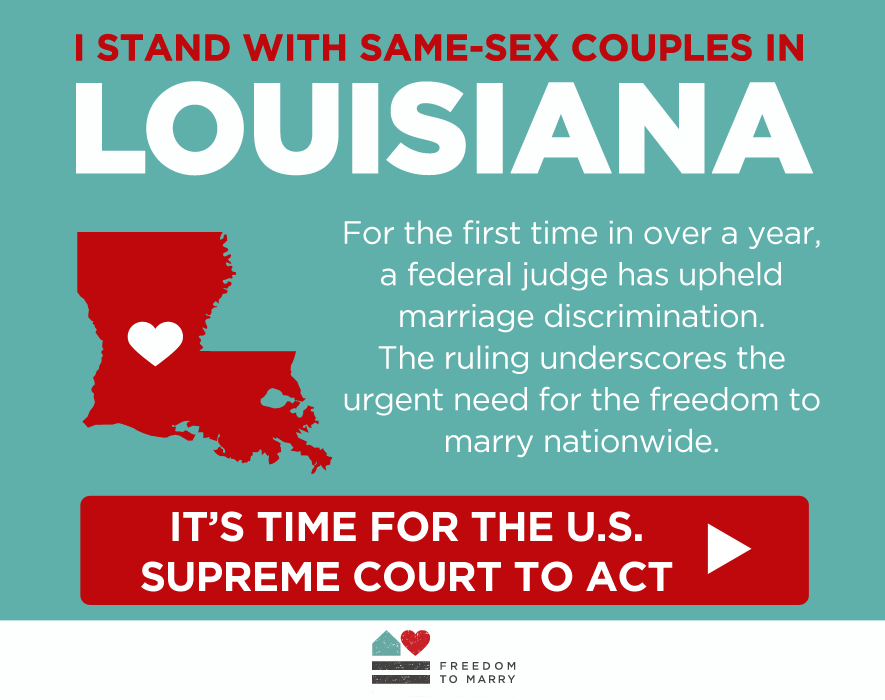
Today, U.S. District Court Judge Martin Feldman has become the first federal judge since June of 2013 to rule against marriage equality in a case filed in Louisiana regarding the state’s ban on same-sex marriage.
From Judge Feldman’s ruling:
“It would no doubt be celebrated to be in the company of the near-unanimity of the many other federal courts that have spoken to this pressing issue, if this Court were confident in the belief that those cases provide a correct guide.”
Feldman maintained that there is no “fundamental right” to marriage: “Public attitude might be becoming more diverse, but any right to same-sex marriage is not yet so entrenched as to be fundamental.”
Chris Geidner from Buzzfeed points to this from Judge Feldman:
This Court is persuaded that Louisiana has a legitimate interest…whether obsolete in the opinion of some, or not, in the opinion of others…in linking children to an intact family formed by their two biological parents, as specifically underscored by Justice Kennedy in Windsor.
Despite the decision he authored, Feldman noted that “many other courts will have an opportunity to take up the issue of same-sex marriage; courts of appeals and, at some point, the U.S. Supreme Court. The decision of this Court is but one studied decision among many.”
Evan Wolfson of Freedom To Marry issued this statement: “We’ve won nearly all of the 40 state and federal marriage cases this year. Today’s Louisiana loss is a reminder that we’re not done. The loss is why couples should not have to fight state by state, case by case, year by year. It’s time for the Supreme Court to rule nationwide.”