The Labor Department reports that 263,000 jobs were added to the U.S. economy in April, making for a record 103 straight months of positive job growth.
With those jobs factored in, the unemployment rate dropped to 3.6 percent, the lowest since 1969.
The official unemployment rate has been at or below 4 percent for more than a year.
Additionally, average hourly earnings rose 3.2 percent in the past year.
Donald Trump’s knee-jerk reaction to criticism by Rush Limbaugh and Ann Coulter, which triggered the longest government shutdown in US history, cost the US economy $11 billion, reports the nonpartisan Congressional Budget Office.
The analysis takes into account lost output from federal workers, delayed government spending and reduced demand.
The report, which was released Monday, estimated a hit of $3 billion, or 0.1 percent, to economic activity during the fourth quarter of 2018. The impact was projected to be greater during the first quarter of 2019: $8 billion, or 0.2 percent of GDP.
Although most of the damage to the economy will be reversed as federal workers return to their jobs, the CBO estimated $3 billion in economic activity is permanently lost after a quarter of the government was closed for nearly 35 days.
“Among those who experienced the largest and most direct negative effects are federal workers who faced delayed compensation and private-sector entities that lost business,” the report said. “Some of those private-sector entities will never recoup that lost income.”
The Chicago Tribuneis reporting General Motors, the largest automaker in the United States, will be laying off 14,500 factory and white-collar workers.
In addition, five plants will be closed during a 2019 company restructuring.
The reduction includes 8,100 white-collar workers, some of whom will take buyouts and others who will be laid off. Most of the affected factories build cars that won’t be sold in the U.S. after next year. They could close or they could get different vehicles to build. They will be part of contract talks with the United Auto Workers union next year.
The four factories in the U.S. and one in Canada could be shuttered by the end of 2019 if the automaker and its unions don’t come up with an agreement to allocate more work to those facilities, GM said in a statement Monday.
Plants without products include assembly plants in Detroit; Lordstown, Ohio; and Oshawa, Ontario. Also affected are transmission factories in Warren, Mich., as well as Baltimore.
More than 6,000 factory workers could lose jobs in the U.S. and Canada, although some could transfer to truck and SUV plants.
The cuts represent 15% of GM’s work force.
The timing could prove problematic for Donald “I Create Jobs” Trump as he enters the 2020 campaign cycle.
According to the Chicago Tribune, the closures will save $6 billion in cash by the end of next year.
This is all in addition to the $6.5 billion in cuts already announced for the end of this year.
#SoMuchWinning
General Motors plans to halt production at 3 assembly plants in Canada, Ohio, and Michigan by not allocating new products, Reuters reports.
Cost pressures have increased. GM also has said Trump-imposed tariffs on imported steel have cost it $1 billion.https://t.co/h2Bzl0DlAM
Donald Trump took to Twitter on the last day of 2017 to boast yet again about the economy:
If the Dems (Crooked Hillary) got elected, your stocks would be down 50% from values on Election Day. Now they have a great future – and just beginning!
Why would smart voters want to put Democrats in Congress in 2018 Election when their policies will totally kill the great wealth created during the months since the Election. People are much better off now not to mention ISIS, VA, Judges, Strong Border, 2nd A, Tax Cuts & more?
If the Dems (Crooked Hillary) got elected, your stocks would be down 50% from values on Election Day. Now they have a great future – and just beginning! https://t.co/9TzSC8F8vY
Why would smart voters want to put Democrats in Congress in 2018 Election when their policies will totally kill the great wealth created during the months since the Election. People are much better off now not to mention ISIS, VA, Judges, Strong Border, 2nd A, Tax Cuts & more?
A few facts are missing from the Trumpster’s perspective here.
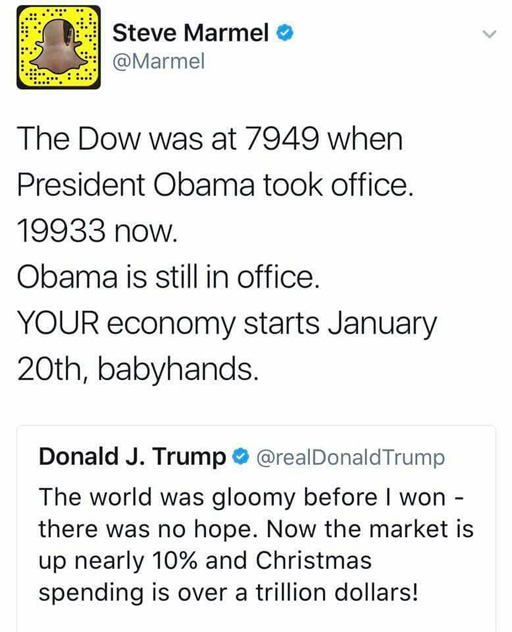
Most importantly the fact that he inherited an already healthy economy with a 4.7% unemployment rate and a stock market that had more than doubled.
And then the smart kids chimed in:
2017 saw the fewest number of jobs created in 6 years. 3.5 million more are uninsured. Premiums are up. And Trump has taken only one step: a $1.5 trillion tax cut, mostly for the rich and corporations. I’ll take that fight. https://t.co/i4PKMX8KcE
I’ll attach the stock market again for about the 200’redthth time. What has the trend been for 8 years? A Chimpanzee could sit where you are and look good. If the Dems were elected, we wouldn’t be doing endless investigations and giving away cash to rich people and corporations. pic.twitter.com/v2lfUiJrAu
1) B/c you’re a liar, none of that is true; 2) you’re a racist, emboldened white supremacists; 3) you’re a sexual predator; 4) you’ve attacks rights of women, LGBT, minorities; 5) climate change; 6) many more reasons, GOP does nothing. That’s why smartvoters won’t vote GOP. https://t.co/DqagbSydMt
Median household income rose to $59,039 in 2016, a 3.2 percent increase from the previous year and the second consecutive year of healthy gains, the Census Bureau reported Tuesday.
The nation’s poverty rate fell to 12.7 percent, returning nearly to what it was in 2007 before a financial crisis and deep recession walloped workers in ways that were still felt years later.
“There’s a danger that this is as good as it gets,” said Peter Atwater, president of Financial Insyghts. “We are already at a 16-year low in unemployment. The likelihood of significant job growth from here is limited.”
Trump promised that a combination of tax cuts, infrastructure investment packages, renegotiated trade deals and the repeal of Obama administration regulations would deliver a burst of job creation and attendant economic growth.
So far, no such boom can be found.
In Trump’s first seven months, the U.S. economy has added about 25,000 fewer jobs per month than it did during the last seven months of Barack Obama’s presidency.
It’ll be interesting to see how the next three years go under Trump having been handed a healthy U.S. economy.
Donald Trump is fond of saying that he created over a million jobs in the first six months of his presidency.
Such language – “I’ve created over a million jobs since I’m president” – is a departure from most presidents who usually use phrases like “the economy has added X number of jobs” or “American businesses have added X number of jobs.” But when it comes to the Trumpster, it’s all about him.
Economic experts say it’s actually difficult to quantify how much a president can influence the job market.
Gary Burtless of the Brookings Institution says it would be wrong to take Trump’s claim literally because American employers actually create jobs, not the president.
And, the trend of job creation in the U.S. over the past 7 years has not changed trajectory. In fact, the number of jobs added to the economy over the past six months lags behind the same time periods of the past few years.
In the first six months of Trump’s presidency, there have been slightly more than 1 million jobs created, according to the Bureau of Labor Statistics.
But Burtless noted there’s been very little change in the trend in employment in the first six months of 2017, compared with the same period in the previous four years.
In fact, the gain in payroll employment in the January-through-July period was a bit slower in 2017 compared with the previous four years, whether measured as an absolute rise in the number of nonfarm payroll jobs or as a percentage of employment in January of the indicated year.
Source: Bureau of Labor Statistics
As you can see in the graphic above, the number of jobs added in the first half of this year is actually less than the same period in Obama’s last four years in office. Ironically, Trump criticized Obama for those very same numbers at the time.
The Washington Post goes on to say that Trump might have some foundation to base his boasts on if he had passed any major economic legislation, but the fact is Trump has little achievement to point to on the legislative front.
Nevada led the way as the U.S. showed strong job growth in 2016, scoring highest among all states in Gallup’s 2016 Job Creation Index.
The rise to the top spot completed a six-year climb for Nevada, which ranked last among the states in both 2009 and 2010.
Moving in the other direction, Wyoming scored last among the states for 2016 — eight years after topping Gallup’s first Job Creation Index in 2008.
Each night in its Gallup Daily tracking survey, Gallup asks employed Americans to report on hiring activity at their place of work. Gallup’s Job Creation Index is based on the percentage of workers saying their place of employment is increasing the size of its workforce, minus the percentage saying their place of employment is reducing the size of its workforce.
For the nation overall, the Job Creation Index score has grown each year since 2009, from -1 to +32 in 2016 (43% hiring, 11% letting go).
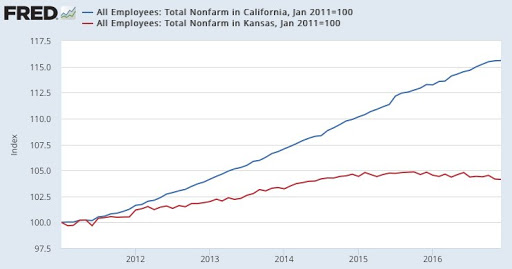
The economy added 156,000 jobs in December, extending the longest streak of total job growth in U.S. history to 75 straight months, with U.S. businesses adding 15.8 million jobs over the recovery.
Average hourly earnings for all private workers increased 2.9 percent over the past year, the fastest twelve-month pace since the end of the recession and above the pace of inflation in 2016.
The unemployment rate has been cut by more than half since its peak in 2009, falling much faster and further than expected. After peaking at 10.0 percent in October 2009, the unemployment rate fell rapidly over the course of the recovery, and by mid-2015 had recovered fully to its pre-recession average. Since then, it has fallen even further, standing at 4.7 percent at the end of 2016.
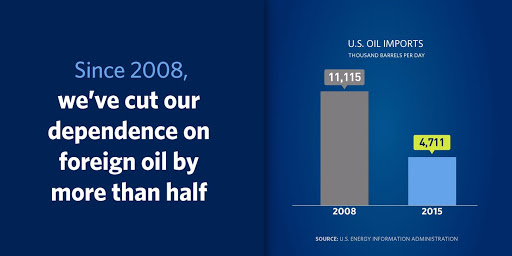
And while we’re at it, just a few more facts to add as Obama closes out his run as president: