The Obama Justice Department has concluded that laws banning same-sex couples from receiving military and veterans benefits violates the equal protection component of the Fifth Amendment, and will no longer defend the statute in court, Attorney General Eric Holder wrote in a letter to Congressional leaders on Friday.
“The legislative record of these provisions contains no rationale for providing veterans’ benefits to opposite-sex couples of veterans but not to legally married same-sex spouses of veterans,” Holder wrote. “Neither the Department of Defense nor the Department of Veterans Affairs identified any justifications for that distinction that would warrant treating these provisions differently from Section 3 of DOMA.”
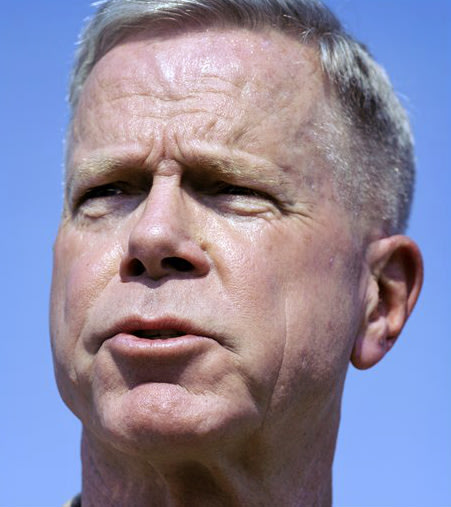
Since the lifting two months ago of a longstanding U.S. ban on gays serving openly in the military, U.S. Marines across the globe have adapted smoothly and embraced the change, says their top officer, Gen. James F. Amos, who previously had argued against repealing the ban during wartime.
“I’m very pleased with how it has gone,” Amos said in an Associated Press interview during a week-long trip that included four days in Afghanistan.
A Defense Department spokeswoman, Cynthia O. Smith, said implementation of the repeal of the gay ban is proceeding smoothly across the military.
“We attribute this success to our comprehensive pre-repeal training program, combined with the continued close monitoring and enforcement of standards by our military leaders at all levels,” Smith said.
Army Capt. Stephen Hill says he wasn’t trying to score political points when he asked the Republican presidential candidates if they would reinstate the ban on gays serving openly in the U.S. military.
Now that “don’t ask, don’t tell” has been lifted, he needed to know if the military would take the next step and recognize his marriage, or if a new president would try to force soldiers like him back into the closet.
“I was looking forward to the future and hoping everybody would realize we are soldiers first, always,” said Hill, 41, an Army reservist who returned last week from his yearlong deployment. “I was hoping ‘don’t ask, don’t tell’ would be a distant memory for everybody.”
In a recent interview, Hill reflected publicly for the first time on his reasons for submitting the pre-recorded question for the Sept. 22 debate, as well as his reaction to the heckles heard around the world; the answer that former Sen. Rick Santorum gave to thunderous applause; and the outrage expressed on his behalf by, among others, his commander in chief.
This is what he asked: “In 2010, when I was deployed to Iraq, I had to lie about who I was because I’m a gay soldier and I didn’t want to lose my job. My question is, under one of your presidencies, do you intend to circumvent the progress that’s been made for gay and lesbian soldiers in the military?”
Santorum replied that he would reinstitute the ban on open service by gay troops because “any type of sexual activity has absolutely no place in the military.”
“What we are doing is playing social experimentation with our military right now. That’s tragic,” he continued. “Leave it alone. Keep it to yourself whether you are heterosexual or homosexual.”
“When the actual booing occurred, my gut dropped out, because my first inclination was, did I just do something wrong?” Hill said.
President Barack Obama, about a week later, chided the Republican contenders for staying silent when several people booed an American soldier.
What Hill remembers most was that a presidential candidate defined his marriage and military service in terms of sex.
“This is not about sex,” Hill said. “A special privilege is not hiding pictures in my house or God forbid, taking mortar fire again and not knowing if Josh will be recognized. I’m fighting every day to protect everyone’s rights as human beings, and it seems counterintuitive for me to be fighting for those rights and not have them.”
Rick Perry, appearing on ABC today said he would be comfortable reinstating DADT as President.
“I think Don’t Ask, Don’t Tell worked very well,” Perry responded, ignoring the thousands of service members dismissed form the military because of their sexual orientation.
“I think the President of the United States changing a policy that was working well and to do it while we were at war in two different theaters, I think was irresponsible and I think he truly did it to respond to his political base,” Perry said.
I personally think the policy did not work at all, and forced gay and lesbian military to lie about who they were – hardly an “honorable” position to put our hard working men and women in uniform. It also was hardly fiscally responsible as thousands and thousands of dollars spent training valuable experts were thrown away as outed men and women were discharged.
Just a few weeks after the implementation of the repeal of “Don’t Ask, Don’t Tell,” a majority of Americans say they support gays and lesbians serving openly in the military, according to a new CBS News poll.
According to the CBS News poll, 68 percent of Americans said they support gay and lesbians’ rights to serve openly. Fifty percent said they “strongly” favored the idea.
Moreover, although many national Republicans leaders were against the repeal of “Don’t Ask, Don’t Tell,” more Republicans surveyed favor the idea of allowing gays and lesbians to serve in the armed forces openly than oppose it.
The poll shows that 48 percent of Republicans overall think gays and lesbians should be able to serve openly; 28 percent of those people said they favored the idea strongly.
Meanwhile, 41 percent of all Republicans opposed allowing gays and lesbians to serve openly- twelve percent of whom opposed the idea strongly, and 29 percent of whom opposed it only somewhat.
Repeal of the 1993 law, which said gays could serve only if they kept their sexual orientations private, became official on September 20, 2011.
Last month, the U.S. military officially ended the policy known as “Don’t Ask Don’t Tell” allowing gay military members to serve openly for the first time in history. However, there’s another part of that policy change that hasn’t been talked about.
Military chaplains will now be allowed to marry gay couples on and off military bases, in states where it is legal.
Military Chaplain Ted Wilson says it’s not a big deal.
“We said that the repeal of don’t ask don’t tell would probably be a non event for the military as a whole, and it really has,” he says. “Day to day mission continues, training pilots, crew, chiefs, the mission goes on.”
A chaplain is not required to marry a gay marriage.
“If your tenet of faith prohibits that, then you are not forced to do it, no harm no foul. if you are allowed to perform it, you perform it no big deal.”
The new rules say another chaplain may step in, or a minister from the community, to perform a same-sex marriage.
On May 25, Time magazine introduced the world to “Officer X,” a closeted, active service member who would blog anonymously about the DADT repeal until it got repealed.
Well DADT has been repealed, so who is he?
It’s 1st Lieutenant Karl Johnson of the Air Force.
In his coming-out article Johnson said, “Putting aside personal angst, there was the risk [that DADT] posed to our national security; with Don’t Ask Don’t Tell ended, the possibility of extortion evaporates. Our nation will be stronger because of the policy’s demise.”
His posts have been thoughtful, inspiring and courageous.
This really is one of the hardest things a guy can do – tell his dad he’s gay. Get to the 2:35 mark. Very simple but moving.
April 18th of this year, this soldier began a series of headless videos on youtube to document his coming out. I really encourage you to watch his other videos to see his journey. Thousands have watched him address a lot of the issues gay men face as they approach owning who they are. Today was the first day – with the repeal of DADT – that we saw his face and watch him tell his father he is gay.
Premiering September 19, this original HBO documentary by out filmmakers Fenton Bailey and Randy Barbato chronicles the controversial legislation that let gays serve in the U.S. military as long as they didn’t disclose their sexual orientation.
In 1993, President Bill Clinton encountered vehement opposition when he tried to deliver on his election promise of lifting a 50-year ban on gays in the military. The result was the compromise legislation “Don’t Ask, Don’t Tell” which allowed gays to serve in the military provided they didn’t disclose their sexual orientation. The Strange History of Don’t Ask, Don’t Tell examines the consequences of the policy and the fight to overturn it, a battle that would last 17 year, span three presidencies and result in the discharge of 13,368 active service members.
Shot during the law’s final 15 months, the film includes personal accounts by active gay soldiers and interviews with key players like Rep. Barney Frank, Rep. Patrick Murphy and Col. Margarethe Cammermeyer.
Debuts September 19th – HBO – check times in your area