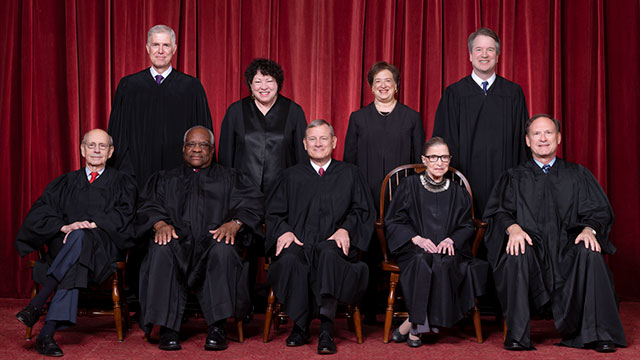
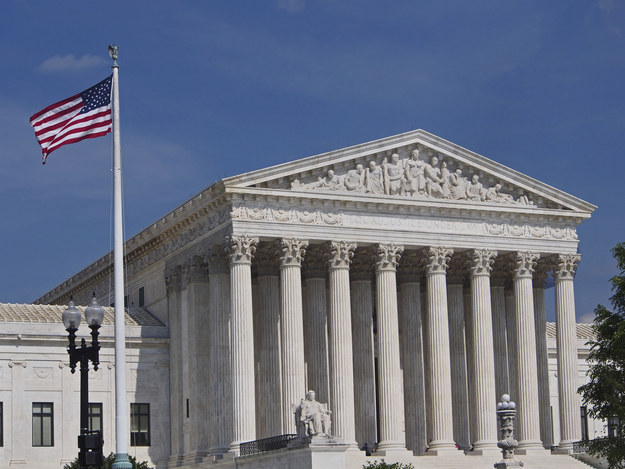
In a 5-4 decision, the U.S. Supreme Court has ruled that the Trump administration cannot move forward with plans to end the Deferred Action for Childhood Arrivals program, which has enabled an estimated 800,000 young people, known as ‘Dreamers,’ to remain in the United States. The decision represents a huge rebuke of Donald Trump’s immigration policy, which has been central to his presidency since he announced his run for office in 2015. According to the majority opinion, the administration failed to give an adequate justification for ending the federal program. From the New York Times:
The court’s ruling was a blow to one of President Trump’s central campaign promises — that as president he would “immediately terminate” an executive order by former President Barack Obama that Mr. Trump had called an illegal executive amnesty for hundreds of thousands of young immigrants.
Chief Justice John G. Roberts Jr. wrote the majority opinion, joined by the court’s four more liberal members in upholding the program, Deferred Action for Childhood Arrivals, or DACA.
“We do not decide whether DACA or its rescission are sound policies,” the chief justice wrote. “We address only whether the agency complied with the procedural requirement that it provide a reasoned explanation for its action.”
As the ruling notes, the decision didn’t rule on the legality of ending DACA, just that the Trump administration hadn’t followed proper procedures. Several pundits have shared the ruling could be used as a ‘road map’ for Trump to re-submit his executive order with more success. Trump has since announced he plans to do exactly that. This is the second ruling this week from the high court that decided against the Trump administration. On Monday, SCOTUS ruled that LGBTQ people are protected in the workplace by existing federal civil rights laws. It’s notable that Chief Justice Roberts voted in the majority in that decision as well. The Trumpster was, of course, not happy.
These horrible & politically charged decisions coming out of the Supreme Court are shotgun blasts into the face of people that are proud to call themselves Republicans or Conservatives. We need more Justices or we will lose our 2nd. Amendment & everything else. Vote Trump 2020!
…ruling & request of yesterday. I have wanted to take care of DACA recipients better than the Do Nothing Democrats, but for two years they refused to negotiate – They have abandoned DACA. Based on the decision the Dems can’t make DACA citizens. They gained nothing! @DHSgov
The current U.S. Supreme Court (image: public domain) In a major victory for LGBTQ rights, the U.S. Supreme Court issued a historic decision Monday morning ruling that current federal law prohibits discrimination against workers for being LGBTQ, finally putting into place long-sought federal protections for LGBTQ people in the workplace. The ruling, a 6-3 decision, finds that anti-LGBTQ discrimination is a form of sex discrimination, which is banned under Title VII of the Civil Rights Act of 1964, according to ScotusBlog. The ruling comes only three days after the Trump Administration chose to roll back healthcare protections for LGBTQ individuals during Pride Month and on the anniversary of the Pulse Nightclub massacre in Orlando, Florida where 49 individuals were murdered in a gay nightclub. Donald Trump’s administration had filed a brief with the Supreme Court urging the justices to rule that it’s legal to fire workers because of their sexual orientation. The court heard oral arguments for 3 consolidated cases last October. Two cases involved gay men who were fired from their jobs — Zarda v. Altitude Express and Bostock v. Clayton County – and a third involving a transgender woman who lost her job, R.G. & G.R. Harris Funeral Homes Inc. v. Equal Employment Opportunity Commission. U.S. Associate Justice Neil Gorsuch, one of the most conservative members of the high court, wrote for the majority, “An employer who fires an individual for being homosexual or transgender fires that person for traits or actions it would not have questioned in members of a different sex. Sex plays a necessary and undisguisable role in the decision, exactly what Title VII forbids.” From the ruling:
A statutory violation occurs if an employer intentionally relies in part on an individual employee’s sex when deciding to discharge the employee. Because discrimination on the basis of homosexuality or transgender status requires an employer to intentionally treat individual employees differently because of their sex, an employer who intentionally penalizes an employee for being homosexual or transgender also violates Title VII. There is no escaping the role intent plays: Just as sex is necessarily a but-for cause when an employer discriminates against homosexual or transgender employees, an employer who discriminates on these grounds inescapably intends to rely on sex in its decisionmaking.
The five other justices agreeing in concert with Gorsuch are U.S Chief Justice John Roberts, U.S. Associate Justice Ruth Bader Ginsburg, U.S. Associate Justice Elena Kagan, U.S. Associate Justice Sonia Sotomayor and U.S. Associate Justice Stephen Breyer. Traditionally conservative-leaning U.S. Associate Justices Samuel Alito, Clarence Thomas, and Brett Kavanaugh issued a dissenting decision.
.@DevinDwyer calls today’s Supreme Court ruling “the biggest opinion for gay rights in this country since 2015…and because of Neil Gorsuch, a conservative justice on this court—simply extraordinary.” https://t.co/XN6SrIZf2Bpic.twitter.com/HLrRqwF5Lu
This is the most extraordinary court victory for LGB Americans since the 2015 Obergefell ruling which made marriage equality the law of the land. And this is the biggest legal decision for transgender Americans in the history of the nation. LGBTQ advocacy groups chimed in on the good news. From GLAAD President & CEO Sarah Kate Ellis:
“The Supreme Court’s historic decision affirms what shouldn’t have even been a debate: LGBTQ Americans should be able to work without fear of losing jobs because of who they are. The decision gives us hope that as a country we can unite for the common good and continue the fight for LGBTQ acceptance,” said GLAAD President & CEO Sarah Kate Ellis. “Especially at a time when the Trump Administration is rolling back the rights of transgender people and anti-transgender violence continues to plague our nation, this decision is a step towards affirming the dignity of transgender people and all LGBTQ people.”
Amit Paley, CEO and Executive Director of The Trevor Project, the world’s largest suicide prevention and crisis intervention organization for LGBTQ young people:
“This landmark decision will save lives. At The Trevor Project, we hear from LGBTQ youth every day who suffer from discrimination and harassment, and our research demonstrates that those who experienced LGBTQ-based workplace discrimination were twice as likely to have attempted suicide in the past year compared to those who did not. By recognizing that LGBTQ workers cannot be discriminated against because of who they are, the Supreme Court has sent a resounding message to LGBTQ youth everywhere that they are free to pursue their talents and dreams.”
Executive Director of OutRight Action International, Jessica Stern, comments:
“The Supreme Court stating explicitly that under the Civil Rights Act discrimination based on sex includes discrimination based on sexual orientation and gender identity is a tremendous victory. The decision comes at a time when the Trump administration has been viciously attacking the rights of LGBTIQ people, in particular trans people. It will protect millions of Americans from discrimination in the workplace, and sends a powerful message – that political power-play can not erase basic human rights. This judgment will have implications for LGBTIQ people everywhere – governments and movements are inspired by each other, and landmark judgments are quoted by courts across the world. OutRight welcomes, and celebrates this ruling!”
Tarah Demant, Director of the Gender, Sexuality, and Identity Program at Amnesty International USA, released the following statement:
“The Supreme Court now has upheld the most basic value of equality, a human right that every one of us deserves. We celebrate the court decision that recognizes that non-discrimination in the workplace applies to everyone, no matter their sex, sexuality, or gender identity—and we celebrate with LGBTQI people who have long waited for equal recognition under the law.”
From the National Center for Lesbian Rights (NCLR) Executive Director Imani Rupert-Gordon:
“For the first time, this historic decision ensures that LGBTQ people have nationwide employment protection and represents a monumental step that will help to create a safer working environment for everyone. During a global health crisis and a growing nationwide movement to focus on supporting and protecting Black Lives – particularly Black transgender lives – against systematic racism and violence, this historic ruling is both uplifting and encouraging. However, we know that our work is far from complete, and the fight for full LGBTQ equality continues.”
From Shannon Minter, Legal Director of NCLR:
“This is a huge victory not just for LGBTQ people, but for our country, which benefits enormously when LGBTQ people are permitted to participate and contribute on equal terms. Today’s decision will be remembered as a watershed in the history of LGBTQ rights, even as our country continues to grapple with the brutal legacy of racism. The transgender movement owes a particular debt of gratitude to Aimee Stephens, who courageously fought this battle in the months of her life.”
Human Rights Campaign President Alphonso David:
“This is a landmark victory for LGBTQ equality. No one should be denied a job or fired simply because of who they are or whom they love. For the past two decades, federal courts have determined that discrimination on the basis of LGBTQ status is unlawful discrimination under federal law. Today’s historic ruling by the Supreme Court affirms that view, but there is still work left to be done. In many aspects of the public square, LGBTQ people still lack non-discrimination protections, which is why it is crucial that Congress pass the Equality Act to address the significant gaps in federal civil rights laws and improve protections for everyone.”
Rea Carey, Executive Director for National LGBTQ Task Force:
“At this most challenging time for our community, the country and the world, it is heartening to see the Court decision bolstering fairness and equality in this country by affirming that LGBTQ+ people are protected from employment discrimination under federal law. Every person celebrating this ruling has decades of work by Black and Brown trans members of our community, in particular, to thank for the ability to work free from discrimination. And while this is a watershed moment for fairness and equality our struggle for LGBTQ liberation, we still have work to do. We must close critical gaps in nondiscrimination protections. For example, it is still legal to discriminate against LGBTQ+ people in federally funded programs, including hospitals, colleges, and adoption agencies as well as discriminate against LGBTQ+, women and others in public accommodations including hotels and restaurants. It is critical that Congress join with the Supreme Court and the overwhelming majority of Americans to pass full federal non-discrimination protections for LGBTQ+ people.
When an individual sits on the bench as a judge – in any court – the responsibility is to be fair and unbiased in applying the law. The public needs to know judges don’t bring their own personal judgements into the courtroom.
Which is why many in Wisconsin are concerned about the candidacy of State Appeals Court Judge Brian Hagedorn for the state Supreme Court.
According to the Milwaukee Journal-Sentinel, in 2016, Hagedorn helped found the Augustine Academy in Merton, Wisconsin.
The private religious school bans students, teachers, and parents from being in gay relationships.
The school’s statement of faith declares that “Adam and Eve were made to complement each other in a one-flesh union that establishes the only normative pattern of sexual relations for men and women, such that marriage ultimately serves as a type of the union between Christ and his church.”
The school’s Code of Personal Conduct (listed in the school teacher application) specifically dictates no “immoral sexual activity” which is defined as “any form of touching or nudity for the purpose of evoking sexual arousal apart from the context of marriage between one man and one woman.”
Violations of the code of conduct could result in teaches being fired. And students face possible expulsion from the school should they or their parents be discovered violating the rules.
It isn’t unusual for a private, faith-based school to have such policies.
However, Hagedorn’s close relationship to the school, which he still oversees, gives pause as to how neutral he would be as a judge on the state’s highest court.
In that the nonpartisan court hears cases that involve LGBTQ discrimination based on “deeply held religious beliefs,” it’s difficult to see Hagedorn putting his personal beliefs aside in such cases.
Analiese Eicher, executive director One Wisconsin Now, expressed her concerns that Hagedorn “remains intimately associated with an organization that actively discriminates against the LGBTQ community.”
Stephan Thompson, a member of the schools board of directors, defended Hagedorn saying he “treats everyone fairly under the law.”
“He is running for the Supreme Court to protect religious freedoms for all Wisconsinites, regardless of faith,” added Thompson. “Yet the latest smear is just another example of attacks on his own faith.”
But the Milwaukee Journal Sentinel has previously reported on blog posts made by Hagedorn while in law school where he once wrote gay rights could lead to legalized bestiality.
In 2005, he wrote, “The idea that homosexual behavior is different than bestiality as a constitutional matter is unjustifiable.”
Hagedorn has stated he sets aside his personal beliefs as a member of the state Appeals Court, and would continue to do so if elected to the Supreme Court.
The U.S. Supreme Court, in a rare unanimous decision, has just ruled that states may rely on total population, and not just eligible voter population, when redrawing voter districts. Conservatives in Texas argued that only eligible voters should be relied upon when redistricting, claiming the U.S. Constitution forbids counting immigrants, children, and prisoners, who are not legally eligible to vote.
“The plaintiffs alleged the Texas legislative map effectively diluted the representation of citizens in rural, Republican-leaning areas in favor of Democratic-trending cities like Houston, where the population includes immigrants and children who are ineligible to vote,” the Wall Street Journal reports.
“As the Framers of the Constitution and the Fourteenth Amendment comprehended, representatives serve all residents, not just those eligible to vote,” Justice Ruth Bader Ginsburg who authored the decision, wrote.
BREAKING: SCOTUS unanimously rejects Texas GOP attempt to limit voting power of Hispanics & other minority groups https://t.co/nSShQLktr4
The American Foundation for Equal Rights looks at today’s appeal by the Prop 8 proponents and what the next few months look like in terms of a time line on a final decision on the Prop 8 debacle.
The US Supreme Court today received an appeal on the overturn of Prop 8. Chris Geidner reports:
Supporters of California’s constitutional amendment banning same-sex couples from marrying, Proposition 8, have asked the Supreme Court to hear the ongoing challenge to the law in order to reverse an appeals court decision from earlier this year that struck down the amendment as unconstitutional.
Specifically, they ask the court in a filing today to decide “Whether the Equal Protection Clause of the Fourteenth Amendment prohibits the State of California from defining marriage as the union of a man and a woman.”
Arguing that “[u]nique recognition of a unique relationship in no way disapproves or dishonors other relationships that the State has chosen to recognize differently,” the Proposition 8 proponents ask the court to take the case to correct the “manifest errors” of the U.S. Court of Appeals for the Ninth Circuit and “to return to the People themselves this important and sensitive issue.”
AFER has 30 days to respond to the filing.
The Supreme Court is currently on summer recess and will not announce which cases it will review until this falls.
The Obama health care reform law is likely to be upheld by the U.S. Supreme Court, predict more than a dozen academics, lawyers and journalists who follow the Supreme Court who were polled by the American Bar Association’s magazine Preview of United States Supreme Court Cases.
Approximately 85 percent of the panel, who were promised anonymity, predict the law will be upheld.
The law’s individual mandate – which requires individuals buy health insurance or pay a penalty – will be affirmed by a vote of 6-3, the group predicts. All of the experts think that the court’s liberal wing – Justices Stephen Breyer, Ruth Bader Ginsberg, Elena Kagan and Sonia Sotomayor – will vote to uphold it. Chief Justice John Roberts will join them, 69 percent of the experts think, as will Justice Anthony Kennedy, according to 53 percent. (source)
 In a 5-4 decision, the U.S. Supreme Court has ruled that the Trump administration cannot move forward with plans to end the Deferred Action for Childhood Arrivals program, which has enabled an estimated 800,000 young people, known as ‘Dreamers,’ to remain in the United States. The decision represents a huge rebuke of Donald Trump’s immigration policy, which has been central to his presidency since he announced his run for office in 2015. According to the majority opinion, the administration failed to give an adequate justification for ending the federal program. From the New York Times: