
The Taiwanese Animators explain the upcoming stalemate between President Obama and Senate Republicans over appointing a new Supreme Court justice after the passing of Antonin Scalia.
I love this stuff.
LGBTQ news and entertainment
The Taiwanese Animators explain the upcoming stalemate between President Obama and Senate Republicans over appointing a new Supreme Court justice after the passing of Antonin Scalia.
I love this stuff.
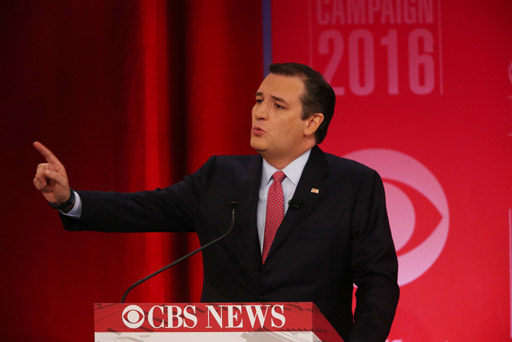
At last night’s GOP debate, Sen. Ted Cruz asserted that presidents shouldn’t appoint Supreme Court justices in the final year of their terms.
Moderator John Dickerson asked Cruz if he would follow the same restriction should he be elected. What followed was a bit of confusion on Cruz’s part and then a crowd booing when facts were introduced.
From Vox:
“Where do you set that date if you’re president?” Dickerson asked. “Does does it begin in election year, in December, November, September? And once you set the date, when you’re president, will you abide by that date?”
Cruz argued that there were “80 years of precedent” of not confirming Supreme Court justices in an election year. In fact, Justice Anthony Kennedy was confirmed in an election year by a Democratic Congress. Dickerson tried to fact-check Cruz in real time, and the audience was not having it.
“Kennedy was confirmed in ’88,” Dickerson said.
“In ’87,” Cruz said. (Kennedy was nominated in 1987 and confirmed in 1988.)
“That’s the question, is it appointing or confirming?”
“In this case it’s both. If I could finish–” Cruz started.
“I want to get the facts straight for the audience,” Dickerson said. The audience promptly booed. “But I apologize.”

From Raw Story:
On Meet the Press, Rubio again insisted that there should be no nominations from a “president nearing the last few months of his administration.”
“Do presidential terms end after three years?” NBC host Chuck Todd shot back at the candidate.
“There comes a point in the last year of the president, especially in their second term, where you stop nominating,” Rubio said. “You basically say, at this point, with a few months left in your term, no accountability from the ballot box on the appointment you’re going to make — on a lifetime appointment.”
“Eleven months!” Todd interrupted.
Republicans keep saying there’s an 80 year precedent of not confirming justices in a president’s last year, which is false. Justice Anthony Kennedy was confirmed in February of President Reagan’s final year in office.

United States Supreme Court Justice Antonin Scalia has passed away at the age of 79 in San Antonio, Texas.
From the New York Post:
Associate Justice of the Supreme Court Antonin Scalia was found dead Saturday on a luxury resort in West Texas, federal officials said.
Scalia, 79, was a guest at the Cibolo Creek Ranch, a resort in the Big Bend region south of Marfa. MySanAntonio.com said he died of apparent natural causes.
Scalia arrived at the ranch on Friday and attended a private party with about 40 people, the website of the San Antonio Express News said. When he did not appear for breakfast, a person associated with the ranch went to his room and found a body.
A federal official who asked not to be named told the San Antonio Express News paper there was no evidence of foul play and it appeared that Scalia died of natural causes.
Scalia was nominated to the U.S. Supreme Court in 1986 by President Ronald Reagan.
(function(d, s, id) { var js, fjs = d.getElementsByTagName(s)[0]; if (d.getElementById(id)) return; js = d.createElement(s); js.id = id; js.src = “//connect.facebook.net/en_US/sdk.js#xfbml=1&version=v2.3”; fjs.parentNode.insertBefore(js, fjs);}(document, ‘script’, ‘facebook-jssdk’));
Supreme Court Justice Antonin Scalia dies at age 79. Here's a look at the justice's life — http://cnn.it/1mzdvWsPosted by CNN Politics on Saturday, February 13, 2016
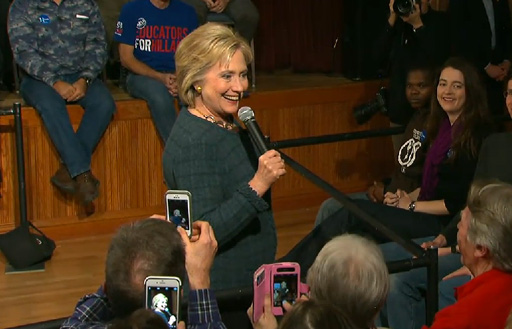
At a campaign stop in Deocorah, Iowa, yesterday, Democratic front-runner Hillary Clinton was asked her thoughts on the idea of nominating President Barack Obama for the U.S. Supreme Court.
Clinton was quite bullish about the proposition.
Via ABC News:
“Wow, what a great idea. No one has ever suggested that to me, I love that, wow,” the Democratic presidential candidate responded. “He may have a few other things to do but I tell you that’s a great idea.”
Clinton went on to talk about how the next president could have to appoint up to three Supreme Court justices, but she then circled back.
“I would certainly take that under advisement,” she told the crowd of 450 people inside a ballroom at the Winn Hotel about a potential Justice Obama. “I mean he’s brilliant, and he can set forth an argument, and he was a law professor, so he’s got all the credentials.”

Hillary Clinton has an op-ed that’s completely on point in the Boston Globe today making the very important point that the next president could possibly nominate 3 Supreme Court justices.
Who do you want making those nominations? Hillary or someone like Ted Cruz? Huge gap in political perspective.
On Election Day, three of the current justices will be over 80 years old, which is past the court’s average retirement age. The next president could easily appoint more than one justice. That makes this a make-or-break moment — for the court and our country.
As president (and a lawyer and former law professor), I’ll appoint justices who will protect the constitutional principles of liberty and equality for all, regardless of race, gender, sexual orientation or political viewpoint; make sure the scales of justice aren’t tipped away from individuals toward corporations and special interests; and protect citizens’ right to vote, rather than billionaires’ right to buy elections.
I’ve been making this point for a long time now. Whatever your pet policy leaning is, so much precedent is set by SCOTUS which affects us all day to day.
Marriage equality, women’s right to choose, organized labor, voting rights – important issues that are in the docket for this term.
It’s really worth the read.


In an effort to find some semblance of relevance in today’s world of marriage equality, virulently anti-gay Brian Brown (of the ironically-named National Organization for Marriage) made an appearance on Fox News last night to talk on Alabama state Supreme Court Justice Roy Moore’s feckless attempt to stop same-sex marriages in his state.
Of course, as we all know, last June the U.S. Supreme Court ruled that same-sex marriage was a right in this country, and thus making it possible for gay and lesbian couples everywhere in America to wed.
Grasping at straws, Brown tried to make an (illogical) legal case for Moore’s impertinence. The results – and response from experienced lawyer Megyn Kelly – were not exactly what Brown was hoping for.
From Mediaite:
Brown’s opening gambit was the fine legal thinking of Rick Santorum and Mike Huckabee (imagine that wedding), which holds that Supreme Court rulings are more, like, guidelines. Kelly lost it a little when Brown said officials shouldn’t “kowtow” to the court (which might be NOM-speak for some kind of man-dairy animal union), then patiently tried to explain the legal concept codified in Marbury vs Madison.
That’s when Brown really stepped in it, telling attorney Megyn Kelly “I think you are misreading Marbury vs Madison.” If Megyn Kelly ever decides to return to practicing law, her new strategy should be to just make faces during opposing counsel’s argument. She’d win every case.

The Advocate has named the United States Supreme Court Justices “People of the Year” for their historic ruling this past June which brought marriage equality to the entire country:
At 10:02 a.m. Eastern on June 26, 2015, the U.S. Supreme Court changed America forever.
In handing down its decision in Obergefell v. Hodges — declaring marriage to be a constitutionally protected right for same-sex couples — the court immediately made the lives of millions better. That doesn’t happen often: Most progress in a obstreperous country like the United States happens incrementally. But with Obergefell, the Supreme Court wiped out dozens of discriminatory measures, scrubbing away decades of antigay prejudice. Suddenly, anti-LGBT states had no excuse to degrade same-sex couples, no legal rationale to deny them marriage licenses. The worldwide push for marriage equality was given an inestimable boost, as marriage equality rights advocates in countries like Australia looked to the Supreme Court for inspiration. And here in America, in an instant, gays and lesbians made an enormous step toward becoming equal citizens under the law.
[snip]
In the days following Obergefell, Kennedy was lionized as a gay rights luminary. He is — but it was really the court itself that was the hero of the moment. Without its independence, its position as the ultimate arbiter of the law, gays and lesbians in America would still be denied access to the fundamental institution of marriage. Supreme Court decision-making involves a certain kind of sorcery which transforms an individual voice into binding legal precedent. The power of that voice lends each ruling legitimacy, and the prestige of the institution makes each ruling enforceable. It may have been Kennedy who wrote that the Constitution grants gay couples “equal dignity in the eyes of the law.” But it is the Supreme Court of the United States that made that judgment a constitutional command.

Matt Baume, who has a knack for breaking down why things work they way they do, drops this short video explaining why the Supreme Court became the final answer on marriage equality.
From Baume:
Where does the Supreme Court get off deciding the definition of marriage? Well, it is kind of their job.
Look at it this way: Remember a few years ago when Pluto stopped being a regular planet and became a trans-Neptunian dwarf? That happened because astronomy experts decided there should be a change in the definition of “planet.” In the same way, the Supreme Court decided what the Constitution requires from the definition of “marriage.”
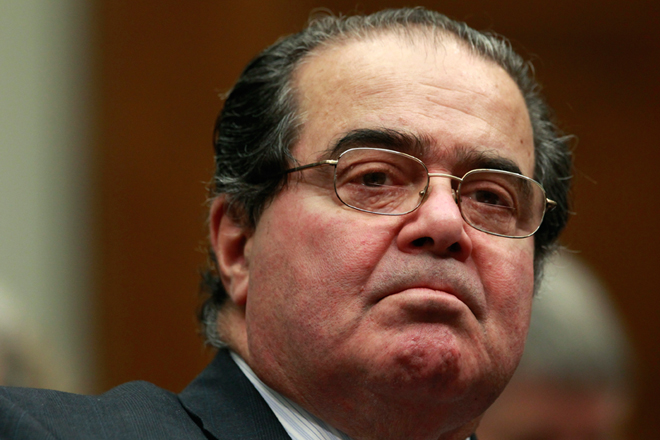
|
| Supreme Court Justice Antonin Scalia |
Many feel the only path forward for Kentucky County Clerk Kim Davis is to resign her post so she, not the state, can accommodate her religious beliefs.
Jonathan Adler, of the Washington Post, has found a surprisingly high profile judge who agrees that public officials cannot decline to perform their duties based on the official’s personal view of morality.
That judge? No less than Supreme Court Justice Antonin Scalia.
In 2002, Scalia explained that if he were to conclude that the death penalty is fundamentally immoral, he should no longer serve on the bench:
[I]n my view the choice for the judge who believes the death penalty to be immoral is resignation, rather than simply ignoring duly enacted, constitutional laws and sabotaging death penalty cases. He has, after all, taken an oath to apply the laws and has been given no power to supplant them with rules of his own. Of course if he feels strongly enough he can go beyond mere resignation and lead a political campaign to abolish the death penalty” and if that fails, lead a revolution. But rewrite the laws he cannot do.
The upshot being that public officials don’t get to rewrite the rules of their duties.
While Scalia has not addressed the specific issue of Kim Davis’ refusals to do her job, he noticeably did not dissent from the recent denial for an emergency stay when requested by Davis’ lawyers.