Marriage equality comes early to Illinois

A federal judge in Illinois ruled today that same-sex marriage can begin immediately:

“There is no reason to delay further when no opposition has been presented to this Court and committed gay and lesbian couples have already suffered from the denial of their fundamental right to marry,” U.S. District Judge Sharon Johnson Coleman said in her ruling.

Although Illinois was the 16th state to legalize marriage equality, the law wasn’t slated to begin until June 1st of this year.

Oregon Attorney General Ellen Rosenblum will not defend same-sex marriage ban in court

Oregon Attorney General Ellen Rosenblum announced today that she will not defend the state against the marriage equality lawsuit filed in federal court in October.

Rosenblum said that she will continue to enforce the gay marriage ban until the court rules, but added that the ban “cannot withstand a federal constitutional challenge under any standard of review.”

Several state Attorney Generals across the country have taken several steps regarding state bans on marriage equality. In Pennsylvania, Virginia, Nevada and more, the AG’s say the laws are unconstitutional and can’t withstand court fights.

A Democrat, Rosenblum is the state’s first female Attorney General.

Indiana: State Senate approves amended marriage equality ban

The Indiana state Senate just approved HJR-3 which would send a referendum to voters for approval of a constitutional ban on same-sex marriage.

Lawmakers in the GOP-controlled chamber voted 32-17 on House Joint Resolution 3, which the body advanced to a final reading last week even though it was stripped of language banning civil unions and other similar arrangements by the state’s House — disqualifying the ban from appearing on this November’s ballot.

A referendum on a constitutional change requires passage of the bill with the exact same language in consecutive General Assemblies.

Because a line was removed from the version passed last year,  the clock restarts and must the bill must be passed in 2015 or 2016 before it could go to voters in the 2016 election.

By that point in time, the Supreme Court may have already ruled on the issue.  OR, with the polls showing shifting attitudes towards marriage equality, the bill may have no chance at all with voters in Indiana.

Alabama: Lawsuit filed regarding recognition of same-sex marriages from other states

A gay man in Alabama has filed suit against the state challenging the current ban on same-sex marriage.

Paul Hard filed the suit hoping to repeal laws banning legal recognition of his marriage that was performed in Massachusetts.

From SeattlePi.com: 

Plaintiff Paul Hard and David Fancher, both of Montgomery, were married in 2011. Three months later, Fancher was killed in a car accident.

Hard says hospital staff initially refused to speak with him, and Fancher’s death certificate says he died unmarried. Hard is also not recognized as the surviving spouse in a wrongful death lawsuit.

Marriage News Watch – February 17, 2014

From the American Foundation for Equal Rights:

Virginia’s marriage ban is unconstitutional, with a strongly-worded victory in AFER’s case.

And that’s just the start of multiple marriage wins from coast to coast this week. We have good news coming out of Kentucky, Indiana, and Nevada, plus several new lawsuits, hearings, and favorable polls.

Kansas: LGBT discrimination bill may not pass in state Senate

A Kansas bill allowing discrimination against gay couples based on religious beliefs which passed the state House in a 72-49 vote may not see passage in the state Senate, President Susan Wagle, R-Wichita, indicated in an email on Thursday.

The Wichita Eagle reports:

“After an initial review, I’ve grown concerned about the practical impact of the bill,” Wagle said in an e-mailed statement. The bill would allow public and private employees alike to refuse service based on religious views of marriage.

“A strong majority of my members support laws that define traditional marriage, protect religious institutions, and protect individuals from being forced to violate their personal moral values,” Wagle said. “However, my members also don’t condone discrimination.

“If we cannot find ample common ground to ease legitimate concerns, I believe a majority of my caucus will not support the bill.”

(via Towleroad)

Virginia: Judge strikes down marriage equality ban

Late Thursday night, a federal judge in Norfolk struck down Virginia’s ban on same-sex marriage, saying it violates the constitution’s 14th Amendment guarantee of equal protection:

“The Court finds Va. Const. Art. I, § 15-A, Va. Code §§ 20-45.2, 20-45.3, and any other Virginia law that bars same-sex marriage or prohibits Virginia’s recognition of lawful same-sex marriages from other jurisdictions unconstitutional. These laws deny Plaintiffs their rights to due process and equal protection guaranteed under the Fourteenth Amendment of the United States Constitution.”

District Federal Court Judge Arenda L. Wright Allen had stated earlier that she would to rule quickly after hearing arguments in Norfolk on Thursday in one of two challenges to Virginia’s ban.

From the Washington Post:

Wright Allen opened her decision with a quote from Mildred Loving, who was at the center of the Virginia case that the Supreme Court used in 1967 to strike down laws banning interracial marriage.

Wright Allen added: Tradition is revered in the Commonwealth, and often rightly so. However, tradition alone cannot justify denying same-sex couples the right to marry any more than it could justify Virginia’s ban on interracial marriage.

Virginia Attorney General Mark R. Herring recently changed the state’s legal position on the issue and joined two gay couples in asking the ban be struck down.

Herring said the state will continue to enforce the ban until the legal process is over.

This victory makes Virginia the fifth state in recent weeks where courts have ruled in favor of marriage equality.

Human Rights Campaign released this statement:

Yet another court has upheld the fundamental idea that gay and lesbian Americans are entitled to full equality under the law. Nearly fifty years ago, another Virginia case struck down bans on interracial marriage across the country, and now this commonwealth brings renewed hope for an end to irrational barriers to marriage for loving and committed couples across the country.

“Following recent decisions in Utah, Oklahoma, Ohio and Kentucky this Virginia ruling proves that marriage equality is once again on the fast track to the United States Supreme Court. From the South to the Midwest, this historic progress sends a message that no American should have to wait for equality, no matter where they live. “Right now this nation is divided into two Americas—one where full legal equality is nearly a reality, and the other where even the most basic protections of the law are nonexistent for loving gay and lesbian couples. We cannot and will not tolerate that patchwork of discrimination, and we won’t stop fighting until fairness and dignity reaches each and every American in all 50 states.”

(source)

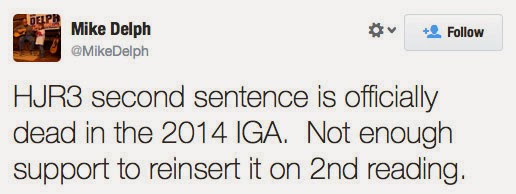
Indiana State Senator: “Second Sentence” issue dead – no public vote on anti-gay marriage referendum in 2014

https://twitter.com/MikeDelph/status/434037631131742208

Indiana State Senator Mike Delph just tweeted the message above: “HJR3 second sentence is officially dead in the 2014 IGA. Not enough support to reinstate it on 2nd reading.”

As the debate continues today in Indiana, this would be good news for the LGBT community.

Constitutional amendments must pass in consecutive General Assemblies with identical language before going to the voters. By removing the “second sentence” (which bars ANY kind of legal relationship “identical or substantially similar” between same-sex couples), the bill will need to pass again in the next legislative session.

The state House removed the sentence earlier this year when approving the measure. LGBT opponents needed the Senate to restore the language and then fight to keep it in during a “conference” debate with House and Senate.

This means the issue won’t reach voters until 2016 at the earliest. And with marriage equality support growing every day, hopefully this won’t even be an issue by then.

Hurray!

Celebrate!  Happy Dance!

(h/t Good As You)

Nevada: Ninth Circuit Court grants Lambda Legal expedited hearing

After Nevada Attorney General Catherine Cortez Masto’s withdrew the state’s brief in defense of banning marriage equality, Lambda Legal has requested and been granted an expedited hearing in the Ninth Circuit Court.

Via press release:

Lambda Legal Senior Attorney Tara Borelli said: “The fact that the government defendants no longer are defending Nevada’s exclusion of same-sex couples from marriage makes any delay in these loving and committed couples securing the relief they seek particularly intolerable. The wheels of justice are now on a much faster track.”

Gov. Sandoval’s request and the earlier decision by Carson City Clerk-Recorder Alan Glover to withdraw his brief were motivated by the Ninth Circuit’s recent ruling in SmithKline Beecham v. Abbott Laboratories that discriminatory classifications based upon sexual orientation must receive heightened scrutiny and should be presumed unconstitutional.

The heightened scrutiny standard is much tougher to meet and rendered the state of Nevada’s arguments in its original brief defending the marriage ban “no longer tenable in the Ninth Circuit,” as Nevada’s Attorney General conceded in a statement released last week.

The withdrawal of the two government defendants leaves only the Coalition for the Protection of Marriage, which the U.S. District Court had allowed to intervene, defending the marriage ban.

Anti-gay Brian Brown whines about Kentucky marriage equality ruling

Brian Brown, president of the anti-gay hate group National Organization for Marriage, issued this statement today after a federal judge ruled Kentucky’s ban on recognition of same-sex marriages from other states was unconstitutional based on the 14th Amendment:

“Today yet another federal judge has entered the competition for lawlessness on the marriage front,” said Brian Brown, NOM President.

“Today’s decision emphasizes the need for Congressional action to prevent our states’ marriage laws from spiraling further into chaos.

“Congress needs to explicitly reinforce the sovereign right of the states to make their own determinations regarding marriage, and to have those determinations respected by the federal government-which would include having those determinations protected from coerced modification through dubious readings of the 14th amendment such as we have here.”

I would suggest that, instead of “lawlessness,” perhaps the problem isn’t with the judges who rule over and over and over again on the unconstitutionality of these laws.

When so many courts cases (Prop 8; DOMA; marriage equality in Oklahoma, Kentucky, Utah) come to the same conclusion – maybe it’s not the judges.

Maybe, Brian Brown, the problem is you.