Pete Buttigieg Calls ‘Bullshit’ On NY Times Journalist

Pete Buttigieg (screen capture via NY Times)
In advance of announcing its endorsement for the Democratic primary this coming Sunday, the editorial board of the New York Times sat down with White House hopefuls Sens. Bernie Sanders, Cory Booker, Elizabeth Warren, Amy Klobuchar, former Vice President Joe Biden, former Massachusetts Gov. Deval Patrick, former Mayor Pete Buttigieg, and business executives Tom Steyer and Andrew Yang. In this clip from the roughly 80 minute interview with Buttigieg, he’s asked why he doesn’t seem as emotive or angry as other young people. The question comes from Binyamin Appelbaum, a leading writer for the board on the subject of economics. In framing his question, Appelbaum asserts that Buttigieg has been “on the front lines of corporate price fixing,” prompting Mayor Pete to call ‘bullshit.’

You can read the full transcript of Buttigieg’s 80-minute interview here. But below is the excerpted transcript with the Times’ annotations in italics.

******************************************

Binyamin Appelbaum: If I can put this question in a slightly different way, you’ve been on the front lines of corporate downsizing. You’ve been on the front lines of corporate price fixing. Buttigieg: Whoa, whoa whoa, that’s, that’s, I’m sorry, that’s —— Appelbaum: You’ve been on the front of our misadventures in foreign policy. You’ve had direct experience in many of the things that make a lot of young people very angry about the way that this country is operating right now. You don’t seem to embody that anger. In 2003, Mr. Buttigieg — then a junior at Harvard — spoke at an antiwar rally in Cambridge, Mass., protesting the invasion of Iraq. More than a decade later, in 2014, he served seven months in Afghanistan as a lieutenant in the U.S. Navy Reserves. Buttigieg: So the proposition that I’ve been on front lines of corporate price fixing is bullshit. Just to get that out of the way. Appelbaum: You worked for a company that was fixing bread prices. Buttigieg: No, I worked for a consulting company that had a client that may have been involved in fixing or was apparently in a scandal. I was not aware of the Canadian bread pricing scandal until last night. Mr. Buttigieg’s campaign has maintained that he only recently heard of the bread price-fixing scheme and while he was working with Loblaws focused on price cuts more broadly across the grocery store chain.

BA: Do you feel the anger that many young people feel about the state of ——

Yeah, of course, because it destroyed my city. I grew up surrounded by crumbling factories and empty houses.  My city lost 30,000 of its 130,000 people, largely before I was born.

South Bend had an unemployment rate of 13 percent in 2010. Under Mayor Buttigieg, it fell to 3.2 percent, though it rose back to 4.3 percent in 2018.

So I’m under no illusions about the problems that are present in American capitalism generally and were unleashed beginning with the Reagan era specifically. And while I may not be as emotive sometimes about my sense of anger or frustration or injustice — and I would argue that some people are given more room to be emotive than others — I would not be doing any of this if I were not propelled by a level of passion.

******************************************

The editorial board’s pick to be the nominee will be revealed on the January 19 episode of “The Weekly,” The Times’s television show on FX and Hulu.

Trump Calls NY Times “True Enemy Of The People”

Donald Trump

Donald Trump began his day attacking The New York Times, no doubt because of their extensive report yesterday regarding Trump reportedly asking then-acting Attorney General Matthew Whitaker last year to shift Trump ally U.S. Attorney Geoffrey Berman to be in charge of the Michael Cohen investigation in New York’s Southern District.

According to the Times, Trump soured on Whitaker when he didn’t do as asked.

The publisher of the Times, A. G. Sulzberger, clapped back at Trump via an op-ed today which read, in part:

In demonizing the free press as the enemy, simply for performing its role of asking difficult questions and bringing uncomfortable information to light, President Trump is retreating from a distinctly American principle. It’s a principle that previous occupants of the Oval Office fiercely defended regardless of their politics, party affiliation, or complaints about how they were covered.

The phrase “enemy of the people” is not just false, it’s dangerous. It has an ugly history of being wielded by dictators and tyrants who sought to control public information. And it is particularly reckless coming from someone whose office gives him broad powers to fight or imprison the nation’s enemies. As I have repeatedly told President Trump face to face, there are mounting signs that this incendiary rhetoric is encouraging threats and violence against journalists at home and abroad.

Through 33 presidential administrations, across 167 years, The New York Times has worked to serve the public by fulfilling the fundamental role of the free press. To help people, regardless of their backgrounds or politics, understand their country and the world. To report independently, fairly and accurately. To ask hard questions. To pursue the truth wherever it leads. That will not change.

NY Times: How OnlyFans Put Adult Performers In Charge Of Their Own Content

The New York Times does a deep dive today into the latest media outlet for adult content, OnlyFans.com.
Matthew Camp calls OnlyFans “online go-go dancing”

The New York Times does a deep dive today into the latest media outlet for adult content, OnlyFans.com.

As many know, the website allows fans of models or performers (insert whatever term you like) to subscribe to private content that might be too explicit for social media.

The monthly fees generally range from $5 to $20, with the performer taking an 80% cut of the monthly fees.

Along the way, the article talks to former go-go dancer and all-around hottie, Matthew Camp, about his perspective on sharing his content on the site.

“Basically, OnlyFans is online go-go dancing,” said Camp.

Ten years ago, the daddy/twink/bear/boy was making $1,000 on a good night at New York City gay clubs and events. Naturally, he caught the eye of porn studios like Lucas Entertainment.

Camp tells the Times that the idea of “having sex for money is appealing,” but he thought $1,000 or so seemed low for video clips that would live forever on the internet, dubbing him a ‘porn star’ for life.

Instead, he worked to develop a steadily growing following on the more PG-13 Instagram platform garnering well over 500,000 followers.

As the NYC gay club landscape began to dry up, he headed upstate to Hudson, New York, and opened an OnlyFans account.

Even though he would sometimes go weeks without posting new video or photo content, the 34-year-old tells the Times he was taking banking over $10,000 a month.

In addition to the regular content, OnlyFans allows private communication between the performers and fans, who can request anything from birthday wishes to specific ‘themed’ photos or video clips.

And now, Camp is branching out to another subscription-based platform by launching an online radio show via DNR Studios called “Happie Camper,” where fans can join him 3 times a week for a fee of $6.95 a month. It’s a live radio show where you can call in and ask questions as Camp chats with folks like Chris “Leave Britney Alone” Crocker and Cameron Rose.

For many of the content creators, the secret to increased success isn’t always having the most “explicit” content but being regular with posting new video or photos.

The most successful ‘fitness model’ on OnlyFans, Australian Jem Wolfe, has 10,000 fans paying $10 monthly for access to her content. But, according to the Times, she mostly “shows off her Kardashianesque proportions, squatting in really tight leggings and squeezing her breasts together, strategically covering her nipples.”

For folks who are fascinated by how the internet continues to shake up old business models and creates new ones, the Times article by Jacob Bernstein is a must-read.

Bernstein delves into topics like how web-camming led to the current OnlyFans concept, and the challenge of not having an app for OnlyFans due to the content being too racy to pass muster for app stores.

I recently covered the banning of overt sexual imagery by Tumblr because the social media platform was threatened with being dropped from app stores.

Camp explains how OnlyFans and its opportunities for one-on-one interaction with performers makes for a better experience than plain raunch.

“Tumblr was filled with the most extreme sexual experiences you could see,” Camp told the Times. “And I think a lot of people were turned off by that. It’s not what they’re looking for. They want more intimate experiences. They want a boyfriend experience. They want to fantasize about someone that they want to have sex with and not feel disgusted by it.”

Head over to The New York Times for the full article, and you can check out my chat with Mr. Matthew Camp below where we discuss how OnlyFans is allowing adult performers to control their own content.

New York Times To Troll Trump During Oscars

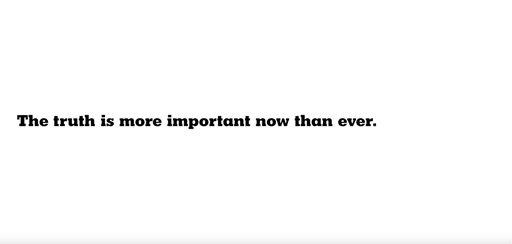
As the Trump administration continues it’s assault on the media over stories deemed ‘less than flattering’ to Trump, the New York Times has a new marketing campaign: “The truth is more important now than ever.”

From CNN:

The New York Times is running its first television ad in seven years during the Oscars Sunday night. The subject? The truth. The ad begins with voices saying, “The truth is our nation is more divided than ever,” with those words spelled out against a white backdrop. The phrase then changes to “The truth is alternative facts are lies.” The ad repeats different versions of the “The truth is…” as the voices speed up and get louder. It ends with: “The truth is hard” and “The truth is more important now than ever.”

The ad’s mission is to tap into “national dialogue going on right now about facts and the truth” and what that means in today’s world, according to New York Times branding exec David Rubin. “The idea is to be a part of that discussion about what does it mean to find the truth,” he said. “What does that mean in a world of ‘fake news’? And what is the role of journalism and journalists in that process and what is the role of reader in supporting that journalism?”

While the Donald likes to refer to the NY Times as ‘failing,’ the truth is their subscriptions are up.

How do I know?

Because I’m one of those new subscriptions 🙂

Watch the new spot below:

New York Times Runs First Front Page Op-Ed Since 1920 Calling For Gun Control

Not to be outdone by the New York Daily News, the New York Times runs it’s first front page op-ed since 1920 calling for gun control laws.

Excerpt:

It is a moral outrage and a national disgrace that civilians can legally purchase weapons designed specifically to kill people with brutal speed and efficiency. These are weapons of war, barely modified and deliberately marketed as tools of macho vigilantism and even insurrection. America’s elected leaders offer prayers for gun victims and then, callously and without fear of consequence, reject the most basic restrictions on weapons of mass killing, as they did on Thursday. They distract us with arguments about the word terrorism. Let’s be clear: These spree killings are all, in their own ways, acts of terrorism.

Opponents of gun control are saying, as they do after every killing, that no law can unfailingly forestall a specific criminal. That is true. They are talking, many with sincerity, about the constitutional challenges to effective gun regulation. Those challenges exist. They point out that determined killers obtained weapons illegally in places like France, England and Norway that have strict gun laws. Yes, they did.

But at least those countries are trying. The United States is not. Worse, politicians abet would-be killers by creating gun markets for them, and voters allow those politicians to keep their jobs. It is past time to stop talking about halting the spread of firearms, and instead to reduce their number drastically — eliminating some large categories of weapons and ammunition.

It is not necessary to debate the peculiar wording of the Second Amendment. No right is unlimited and immune from reasonable regulation.

Cabaret: New York Times Disses Debbie Harry

Photo by Michael Wilhoite for Café Carlyle

Debbie Harry is currently performing a sold-out residency at the Cafe Carlyle in New York City.

Sold-out or not, Stephen Holden of the New York Times was not impressed by the 69 year old punk rock legend’s cabaret act:

Making a grand entrance in a black leather jacket and tinted sunglasses, she was every inch the platinum-haired downtown bad girl and face of the seminal, still-extant post-punk band Blondie. She resembled a tabloid American Catherine Deneuve. Instead of a band, she brought with her a one-man computer-and-synthesizer sound machine in the person of Blondie’s current keyboardist, Matt Katz-Bohen, who also played a little piano and guitar.

Those hoping that Ms. Harry would sing Blondie hits like “Rapture,” “Heart of Glass” and “Call Me” were treated to a program of songs taken mostly from her uneven solo albums, whose musical styles ranged from poppy dance numbers like her minor 1986 hit, “French Kissin’, ” to more sophisticated ballads like “Imitation of a Kiss,” which she recorded with the Jazz Passengers.

[snip]

Nothing could camouflage Ms. Harry’s vocal difficulties. She was so consistently off-pitch that the songs nearly disappeared under her struggle to sing the notes. The show was the professional equivalent of a very shaky audition.

OUT’s Greg Garry felt differently:

At 69, this NYC legend’s voice still sounds strong and clear, with a slight husky tone but still able to hit those high notes, and these shows should take full advantage of that. Hopefully this will inspire her to record an album of torch songs. Then she can be the punk rock Peggy Lee. Comparisons aside, there’s only one Debbie Harry.

Frank Bruni for New York Times: “Dear President Clinton”

“Dear President Clinton, 

What a year you’ve had, the kind that really burnishes a legend. At the Democratic National Convention, on the campaign trail, in speeches aplenty and during interviews galore, you spoke eloquently about what this country should value, and you spoke unequivocally about where it should head. Such a bounty of convictions, such a harvest of words, except for one that’s long overdue: Sorry.

“Where’s your apology for signing the Defense of Marriage Act? And why, amid all the battles you’ve joined, and with all the energy you’ve been able to muster, haven’t you made a more vigorous case for same-sex marriage, especially in light of your history on this issue? You fret about your legacy, as any president would. For turning a blind eye to the butchery in Rwanda, you struggled through a mea culpa of sorts, and after Barack Obama seemed to lavish higher praise on Ronald Reagan than on you, you seethed.

“Well, DOMA, which says that the federal government recognizes only marriages of a man and a woman, is one of the uglier blemishes on your record, an act of indisputable discrimination that codified unequal treatment of gay men and lesbians and, in doing so, validated the views of Americans who see us as lesser people. If our most committed, heartfelt relationships don’t measure up, then neither do we. If how we love is suspect, then so is who we are. No two ways to interpret that. No other conclusion to be drawn.

[snip]

“I was sloppy at the start. What I and many others want most from you isn’t really an apology. It’s full membership — and, better yet, leadership — in a movement that’s headed inexorably in the right direction, with or without you.” – Frank Bruni, writing for the New York Times.

Read the full essay here.