There was a lot in 2020 that was just heinous and I’m happy to leave it behind. But I did want to take a pause to look at some of the good news and big moments of the past year in this ‘Best of 2020 – LGBTQ edition.’ Continue reading “Podcast: The Best of 2020 – LGBTQ Edition”
The U.S. Supreme Court has declined to hear a case that could have undercut marriage rights for same-sex couples.
Even with a 6-3 conservative majority on the high court, SCOTUS refused to roll back same-sex marriage rights.
The case, Box v. Henderson, was brought by parents Ruby and Ashlee Henderson in 2015 as a challenge to Indiana’s birth records law. The couple sued when county officials refused to list both on the birth certificate of their son, who was conceived via artificial insemination.
The state of Indiana regularly lists the male spouse on birth certificates in opposite-sex marriages that conceive via anonymous sperm donors even though the husband has no biological link to the child.
But in the case of the Hendersons, Indiana Attorney General Curtis Hill argued “whenever a birth-mother’s wife gains presumptive ‘parentage’ status, a biological father’s rights and obligations to the child have necessarily been undermined without proper adjudication.”
In his brief to the Supreme Court, Hill wrote that it’s just “common sense” that while “the husband of a birth mother is usually the biological father, the wife of a birth mother is never the biological father.”
But in its 2015 Obergefell v. Hodges ruling, which made marriage equality the law of the land, the high court was specific that same-sex couples are entitled to the same “constellation of benefits” of marriage that opposite-sex married couples are afforded. And that includes birth certificates for their children.
(stock photo via Depositphotos)
The Hendersons argued in their original suit that a number of legal issues could arise regarding who could enroll their son in school, ensure he was covered by health insurance, or even speak on the child’s behalf during a medical appointment. Without the legal status conferred by a birth certificate, one of the women would need to formally adopt their son which could cost up to $5,000 in legal fees.
The couple won in federal court in 2016 but Indiana appealed to the 7th Circuit Court of Appeals which upheld the lower court’s ruling ten months ago. In its unanimous decision, the 7th Circuit cited due process and equal protection clauses of the 14th Amendment.
In other words, just because someone’s a wife, not a husband, doesn’t mean you can deny them marriage rights.
In 2017, the Supreme Court had ruled on the issue of same-sex parents and birth certificates in Pavan v. Smith, in which SCOTUS found in favor of a same-sex couple who had also conceived through assisted reproduction.
Since that time, SCOTUS refused to hear a similar case in 2018 from Arizona where a lesbian couple sued for legal recognition of the birth mother’s wife as a parent after using an anonymous sperm donor to conceive.
With the Supreme Court’s refusal to review the case today, the lower court rulings will stand.
Another bullet dodged. Whew. LGBTQ rights are simple human rights. And the children of same-sex couples especially deserve equal dignity and decent treatment. Indiana should be ashamed of itself. https://t.co/05vb7l9pp9
In “victory” for LGBTQ families, US Supreme Court declines to take up Indiana case seeking to reverse a lower court’s ruling that allows both members of same-sex couples in the state to be listed as parents on the birth certificates of their children. https://t.co/peulZwxUAJ
The Supreme Court denied cert Monday in a case that threatened to chip away at marriage equality. The Court’s denial will disallow Indiana’s effort to discriminate against same-sex couples, and will continue to preserve the meaning of Obergefell v. Hodges. https://t.co/H2TdczYmrk
Karen Celestino-Horseman, the attorney for the Hendersons, told The Indianapolis Star they were “delighted” about the Supreme Court’s decision.
“It’s a major victory that is going to keep the same-sex families together, and the children born to these marriages will have two parents to love and protect them,” added Celestino-Horseman.
Cathy Sakimura, Deputy Director and Family Law Director for the National Center for Lesbian Rights (NCLR), said in a statement today, “The Supreme Court rightly denied this case because it has already clearly decided that same-sex spouses and different-sex spouses must be treated equally.”
Solicitor General Tom Fisher, speaking for the Indiana Attorney General’s office, issued a lame “We are disappointed the Court declined to take up the case.”
(image via Depositphotos) The state of Nevada is on its way to making history as the first state in the U.S. to acknowledge all marriages in its state constitution. On the ballot this election cycle was Question 2 which asked voters to remove an existing provision that only marriage between a male person and a female person would be recognized. The state constitution will be amended to require the state (and its political subdivisions) to recognize all marriages and issue marriage licenses to couples regardless of gender, and to treat those marriages equally under the law. The ballot question did include explicit language that allows religious organizations and clergy to refuse to perform a marriage that they don’t agree with on religious terms. Same-sex marriages became legal in the Silver State in 2014, and across the nation in 2015 thanks to the U.S. Supreme Court’s historic Obergefell v. Hodges ruling. At this writing, the Secretary of State’s website shows the measure passing overwhelmingly by 61.69 percent to 38.31 percent. Gary Brewer, who married his husband this past May in a small ceremony, told local news affiliate FOX5, “It feels really good to know this is the direction Nevada has taken and I feel really proud to call the state my home,” Chris Davey of the Henderson Equality Center told FOX5 the legal amendment won’t change daily life for LGBTQ Nevadans at this time, but could prove to be crucial if the now-conservative leaning U.S. Supreme Court were to rule in favor of rolling back rights for same-sex marriages.
As I reported last month, on the first day of the Supreme Court’s new term, conservative Justices Clarence Thomas and Samuel Alito chose to reignite their discontent with the 2015 decision that made marriage equality the law of the land. Justice Thomas wrote that the Obergefell ruling “enables courts and governments to brand religious adherents who believe that marriage is between one man and one woman as bigots, making their religious liberty concerns that much easier to dismiss.” Since that time, Amy Coney Barrett (who has a history of anti-LGBTQ views) has been confirmed to replace recently-deceased Justice Ruth Bader Ginsburg increasing the conservative-leaning of the court to 6-3. Just this week, Barrett heard arguments in a case regarding a Roman Catholic adoption agency in Philadelphia (Catholic Social Services) that claims a First Amendment right to decline to match foster children with same-sex households even though it signed a contract with the city agreeing not to engage in anti-LGBTQ discrimination through its taxpayer-funded activities. According to Washington Blade reporter Chris Johnson, the court appeared to side with CSS after the oral arguments. With these Supreme Court developments in mind, state-based legal moves like Question 2 in Nevada become all the more important for LGBTQ Americans. (source: FOX5 News, Washington Blade)
Pope Francis (image via public domain) In a new documentary that premiered in Rome on Wednesday, Pope Francis signaled a break from the Catholic Church’s official teaching calling for civil union laws for same-sex couples. And this from the Catholic News Agency:
“Homosexuals have a right to be a part of the family. They’re children of God and have a right to a family. Nobody should be thrown out, or be made miserable because of it,” Pope Francis said in the film, of his approach to pastoral care.
After those remarks, and in comments likely to spark controversy among Catholics, Pope Francis weighed in directly on the issue of civil unions for same-sex couples. “What we have to create is a civil union law. That way they are legally covered,” the pope said. “I stood up for that.”
Francis has expressed an interest in reaching out to the church’s LGBTQ followers in the past, but his comments have primarily been along the lines of general ‘welcoming’ and not substantive policies.
In a documentary that premiered Wednesday in Rome, Pope Francis called for the passage of civil union laws for same-sex couples. https://t.co/e9VObaZ1BP
Judge Amy Coney Barrett (photo: Rachel Malehorn/Wikimedia Commons) Today, Donald Trump announced the nomination of ultra-conservative Amy Coney Barrett to replace Justice Ginsburg, just days after Justice Ginsburg’s death and before her burial at Arlington National Cemetery next week. From the New York Times:
While other justices have been approved in presidential election years, none has been voted on after July. Four years ago, Senate Republicans refused to even consider President Barack Obama’s nomination to replace Justice Scalia with Judge Merrick B. Garland, announced 237 days before Election Day, on the grounds that it should be left to whoever was chosen as the next president.
In picking Judge Barrett, a conservative and a hero to the anti-abortion movement, Mr. Trump could hardly have found a more polar opposite to Justice Ginsburg, a pioneering champion of women’s rights and leader of the liberal wing of the court.
And the Human Rights Campaign notes just some of Coney Barrett’s low-lights regarding LGBTQ rights:
Coney Barrett defended the Supreme Court’s dissenters on the landmark marriage equality case of Obergefell v. Hodges, questioning the role of the court in deciding the case:
[Chief Justice Roberts, in his dissent,] said, those who want same-sex marriage, you have every right to lobby in state legislatures to make that happen, but the dissent’s view was that it wasn’t for the court to decide…So I think Obergefell, and what we’re talking about for the future of the court, it’s really a who decides question.” – Coney Barrett
Coney Barrett says Title IX protections do not extend to transgender Americans, claiming it’s a “strain on the text” to reach that interpretation:
“When Title IX was enacted, it’s pretty clear that no one, including the Congress that enacted that statute, would have dreamed of that result, at that time. Maybe things have changed so that we should change Title IX, maybe those arguing in favor of this kind of transgender bathroom access are right. That’s a public policy debate to have. But it does seem to strain the text of the statute to say that Title IX demands it.” – Coney Barrett
Coney Barrett misgendered transgender people, referring to a transgender women as “physiological males,” while casting doubt on transgender rights:
“People will feel passionately on either side about whether physiological males who identify as females should be permitted in bathrooms, especially where there are young girls present.” – Coney Barrett
A new ABC News/Washington Post poll shows 57 percent of Americans say the next justice of the U.S. Supreme Court should be left to the winner of the presidential election and a Senate vote next year. Only 38 percent feel the confirmation should happen in the next weeks. The same poll shows: • 54 percent of respondents oppose increasing the number of Supreme Court justices versus 32 percent who support the idea • 50 percent said they trust Joe Biden more to handle the next SCOTUS nomination versus 42 percent who trust Donald Trump more to make the choice (graphic via ABC News/Washington Post poll)
The hearse carrying the late Rep. John Lewis pauses at Rainbow Intersection As the motorcade for the late civil rights icon Rep. John Lewis (D-GA) made its way through the streets of Atlanta on Wednesday heading to the Georgia State Capitol, the hearse carrying his body paused in tribute to his support for the LGBTQ community at an intersection marked by rainbow-painted crosswalks. Supporters were already waiting at Piedmont and 10th Street where the scheduled stop had been previously announced. When the hearse paused in the intersection, supporters clapped and cheered the memory of the civil rights legend. And as the motorcade resumed its journey, Terrence James, a downtown Atlanta resident, began singing “We Shall Overcome.”
Terrence James, who lives downtown, began singing “We Shall Overcome” as Lewis’ hearse paused at the rainbow intersection pic.twitter.com/SBHCvlyRs9
In addition to his lifelong commitment to equal rights for Black Americans, Lewis was an early ally to the LGBTQ community In 1996, long before gay rights were widely embraced by mainstream America, Lewis took to the floor of the House of Representatives to denounce the heinous anti-gay Defense of Marriage Act (DOMA) as a “mean” and “cruel” bill. “This bill seeks to divide our nation, turn Americans against Americans, to seed fear, hatred, and intolerance,” declared Lewis. “Marriage is a basic human right. You cannot tell people they cannot fall in love.”
A few years later, he penned an op-ed for the Boston Globe urging equal rights for LGBTQ Americans. “This discrimination is wrong,” he wrote in 2003. “We cannot keep turning our backs on gay and lesbian Americans. I have fought too hard and too long against discrimination based on race and color not to stand up against discrimination based on sexual orientation.” “I’ve heard the reasons for opposing civil marriage for same-sex couples. Cut through the distractions, and they stink of the same fear, hatred, and intolerance I have known in racism and in bigotry.” And in 2017, he compared the struggles by the LGBTQ community to those of other marginalized Americans. “It doesn’t matter whether they are black or white, Latino, Asian American or Native American, whether they are straight or gay, Muslim, Christian or Jews,” Lewis said during a Congressional hearing. “We all live in the same house. The American house.”
June 26 has become such a special day in LGBTQ history in the United States many now view the date as ‘National Gay Pride Day.’ It was on this day in 2003 the U.S. Supreme Court struck down so-called ‘sodomy’ laws which made consensual adult sexual activity in private a crime (Lawrence v Texas). In 2013, SCOTUS invalidated the ‘Defense of Marriage Act’ which prohibited the federal government from recognizing same-sex marriages (Windsor v United States). June 26, 2015, was a historic day for LGBTQ people when the high court ruled marriage equality is a constitutional right bringing same-sex marriage to the entire United States (Obergefell v Hodges). Two years later, on June 26, 2017, the Supreme Court the court gave us another win in Pavan v. Smith ruling that the state of Arkansas, by refusing to automatically list both members of a same-sex couple as parents on their children’s birth certificates (which was routinely done for opposite-sex parents), was violating the legal parameters enumerated in Obergefell which declared same-sex couples must be afforded “the constellation of benefits that the State has linked to marriage.” A lot of progress has been made by the LGBTQ community in great part because of changing attitudes about homosexuality, not only in the U.S. but around the world. Pew Research has been tracking public opinion on the acceptance of LGBTQ people since 2002. In its latest survey of 38,426 people in 34 countries, Pew found acceptance is still growing in most of the world, but not everywhere. For instance, from 2013 (the last time Pew polled the question) to 2019, the number of Americans who say homosexuality should be accepted has risen from 60% to 72%. Only 21% said homosexuality should not be accepted by society. Most of Western Europe supports acceptance. Sweden has the highest level of support at 94% followed by The Netherlands (92%), Spain (89%), France (86%), and the UK (86%).
Other countries, while not quite as approving, have shown double-digit increases in support like South Africa (from 32% to 54% support), India (15% to 37%), and Turkey (9% to 25%). But in regions like the Middle East and Africa, some nations offer little support like Kenya (14%) and Tunisia (9%). Israel stands out as an exception in the Middle East with 47% support, although many might have expected that figure to be higher considering the popularity of Pride events in cities like Tel Aviv.
However, the results aren’t all puppies and rainbows. Attitudes in some countries have actually dropped since Pew first began asking the question in 2002. The 2019 survey shows only 14% support in Russia, 9% in Indonesia, and a scant 7% in Nigeria. All of those figures are lower than the 2002 results. Pew Research does note, though, that the Philippines, often seen as a conservative nation in terms of social issues, was found to have 73% acceptance. A country’s wealth seems to have a correlating factor to acceptance as well. Germany, Sweden, and The Netherlands each have a per-capita gross domestic product over $50,000 and all show huge support for LGBTQ people. But poorer countries like Kenya, Ukraine, and Nigeria – all with per-capita GDP under $10K – indicate approval around 14% or lower. For those interested, 32 countries around the world have legalized marriage equality with Costa Rica joining the list last month. (source: Pew Research)
It was five years ago today that the U.S. Supreme Court issued its historic ruling, Obergefell v. Hodges, making same-sex marriage legal across the entire United States. In light of the happy occasion, I thought it would be a good idea to take a look back at how marriage equality has spread across the globe. Currently, 32 countries recognize same-sex marriage. On September 12, 2000, The Netherlands became the first nation on the planet to legalize marriage equality. On April 1, 2001, the day the law went into effect, the world watched as four same-sex couples exchanged marriage vows in a ceremony officiated by the mayor of Amsterdam. In July 2010, Argentina led the way in South America after several cities including Buenos Aires had allowed gays and lesbians to enter into civil unions. While Denmark made marriage equality legal in 2012, it’s worth noting they were the first country in the world to recognize same-sex couples as domestic partners. (image via ABC News) In 2015, Ireland became the first country to legalize same-sex marriage via popular vote. Until then, other countries came to marriage equality via court ruling or legislation. In 2019, Taiwan became the first country in Asia to legalize marriage equality. Last month, Costa Rica became the first nation in Central America to recognize same-sex marriage. Here are the 32 countries (so far) that have legalized same-sex marriage (in chronological order): The Netherlands Belgium Spain Canada South Africa Norway Sweden Argentina Portugal Iceland Denmark Uruguay Brazil New Zealand England Wales France Luxembourg Scotland United States Ireland Finland Greenland Colombia Malta Australia Germany Austria Taiwan Ecuador Northern Ireland Costa Rica (source: ABC News)
L-R Former President Barack Obama, Donald Trump When asked about the U.S. Supreme Court’s landmark ruling that found LGBTQ people are protected by federal employment discrimination laws, Donald Trump told reporters, “I’ve read the decision, and some people were surprised. But they’ve ruled and we live with their decision. That’s what it’s all about. We live with the decision of the Supreme Court. Very powerful. Very powerful decision actually. But they have so ruled.”
That’s some enthusiasm, huh? You’ll recall during the 2016 presidential campaign, the Donald declared he would be a better friend to the LGBT community than Hillary Clinton. And, as we now know, that’s not turned out to be the case. Presumptive Democratic presidential candidate Joe Biden was much more uplifting in his remarks, writing in part:
Today’s Supreme Court decision is a momentous step forward for our country. Before today, in more than half of states, LGBTQ+ people could get married one day and be fired from their job the next day under state law, simply because of who they are or who they love. This landmark 6–3 ruling affirms that LGBTQ+ Americans are entitled to equal rights under the law. This decision is another step in our march towards equality for all. And while we celebrate this victory today, we know that our work is not yet done. As President, I look forward to signing into law the Equality Act, protecting the civil rights of LGBTQ+ Americans, and championing equal rights for all Americans. Happy Pride!
Today’s decision is another step in our march toward equality for all. The Supreme Court has confirmed the simple but profoundly American idea that every human being should be treated with respect. But we’re not done. https://t.co/Bz4SMA9tgb
And, former President Barack Obama tweeted his response: “Today reminds us that progress might be slow. It might take decades. But no matter what things might look like today, it’s always possible. Happy Pride month, everybody.”
Today reminds us that progress might be slow. It might take decades. But no matter what things might look like today, it’s always possible. Happy Pride month, everybody. pic.twitter.com/ey7p2TgEEf
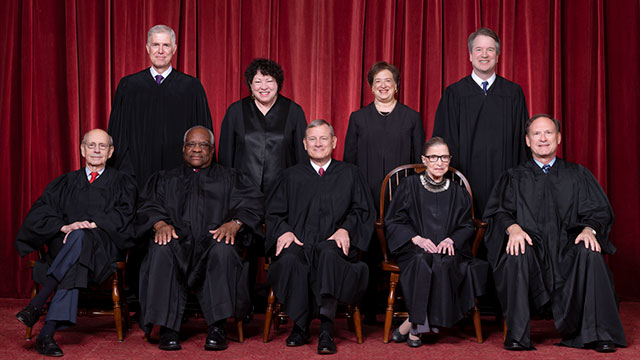
The current U.S. Supreme Court (image: public domain) In a major victory for LGBTQ rights, the U.S. Supreme Court issued a historic decision Monday morning ruling that current federal law prohibits discrimination against workers for being LGBTQ, finally putting into place long-sought federal protections for LGBTQ people in the workplace. The ruling, a 6-3 decision, finds that anti-LGBTQ discrimination is a form of sex discrimination, which is banned under Title VII of the Civil Rights Act of 1964, according to ScotusBlog. The ruling comes only three days after the Trump Administration chose to roll back healthcare protections for LGBTQ individuals during Pride Month and on the anniversary of the Pulse Nightclub massacre in Orlando, Florida where 49 individuals were murdered in a gay nightclub. Donald Trump’s administration had filed a brief with the Supreme Court urging the justices to rule that it’s legal to fire workers because of their sexual orientation. The court heard oral arguments for 3 consolidated cases last October. Two cases involved gay men who were fired from their jobs — Zarda v. Altitude Express and Bostock v. Clayton County – and a third involving a transgender woman who lost her job, R.G. & G.R. Harris Funeral Homes Inc. v. Equal Employment Opportunity Commission. U.S. Associate Justice Neil Gorsuch, one of the most conservative members of the high court, wrote for the majority, “An employer who fires an individual for being homosexual or transgender fires that person for traits or actions it would not have questioned in members of a different sex. Sex plays a necessary and undisguisable role in the decision, exactly what Title VII forbids.” From the ruling:
A statutory violation occurs if an employer intentionally relies in part on an individual employee’s sex when deciding to discharge the employee. Because discrimination on the basis of homosexuality or transgender status requires an employer to intentionally treat individual employees differently because of their sex, an employer who intentionally penalizes an employee for being homosexual or transgender also violates Title VII. There is no escaping the role intent plays: Just as sex is necessarily a but-for cause when an employer discriminates against homosexual or transgender employees, an employer who discriminates on these grounds inescapably intends to rely on sex in its decisionmaking.
The five other justices agreeing in concert with Gorsuch are U.S Chief Justice John Roberts, U.S. Associate Justice Ruth Bader Ginsburg, U.S. Associate Justice Elena Kagan, U.S. Associate Justice Sonia Sotomayor and U.S. Associate Justice Stephen Breyer. Traditionally conservative-leaning U.S. Associate Justices Samuel Alito, Clarence Thomas, and Brett Kavanaugh issued a dissenting decision.
.@DevinDwyer calls today’s Supreme Court ruling “the biggest opinion for gay rights in this country since 2015…and because of Neil Gorsuch, a conservative justice on this court—simply extraordinary.” https://t.co/XN6SrIZf2Bpic.twitter.com/HLrRqwF5Lu
This is the most extraordinary court victory for LGB Americans since the 2015 Obergefell ruling which made marriage equality the law of the land. And this is the biggest legal decision for transgender Americans in the history of the nation. LGBTQ advocacy groups chimed in on the good news. From GLAAD President & CEO Sarah Kate Ellis:
“The Supreme Court’s historic decision affirms what shouldn’t have even been a debate: LGBTQ Americans should be able to work without fear of losing jobs because of who they are. The decision gives us hope that as a country we can unite for the common good and continue the fight for LGBTQ acceptance,” said GLAAD President & CEO Sarah Kate Ellis. “Especially at a time when the Trump Administration is rolling back the rights of transgender people and anti-transgender violence continues to plague our nation, this decision is a step towards affirming the dignity of transgender people and all LGBTQ people.”
Amit Paley, CEO and Executive Director of The Trevor Project, the world’s largest suicide prevention and crisis intervention organization for LGBTQ young people:
“This landmark decision will save lives. At The Trevor Project, we hear from LGBTQ youth every day who suffer from discrimination and harassment, and our research demonstrates that those who experienced LGBTQ-based workplace discrimination were twice as likely to have attempted suicide in the past year compared to those who did not. By recognizing that LGBTQ workers cannot be discriminated against because of who they are, the Supreme Court has sent a resounding message to LGBTQ youth everywhere that they are free to pursue their talents and dreams.”
Executive Director of OutRight Action International, Jessica Stern, comments:
“The Supreme Court stating explicitly that under the Civil Rights Act discrimination based on sex includes discrimination based on sexual orientation and gender identity is a tremendous victory. The decision comes at a time when the Trump administration has been viciously attacking the rights of LGBTIQ people, in particular trans people. It will protect millions of Americans from discrimination in the workplace, and sends a powerful message – that political power-play can not erase basic human rights. This judgment will have implications for LGBTIQ people everywhere – governments and movements are inspired by each other, and landmark judgments are quoted by courts across the world. OutRight welcomes, and celebrates this ruling!”
Tarah Demant, Director of the Gender, Sexuality, and Identity Program at Amnesty International USA, released the following statement:
“The Supreme Court now has upheld the most basic value of equality, a human right that every one of us deserves. We celebrate the court decision that recognizes that non-discrimination in the workplace applies to everyone, no matter their sex, sexuality, or gender identity—and we celebrate with LGBTQI people who have long waited for equal recognition under the law.”
From the National Center for Lesbian Rights (NCLR) Executive Director Imani Rupert-Gordon:
“For the first time, this historic decision ensures that LGBTQ people have nationwide employment protection and represents a monumental step that will help to create a safer working environment for everyone. During a global health crisis and a growing nationwide movement to focus on supporting and protecting Black Lives – particularly Black transgender lives – against systematic racism and violence, this historic ruling is both uplifting and encouraging. However, we know that our work is far from complete, and the fight for full LGBTQ equality continues.”
From Shannon Minter, Legal Director of NCLR:
“This is a huge victory not just for LGBTQ people, but for our country, which benefits enormously when LGBTQ people are permitted to participate and contribute on equal terms. Today’s decision will be remembered as a watershed in the history of LGBTQ rights, even as our country continues to grapple with the brutal legacy of racism. The transgender movement owes a particular debt of gratitude to Aimee Stephens, who courageously fought this battle in the months of her life.”
Human Rights Campaign President Alphonso David:
“This is a landmark victory for LGBTQ equality. No one should be denied a job or fired simply because of who they are or whom they love. For the past two decades, federal courts have determined that discrimination on the basis of LGBTQ status is unlawful discrimination under federal law. Today’s historic ruling by the Supreme Court affirms that view, but there is still work left to be done. In many aspects of the public square, LGBTQ people still lack non-discrimination protections, which is why it is crucial that Congress pass the Equality Act to address the significant gaps in federal civil rights laws and improve protections for everyone.”
Rea Carey, Executive Director for National LGBTQ Task Force:
“At this most challenging time for our community, the country and the world, it is heartening to see the Court decision bolstering fairness and equality in this country by affirming that LGBTQ+ people are protected from employment discrimination under federal law. Every person celebrating this ruling has decades of work by Black and Brown trans members of our community, in particular, to thank for the ability to work free from discrimination. And while this is a watershed moment for fairness and equality our struggle for LGBTQ liberation, we still have work to do. We must close critical gaps in nondiscrimination protections. For example, it is still legal to discriminate against LGBTQ+ people in federally funded programs, including hospitals, colleges, and adoption agencies as well as discriminate against LGBTQ+, women and others in public accommodations including hotels and restaurants. It is critical that Congress join with the Supreme Court and the overwhelming majority of Americans to pass full federal non-discrimination protections for LGBTQ+ people.
 There was a lot in 2020 that was just heinous and I’m happy to leave it behind. But I did want to take a pause to look at some of the good news and big moments of the past year in this ‘Best of 2020 – LGBTQ edition.’ Continue reading “Podcast: The Best of 2020 – LGBTQ Edition”