Texas Attorney General Ken Paxton has filed a lawsuit against the Equal Employment Opportunity Commission and the Biden administration in an attempt to refuse compliance with new guidance regarding gender identity mandates in the workplace. Continue reading “Texas AG Sues EEOC To Contest LGBTQ Workplace Protections”
Chasten Buttigieg, husband of newly-confirmed Secretary of Transportation Pete Buttigieg, recently shared a workplace incident when he was brazenly outed by a co-worker.
What we know of Chasten’s employment history to date is that he taught theatre classes in public schools in Wisconsin, Illinois, and Indiana. Chasten doesn’t specify where the incident mentioned took place other than a “break room.”
“I’ll never forget when an assistant manager found out I was gay in the break room, marched out onto the floor, came right up to my face and said ‘wait, is it true you’re a f**?’” Buttigieg tweeted. “Now imagine if my manager didn’t like that about me either.”
“At the time, it would have been legal in far too many places in America for them to simply show me the door,” he continued. “It is time to codify true equality for LGBTQ people and pass the #EqualityAct.”
I’ll never forget when an assistant manager found out I was gay in the break room, marched out onto the floor, came right up to my face and said “wait, is it true you’re a f**?” Now imagine if my manager didn’t like that about me either. [1/2]
At the time, it would have been legal in far too many places in America for them to simply show me the door. It is time to codify true equality for LGBTQ people and pass the #EqualityAct
The Equality Act, currently working its way through Congress, would amend the Civil Rights Act of 1964 to include sexual orientation and gender identity as protected classes. It would be the first time LGBTQ Americans would have nationwide protections against discrimination in areas of employment, housing and medical facilities. Currently, 21 states and 5 U.S. territories have no explicit prohibitions for discrimination based on sexual orientation or gender identity in state law. The legislation passed in the House last week by a vote of 224-206. But the bill faces a steeper climb in the Senate as 10 Republican senators will have to vote with Democrats in order to overcome a possible filibuster. LGBTQ activists and advocates are unsure if the 10 GOP votes will be there when the time comes. President Joe Biden has been a vocal proponent of the Equality Act promising the sign the legislation if it reaches his desk. Chasten’s story inspired other LGBTQ people on Twitter to share their own experiences – closeted or not – in the workplace.
A shift manager found out I was gay not long after I was forced out of the closet and went ballistic on me, telling me I should kill myself. I ended up in a meeting with the owner of the store, who agreed with the manager and said I lucky to still have a job.
I chose to protect myself and lie. I then had to keep up this lie and remain unauthentic for the rest of my time there. All because he NEEDED to know my sexual orientation, before I was ready to share it (with anyone) 2/2
My best friend died last month and many of his co-workers didn’t know that he was gay until they saw the obituary and his partner of 20 plus years was mentioned. 😔
Folks think that Obergefell changed everything. The fact that folks could get married over the weekend and fired for it on Monday tells people everything they need to know.
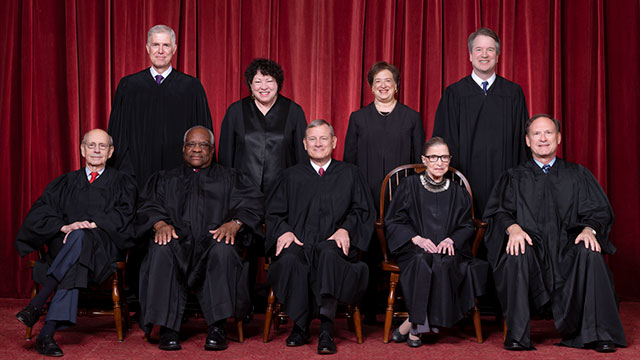
The current U.S. Supreme Court (image: public domain) In a major victory for LGBTQ rights, the U.S. Supreme Court issued a historic decision Monday morning ruling that current federal law prohibits discrimination against workers for being LGBTQ, finally putting into place long-sought federal protections for LGBTQ people in the workplace. The ruling, a 6-3 decision, finds that anti-LGBTQ discrimination is a form of sex discrimination, which is banned under Title VII of the Civil Rights Act of 1964, according to ScotusBlog. The ruling comes only three days after the Trump Administration chose to roll back healthcare protections for LGBTQ individuals during Pride Month and on the anniversary of the Pulse Nightclub massacre in Orlando, Florida where 49 individuals were murdered in a gay nightclub. Donald Trump’s administration had filed a brief with the Supreme Court urging the justices to rule that it’s legal to fire workers because of their sexual orientation. The court heard oral arguments for 3 consolidated cases last October. Two cases involved gay men who were fired from their jobs — Zarda v. Altitude Express and Bostock v. Clayton County – and a third involving a transgender woman who lost her job, R.G. & G.R. Harris Funeral Homes Inc. v. Equal Employment Opportunity Commission. U.S. Associate Justice Neil Gorsuch, one of the most conservative members of the high court, wrote for the majority, “An employer who fires an individual for being homosexual or transgender fires that person for traits or actions it would not have questioned in members of a different sex. Sex plays a necessary and undisguisable role in the decision, exactly what Title VII forbids.” From the ruling:
A statutory violation occurs if an employer intentionally relies in part on an individual employee’s sex when deciding to discharge the employee. Because discrimination on the basis of homosexuality or transgender status requires an employer to intentionally treat individual employees differently because of their sex, an employer who intentionally penalizes an employee for being homosexual or transgender also violates Title VII. There is no escaping the role intent plays: Just as sex is necessarily a but-for cause when an employer discriminates against homosexual or transgender employees, an employer who discriminates on these grounds inescapably intends to rely on sex in its decisionmaking.
The five other justices agreeing in concert with Gorsuch are U.S Chief Justice John Roberts, U.S. Associate Justice Ruth Bader Ginsburg, U.S. Associate Justice Elena Kagan, U.S. Associate Justice Sonia Sotomayor and U.S. Associate Justice Stephen Breyer. Traditionally conservative-leaning U.S. Associate Justices Samuel Alito, Clarence Thomas, and Brett Kavanaugh issued a dissenting decision.
.@DevinDwyer calls today’s Supreme Court ruling “the biggest opinion for gay rights in this country since 2015…and because of Neil Gorsuch, a conservative justice on this court—simply extraordinary.” https://t.co/XN6SrIZf2Bpic.twitter.com/HLrRqwF5Lu
This is the most extraordinary court victory for LGB Americans since the 2015 Obergefell ruling which made marriage equality the law of the land. And this is the biggest legal decision for transgender Americans in the history of the nation. LGBTQ advocacy groups chimed in on the good news. From GLAAD President & CEO Sarah Kate Ellis:
“The Supreme Court’s historic decision affirms what shouldn’t have even been a debate: LGBTQ Americans should be able to work without fear of losing jobs because of who they are. The decision gives us hope that as a country we can unite for the common good and continue the fight for LGBTQ acceptance,” said GLAAD President & CEO Sarah Kate Ellis. “Especially at a time when the Trump Administration is rolling back the rights of transgender people and anti-transgender violence continues to plague our nation, this decision is a step towards affirming the dignity of transgender people and all LGBTQ people.”
Amit Paley, CEO and Executive Director of The Trevor Project, the world’s largest suicide prevention and crisis intervention organization for LGBTQ young people:
“This landmark decision will save lives. At The Trevor Project, we hear from LGBTQ youth every day who suffer from discrimination and harassment, and our research demonstrates that those who experienced LGBTQ-based workplace discrimination were twice as likely to have attempted suicide in the past year compared to those who did not. By recognizing that LGBTQ workers cannot be discriminated against because of who they are, the Supreme Court has sent a resounding message to LGBTQ youth everywhere that they are free to pursue their talents and dreams.”
Executive Director of OutRight Action International, Jessica Stern, comments:
“The Supreme Court stating explicitly that under the Civil Rights Act discrimination based on sex includes discrimination based on sexual orientation and gender identity is a tremendous victory. The decision comes at a time when the Trump administration has been viciously attacking the rights of LGBTIQ people, in particular trans people. It will protect millions of Americans from discrimination in the workplace, and sends a powerful message – that political power-play can not erase basic human rights. This judgment will have implications for LGBTIQ people everywhere – governments and movements are inspired by each other, and landmark judgments are quoted by courts across the world. OutRight welcomes, and celebrates this ruling!”
Tarah Demant, Director of the Gender, Sexuality, and Identity Program at Amnesty International USA, released the following statement:
“The Supreme Court now has upheld the most basic value of equality, a human right that every one of us deserves. We celebrate the court decision that recognizes that non-discrimination in the workplace applies to everyone, no matter their sex, sexuality, or gender identity—and we celebrate with LGBTQI people who have long waited for equal recognition under the law.”
From the National Center for Lesbian Rights (NCLR) Executive Director Imani Rupert-Gordon:
“For the first time, this historic decision ensures that LGBTQ people have nationwide employment protection and represents a monumental step that will help to create a safer working environment for everyone. During a global health crisis and a growing nationwide movement to focus on supporting and protecting Black Lives – particularly Black transgender lives – against systematic racism and violence, this historic ruling is both uplifting and encouraging. However, we know that our work is far from complete, and the fight for full LGBTQ equality continues.”
From Shannon Minter, Legal Director of NCLR:
“This is a huge victory not just for LGBTQ people, but for our country, which benefits enormously when LGBTQ people are permitted to participate and contribute on equal terms. Today’s decision will be remembered as a watershed in the history of LGBTQ rights, even as our country continues to grapple with the brutal legacy of racism. The transgender movement owes a particular debt of gratitude to Aimee Stephens, who courageously fought this battle in the months of her life.”
Human Rights Campaign President Alphonso David:
“This is a landmark victory for LGBTQ equality. No one should be denied a job or fired simply because of who they are or whom they love. For the past two decades, federal courts have determined that discrimination on the basis of LGBTQ status is unlawful discrimination under federal law. Today’s historic ruling by the Supreme Court affirms that view, but there is still work left to be done. In many aspects of the public square, LGBTQ people still lack non-discrimination protections, which is why it is crucial that Congress pass the Equality Act to address the significant gaps in federal civil rights laws and improve protections for everyone.”
Rea Carey, Executive Director for National LGBTQ Task Force:
“At this most challenging time for our community, the country and the world, it is heartening to see the Court decision bolstering fairness and equality in this country by affirming that LGBTQ+ people are protected from employment discrimination under federal law. Every person celebrating this ruling has decades of work by Black and Brown trans members of our community, in particular, to thank for the ability to work free from discrimination. And while this is a watershed moment for fairness and equality our struggle for LGBTQ liberation, we still have work to do. We must close critical gaps in nondiscrimination protections. For example, it is still legal to discriminate against LGBTQ+ people in federally funded programs, including hospitals, colleges, and adoption agencies as well as discriminate against LGBTQ+, women and others in public accommodations including hotels and restaurants. It is critical that Congress join with the Supreme Court and the overwhelming majority of Americans to pass full federal non-discrimination protections for LGBTQ+ people.
(Photo: Fred Schilling, Collection of the Supreme Court of the United States/Public Domain) The U.S. Supreme Court heard oral arguments on Tuesday for three cases considering whether federal civil rights laws protect LGBTQ people in the workplace. Two of the cases (Zarda v. Altitude Express and Bostock v. Clayton County) involve the firing of gay men and question whether anti-gay discrimination is illegal under Title VII of the Civil Rights Act of 1964. The third case, EEOC v. Harris Funeral Homes, looks for resolution on whether anti-transgender discrimination is illegal under the law. The basic premise of the arguments hinges on whether discrimination based on “sex” – which Title VII prohibits – includes any discrimination involving sexual orientation. In other words, are employers allowed to discriminate against an employee based on the sex of the person they may date or marry? Conservative Justice Samuel Alito seemed to take the position that Congress in 1964 did not foresee covering sexual orientation or gender identity when passing Title VII. “You’re trying to change the meaning of ‘sex,’” said Alito according to the Associated Press. But Justice Elena Kagan suggested ‘sexual orientation’ is clearly a subset of sex discrimination in that a man who loves other men shouldn’t be treated differently by an employer than a woman who loves men. Here are the immediate reactions by some reporters who attended the oral arguments. Chris Johnson, of the Washington Blade, tweets that the ruling could come down, surprisingly, to Justice Neil Gorsuch who asked several questions “if sex is also in play” in cases regarding anti-LGBTQ discrimination. Johnson also notes that Chief Justice John Roberts, who has become something of the ‘moderate/swing vote’ on the court since the retirement of Anthony Kennedy, should not be counted on to rule in our favor.
Gorsuch, a textualist, asked many Qs about if “sex is also in play” in cases of anti-LGBT discrimination.
To be sure, Gorsuch also asked Qs about whether employers could keep sex-segregated bathrooms under LGBT-inclusive Title VII. — Chris Johnson (@chrisjohnson82) October 8, 2019
Gorsuch was the only justice U.S. Solicitor General Noel Francisco address during his time.
Perhaps Francisco sensed Gorsuch would come down on the side opposite of the anti-LGBT view of the Trump administration. — Chris Johnson (@chrisjohnson82) October 8, 2019
Justice Kavanaugh was very quiet during the Title VII arguments. It’s hard to tell what he’s thinking.
He asked only one technical legal question about the plain vs. ordinary meaning of the statute. — Chris Johnson (@chrisjohnson82) October 8, 2019
Justice Alito was obsessed with this hypothetical about an employer refusing to hire a job applicant after learning they’re gay, but not knowing their sex.
To him, that hypothetical shows anti-gay discrimination isn’t sex discrimination. — Chris Johnson (@chrisjohnson82) October 8, 2019
Legal blogger Amy Howe, formerly of SCOTUS Blog, also came away thinking Gorsuch may be the swing vote.
#SCOTUS finished with oral arguments on whether federal civil rights laws protect LGBT employees. Justices are closely divided; decision could hinge on Justice Neil Gorsuch, who acknowledged that question is “close” but also expressed concern about “massive social upheaval.”
Gorsuch claimed that interpreting Title VII to protect LGBTQ employees will cause “massive social upheaval.” He gestured toward open-mindedness on the textual argument but I think he will vote against LGBTQ rights.
Gorsuch seemed ambivalent, but said that “when a case is really close on the textualist evidence,” the court should refuse to work “a drastic change in this country.” I think he will cast an anti-LGBTQ vote and claim judicial modesty.
Kavanaugh asked one question: Whether the anti-LGBTQ side was “drawing a distinction between the literal and ordinary meaning” of discrimination “because of sex.” I’m not sure he has made up his mind. I suspect that when he does, he will side against LGBTQ rights.
Anyway I think the court will reject the argument for LGBTQ equality by a 5–4 vote, with the five conservatives claiming judicial modesty and saying Congress has to deal with this. But I wouldn’t say there’s NO cause for hope. It was not a wipeout for LGBTQ rights by any means.
A Virginia restaurant operator has agreed to pay $40,000 to resolve a lawsuit that claims its employees routinely harassed a gay server with homophobic epithets and taunted him about his sexuality.
A federal judge on Thursday signed off on the settlement between the U.S. Equal Employment Opportunity Commission and Mejia Corp., which does business as El Tio Tex-Mex Grill restaurant in Gainesville.
The commission’s September 2018 lawsuit claimed restaurant employees also harassed the gay server’s heterosexual friend, a busser, based on their friendship.
The settlement calls for the server and his friend to split the $40,000 payments from the company. The agreement also bars the restaurant from engaging in or condoning sex-based harassment of any employee.
The EEOC determined that the two men had legal standing to sue for discrimination under Title VII of the Civil Rights Act of 1964.
Recent court cases have found that discrimination based on sexual orientation is covered under the prohibition of “sex” discrimination under Title VII.
Republican governors and attorneys general from 16 states have asked the U.S. Supreme Court to rule that LGBT employees can be fired based merely on their sexual orientation and gender identity.
The states that signed onto the friend-of-the-court brief are Nebraska, Alabama, Arkansas, Kansas, Louisiana, Oklahoma, South Carolina, South Dakota, Tennessee, Texas, Utah, West Virginia, Wyoming, Maine, Mississippi, and Kentucky.
Currently, only 20 states plus Washington, D.C. have passed laws expressly banning LGBT discrimination in the workplace.
A study by the Human Rights Campaign in 2011 showed a whopping 87% of voters erroneously believe its illegal under federal law to fire someone just for being LGBT.
Its notable that Maine and Utah, two of the 20 states that have LGBT workplace protections in place, have signed on in support of the brief.
The request to the Supreme Court comes in response to a lawsuit brought by the Equal Employment Opportunity Commission on behalf of a transgender funeral home employee in Michigan, Aimee Stephens, who was fired in 2013 after sharing with her supervisor she was transitioning.
In 2017, the 6th Circuit Court of Appeals ruled that Harris Funeral Homes illegally discriminated against Stephens in firing her referencing Title VII of the 1964 Civil Rights Act which bans workplace discrimination based on sex.
At the time, Judge Karen Nelson Moore of the 6th Circuit wrote in the opinion that anti-trans discrimination is inherently sex based.
“[I]t is analytically impossible to fire an employee based on that employee’s status as a transgender person without being motivated, at least in part, by the employee’s sex,” she wrote. Businesses that discriminate against a worker on the basis of being “transgender or transitioning status,” is taking sex into account thus violating Title VII.
Led by Nebraska Attorney General David Bydalek, the 16 states are asking SCOTUS to overturn that appeals court decision saying Congress didn’t intend for the ban on sex discrimination in Title VII to cover bias against lesbian, gay, bisexual, or transgender employees.
“The States’ purpose is to note that ‘sex’ under the plain terms of Title VII does not mean anything other than biological status,” Bydalek wrote.
The Supreme Court will decide this fall whether to take up the case. (h/t Bloomberg Law)
In a huge win for the LGBTQ community, the 2nd Circuit Court of Appeals has ruled that Title VII of the Civil Rights Act of 1964 bans anti-gay discrimination.
The case examined whether Donald Zarda, a now-deceased skydiver who alleged he was fired from Altitude Express for being gay, could sue under existing civil rights law because sexual-orientation discrimination is a form of sex discrimination.
The Court of Appeals for the 2nd Circuit ruled Monday, “We now hold that sexual orientation discrimination constitutes a form of discrimination ‘because of . . . sex,’ in violation of Title VII.” In doing so, the court overruled a lower court — and a precedent from two previous court cases — and remanded the case to be litigated in light of their reading of Title VII.
The decision holds national implications due to its high tier in the judicial system, and because it’s seen as a litmus test of the Trump administration’s ability — or inability — to curb LGBT rights through court activism. The Justice Department had injected itself into the case even though it wasn’t a party to the lawsuit and doesn’t normally involve itself in private employment disputes.
“Sexual orientation is a function of sex and, by extension, sexual orientation discrimination is a subset of sex discrimination,” the majority wrote.
In reaching its decision Monday, the court pointed out that anti-gay discrimination would not exist “but for” a person’s sex. That is to say, gays, lesbians, and bisexuals would not experience this type of unequal treatment had been born a different gender, or were attracted to a different sex.
Robert A. Katzmann, the 2nd Circuit’s chief judge who authored the majority ruling, was joined by nine other judges while three judges dissented.
This ruling is also a blow to the Trump administration which was not a party to the case.
The Justice Department sent Deputy Assistant Attorney General Hashim Mooppan to take part in oral arguments in September arguing that despite Title VII employers should be able to fire workers for being gay.
Zarda had apparently told a female student as they prepared for a sky-diving jump that he was “100 percent gay” in an attempt to make the woman less anxious about the close physical contact involved in being strapped to her instructor.
The woman’s boyfriend complained to the school about the encounter, and that led to Zarda’s dismissal.
This ruling now allows Zarda’s estate to file a discrimination lawsuit against Altitude Express.
The case was heard by all 13 eligible judges of the 2nd Circuit, known as an en banc hearing, meaning the only option for left for the haters is to head to the U.S. Supreme Court.
Major American corporations have signed on to an amicus brief filed in the U.S. Supreme Court urging the high court to rule that Title VII of the Civil Rights Act of 1964 bars discrimination based on sexual orientation in the workplace.
The Trump administration has taken the opposite opinion.
The 76 businesses and organizations – including American Airlines, Apple, eBay, Facebook, Google, Starbucks and Microsoft – filed a brief Wednesday encouraging the high court to take up the issue. They want the court to take a case out of Georgia in which a gay woman who worked as a hospital security officer says she was harassed and punished for dressing in a male uniform and wearing her hair short. Jameka Evans, who worked at Georgia Regional Hospital at Savannah from 2012 to 2013, ultimately left her job and sued.
The question in her case is whether a federal law barring workplace discrimination “because of…sex” covers discrimination against someone because of their sexual orientation. The Equal Employment Opportunity Commission under President Barack Obama took the view that it does. But President Donald Trump’s administration has argued that Title VII of the Civil Rights Act of 1964 bars discrimination based on gender but doesn’t cover sexual orientation.
The businesses’ court filing says they and their employees would benefit if the court agreed to take the case and rule that Title VII covers sexual orientation discrimination.
The Associated Press is reporting that the 7th Circuit Court of Appeals has ruled that Title VII of the Civil Rights Act of 1964 protects LGBTs from workplace discrimination.
Normally, a case would be heard by three judges on the court, but this was heard by the full 7th Circuit Court of Appeals. The judges ruled 8-3 that Title VII protects LGBTs in the workplace.
This is WAY huge.
The decision by the 7th U.S. Circuit Court of Appeals comes after it threw out a July finding by three of its own judges that the law doesn’t cover sexual-orientation bias and ordered a rare rehearing by the full court, a rare session known as an en banc hearing.
It also comes as President Donald Trump’s administration has begun setting its own policies on LGBT rights. Late in January, the White House declared Trump would enforce an Obama administration order barring companies that do federal work from workplace discrimination on the basis of sexual identity. But in February, it revoked guidance on transgender students’ use of public school bathrooms, deferring to states.
The Hively case stems from a lawsuit by Indiana teacher Kimberly Hively alleging that the Ivy Tech Community College in South Bend didn’t hire her full time because she is a lesbian. The entire court reheard oral arguments in November and directed the toughest questions at a lawyer for the college who argued only Congress could extend the protections. The aggressive questions suggested the court might be willing to expand the 53-year-old landmark law.
Judge Diane Wood called it a “common-sense reality that it is actually impossible to discriminate on the basis of sexual orientation without discriminating on the basis of sex.”
The 7th Circuit covers federal lawsuits out of Indiana, Illinois, and Wisconsin.
BREAKING: Federal court rules employers can’t fire people for being gay! This is a HUGE victory! #LGBTQhttps://t.co/2WKlwza48a