AstraZeneca plans to make as many as 30 million doses of coronavirus vaccine available to the U.K. by September and has committed to delivering 100 million doses this year. The U.K. would be the first country in the world to get access to the AstraZeneca vaccine. From Bloomberg News:
The vaccine being developed at the University of Oxford will get 65.5 million pounds ($79 million) of funding, U.K. Business Secretary Alok Sharma said today in a statement.
The inoculation is already being studied in humans and could reach late-stage trials by the middle of the year. Another 18.5 million pounds will go to Imperial College London as trials accelerate.
Drugmakers are scaling up to make a Covid vaccine before the shots are fully tested, so inoculations will be ready as soon as possible. No vaccine exists yet for Covid-19, which has killed more than 312,000 people globally and infected 4.7 million.
The U.K. has the second-deadliest outbreak after the U.S.
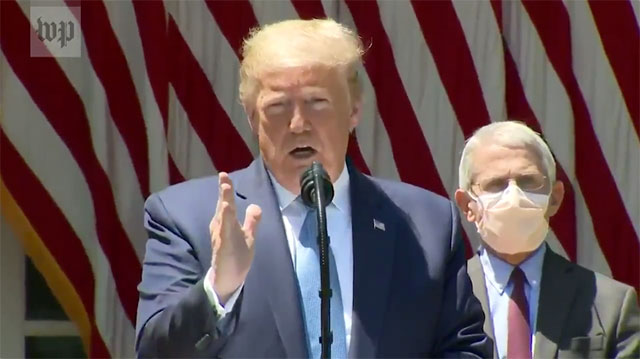
Donald Trump speaks to reporters at the White House (screen capture) As the U.S. COVID-19 death toll passes 85,000, one of the world’s oldest and best-known medical journals published an op-ed calling out the Trump administration’s ” inconsistent and incoherent national response to the COVID-19 crisis.” The new editorial by The Lancet notes that, following two months of stay-at-home restrictions, infection and death rates have declined in those states hardest hit like New Jersey and New York. But recent outbreaks in Iowa and Minnesota raise disconcerting questions regarding the effectiveness of the federal response. The op-ed accuses the administration of, among other things, minimizing top officials at the CDC, as well as creating an “intelligence vacuum” in China when it pulled the last CDC officer from the country in July 2019. “The Administration is obsessed with magic bullets — vaccines, new medicines, or a hope that the virus will simply disappear,” it continued. “But only a steadfast reliance on basic public health principles, like test, trace, and isolate, will see the emergency brought to an end, and this requires an effective national public health agency.” The editorial closes with a call for new leadership in the White House writing, “Americans must put a president in the White House come January 2021, who will understand that public health should not be guided by partisan politics.” Meanwhile, during a press event today, Trump told reporters the country will overcome the COVID-19 crisis with or without an effective vaccine, claiming that the disease will “go away at some point” either way.
Trump offers some remarkably callous comments about the US coronavirus death toll, which currently sits at 86,607: "It's a very, very small percentage. I say it all the time — it's a tiny percentage. The vast majority — many people don't even know they have it." pic.twitter.com/b7fSqGNJMs
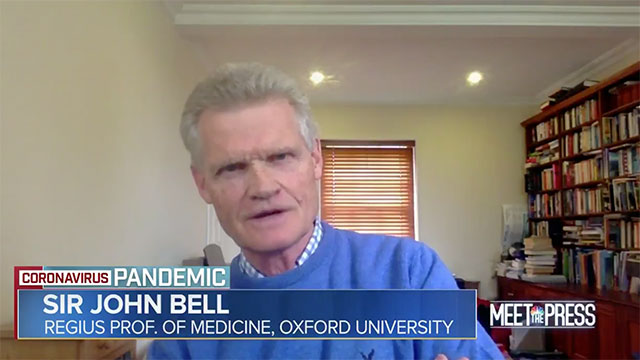
A scientist at Oxford University told “Meet The Press” host Chuck Todd this morning his team hopes to see a “signal” by June was to whether a potential coronavirus vaccine being developed there might work. “We are gradually reeling it in, bit by bit and as everyday goes by, the likelihood of success goes up,” said Sir Bell. From NBC News:
Sir John Bell, the Regius Professor of Medicine at Oxford University, where one of the leading efforts to develop a vaccine is underway, said that the prospects for its candidate are “pretty good” and that “as every day goes by, the likelihood of success goes up.”
The researchers hope to have enough data from their phase-two trials that “we would get evidence that the vaccine has efficacy by the beginning of June.”
The group at Oxford is one of the many racing toward finding an effective and safe vaccine for the coronavirus alongside efforts to contain the spread of the pandemic.
EXCLUSIVE: Professor Sir John Bell of Oxford University says “the prospects are pretty good” for the development of a COVID-19 vaccine. #MTP#IfItsSunday
Sir Bell: “We are gradually reeling it in, bit by bit and as everyday goes by, the likelihood of success goes up.” pic.twitter.com/SSmKN9XVgT
Gus Kenworthy and Birdie (via Instagram) Some news items you might have missed: • New York Times: National Institutes of Health scientists in Montana last month inoculated six rhesus macaque monkeys (considered the closest equivalent to humans) with single doses of a vaccine developed by the Oxford University’s Jenner Institute. The animals were then exposed to heavy quantities of the virus that is causing the pandemic — exposure that had consistently sickened other monkeys in the lab. But more than 28 days later all six were healthy. • InstaHunks: I spent about a year studying the guitar when I was younger, and I was terrible. Woofy Gus Kenworthy (top) has really learned a lot in just two months. Color me impresssed. But it looks like his best fur pal Birdie isn’t feeling it. Watch below.
• Reuters: A study of more than 1400 LGBT+ women – one of the largest of its kind – found 37% of lesbian mothers in the UK suffered discrimination from other parents, while the same number’s children were victimized. • Bloomberg News: Donald Trump indicated today he’s considering withholding COVID-19 financial assistance from blue states unless they agree to do away with sanctuary cities. Note: states like California and New York, which have sanctuary cities, already send much more to the federal government than they receive.
Trump suggests any relief for states hit hard by COVID will require ending “sanctuary city” policies and turning residents over to ICE. pic.twitter.com/BSxqfPu0id
• Atlanta Journal-Constitution: Two people in Georgia drank liquid cleaning products over the weekend in misguided attempts to ward off COVID-19, according to the Georgia Poison Center. Both men had histories of psychiatric problems and are expected to recover. •The Gaily Grind: ABC News correspondent Will Reeve, the son of the late “Superman” actor Christopher Reeve, accidentally revealed to the nation that he wasn’t wearing any pants while doing a live report on “Good Morning America” from his home. The 27-year-old’s camera was angled down and revealed that the correspondent was not wearing any pants as he sat on a stool immediately generating reactions on social media after the moment on “Good Morning America” went viral.
Pharmaceutical company Johnson & Johnson will soon begin testing an experimental HIV vaccine in the U.S. and Europe sometime this year, according to Bloomberg News.
The experimental vaccine, described as a “mosaic-based preventative immunization,” is made up of four components that target several strains the HIV virus.
The vaccine utilizes an altered cold virus to create a group of “mosaic” proteins that will elicit immune responses to a variety of strains.
Approximately 3,800 men who have sex with men are expected to take part in the trial expected to begin later this year. The participants will receive a series of six shots in four sessions.
Dan Barouch, a Harvard Medical School professor who has worked on the vaccine for years, told Bloomberg the J&J vaccine has provided protection in up to two-thirds of tested animals.
Results from the human trials are expected as soon as 2023.
Additionally, another version of the mosaic vaccine is currently being tested across five countries in southern Africa. Some 2,600 women are enrolled in that study called “Imbokodo.”
According to J&J, “Imbokodo” is the Zulu word for ‘rock’ which is part of a well-known proverb in South Africa that refers to the strength of women and their importance in the community.
Exciting news today from Science Daily – a new anti-HIV drug candidate appears so potent it could work as an unconventional vaccine against the disease:
The study shows that the new drug candidate blocks every strain of HIV-1, HIV-2 and SIV (simian immunodeficiency virus) that has been isolated from humans or rhesus macaques, including the hardest-to-stop variants. It also protects against much-higher doses of virus than occur in most human transmission and does so for at least eight months after injection.
“Our compound is the broadest and most potent entry inhibitor described so far,” said Michael Farzan, a TSRI professor who led the effort. “Unlike antibodies, which fail to neutralize a large fraction of HIV-1 strains, our protein has been effective against all strains tested, raising the possibility it could offer an effective HIV vaccine alternative.”
 AstraZeneca plans to make as many as 30 million doses of coronavirus vaccine available to the U.K. by September and has committed to delivering 100 million doses this year. The U.K. would be the first country in the world to get access to the AstraZeneca vaccine. From Bloomberg News: