Colorado: Same-sex marriage support continues to rise

A new poll by Quinnipiac shows support for marriage equality is still on the rise in Colorado.

From Politico:

On the issue of same-sex marriage, 61 percent of voters support allowing same-sex couples to marry in the state and 33 percent are opposed.

Democrats support same-sex marriage in the state 85 to 12 percent, while Republicans are opposed 58 to 34 percent.

The Quinnipiac poll was conducted April 15 to 21 and surveyed 1,298 registered Colorado voters. It has a margin of error of plus or minus 2.7 percentage points.

The bolding above is mine.

It’s important to note that the survey size – 1,298 – is substantial for a statewide poll. These numbers exceed the national average which puts current support at 55-58% depending on the poll.

Currently, there are two lawsuits in Colorado pushing for marriage equality.

United Church of Christ challenges North Carolina’s ban on marriage equality for denying religious freedoms

Here’s a great approach to the marriage equality fight.

The United Church of Christ, twelve clergy members and several gay couples are challenging North Carolina’s ban on same-sex marriage on the grounds that it violates their religious freedoms:

From the Washington Blade:

The lawsuit — which was filed in U.S. District Court for the Western District of North Carolina — argues the marriage amendment violates the religious beliefs of denominations and congregants who support the recognition of gay nuptials and clergy who want to perform them. Rev. Geoffrey A. Black, president of the United Church of Christ, and Rev. Nancy Kraft of Holy Trinity Lutheran Church in Charlotte are among the plaintiffs who attended a Charlotte press conference.

“As a senior minister, I am often asked to perform marriage ceremonies for same-sex couples in my congregation,” said Rev. Joe Hoffman (pictured) of First Congregational United Church of Christ in Asheville, who is a plaintiff along with Diane Ansley and Cathy McGaughey, two of his congregants who have been together for 14 years. “My denomination — the United Church of Christ — authorizes me to perform these ceremonies, but Amendment One denies my religious freedom by prohibiting me from exercising this right.”

Bolding is mine.

Get ready for the haters’ head to explode in 3, 2, 1…

South Dakota will soon see legal challenge filed against same-sex marriage ban

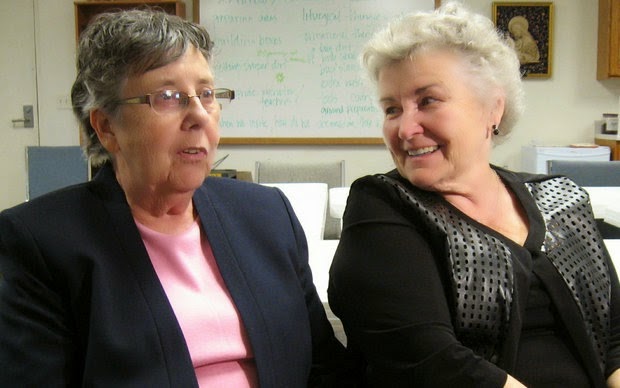
This weekend, Minneapolis Mayor Betsy Hodges will marry a lesbian couple from South Dakota, setting the stage for a soon-to-be-filed lawsuit aimed at overturning South Dakota’s same-sex marriage ban.

From TwinCities.com:

The couple, Nancy Robrahn, 68, and Jennie Rosenkranz, 72, say that along with two other gay South Dakota couples, they plan on filing a federal class-action lawsuit against state officials.

Robrahn and Rosenkranz will argue that South Dakota should recognize same-sex marriages when performed outside of the state. In addition, the suit will seek to overturn South Dakota’s statewide same-sex marriage ban enacted by a constitutional amendment in 2006.

A spokesman for Hodges said she does not know Robrahn and Rosenkranz personally, but responded positively after those working with them reached out to her office.

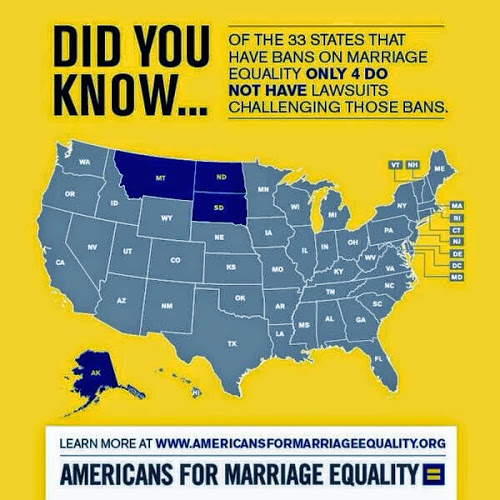
Once the lawsuit is filed,  only North Dakota, Alaska and Montana will remain as states banning same-sex marriage without legal challenges.

Robrahn and Rosenkranz have been together for 27 years. In March they were denied a marriage license by the clerk’s office in South Dakota’s Pennington County.

Oregon’s marriage equality ban has it’s day in court

Yesterday,  standing before Judge Michael McShane, four couples who have filed a challenge to Oregon’s same-sex marriage ban asked the court to strike down the discriminatory law.  The state of Oregon, having found the law unconstitutional, agreed with the plaintiffs and asked for the same resolution.

From ABC News:

No comments were made in favor of the ban, so lawyers on both sides of the case were in the rare position of asking for the same ruling from the judge. Oregon’s attorney general, Democrat Ellen Rosenblum, has said the ban is legally indefensible and has refused to offer arguments in favor of keeping it.

Judge Michael McShane did not say which way he was leaning. His questioning focused heavily on how he should apply precedents from higher courts and whether he should delay implementation of his ruling until appeals courts sort out gay marriage cases pending around the country.

The judge is deciding two parallel cases. The couples who filed suit are asking him to declare the ban unconstitutional and allow same-sex couples to wed. They also want an order that same-sex marriages performed in other states must be recognized in Oregon.

McShane has agreed to hear a petition from the Washington DC based National Organization for Marriage, who request standing to defend the anti-gay law. The hearing will be on May 14th. McShane has said he will not rule until that hearing. Should he grant standing to NOM, there will be a second hearing for oral arguments.
Where do all the marriage equality lawsuits stand?

Click to enlarge

With 65 marriage equality lawsuits in progress in 31 states and US territories, it’s hard to know who is doing what when. Freedom To Marry shares the handy dandy graphic above to help remember what all is going on.

Freedom To Marry‘s Evan Wolfson recently spoke about the marriage equality cases currently before the various circuit courts of appeal:

Presumably, we will soon – meaning, in a matter of months – have rulings from one or more of the federal appellate courts.

Then there’s the possibility of further procedures as to whether the three-judge panels in those courts that will rule will then go to the broader, full panel of the entire circuit courts [a process called en banc review]. That could consume a few more months.

When that gets resolved (either by bypassing that step or by having another set of arguments and further round of decisions), then whoever loses that ultimate appeals court ruling may ask the Supreme Court to hear the case. That’s called “seeking cert.” That stage then requires another few months of briefing and argument, with one side saying the Supreme Court should hear the case and the other side saying the Court should not hear the case.

Then, it’s up to the Supreme Court to decide whether it’s going to take one of the cases or not.

It takes only four of the nine justices to vote to hear a case.

For a full list of marriage litigation, head over to Freedom To Marry’s comprehensive list.

Colorado: Service members speak out in support of marriage equality

In its ongoing work to demonstrate that the broad majority of Coloradans support the freedom to marry, Why Marriage Matters Colorado, a coalition of state and national organizations, released a 30-second television spot featuring a group of local veterans standing up for their gay comrade in arms.

The ad, airing statewide, features three military veterans who, together with their friend, U.S. Air Force Master Sergeant T. Ashley Metcalf – who is still actively serving his country – represent 45 years of military service. Sgt. Metcalf is gay, and his band of brothers – former Army Staff Sgt. Izzy Abbass, retired U.S. Air Force Senior Master Sgt. Dennis Mont’Ros, and former Marine Sgt. Will Glenn – talk about the importance of the freedom to marry for everyone.

(Via Why Marriage Matters Colorado)

Challenge to Oregon’s gay marriage ban in court this week

A federal judge will hear two cases Wednesday that aim to strike down Oregon’s anti-marriage equality law, but no party has stepped in to defend the voter-approved constitutional amendment.

From The Republic:

Oregon’s attorney general, Democrat Ellen Rosenblum, says the state’s ban is legally indefensible. Her office filed a lengthy brief urging judge U.S. District Judge Michael McShane to throw it out. There have been no legal arguments submitted for upholding the ban.

Federal judges in five states have thrown out voter-approved bans on same-sex marriage on constitutional grounds since the U.S. Supreme Court struck down a portion of the federal Defense of Marriage Act last year, and many other challenges are pending.

For Oregon’s ban, oral arguments are scheduled for Wednesday at U.S. District Court in Eugene.

“The ban on same-sex marriage serves no rational purpose and harms Oregon citizens,” lawyers for the state wrote. “This case presents that rare case in which there simply is no legal argument to be made in support of a state law.”

The U.S. Constitution’s equal protection clause prohibits the government from treating a group of people differently from others unless there’s sufficient justification that furthers a legitimate public interest.

In this case, much of the legal analysis surrounds how high the bar should be for the government to prove it has an interest in treating gays and lesbians differently with respect to marriage.