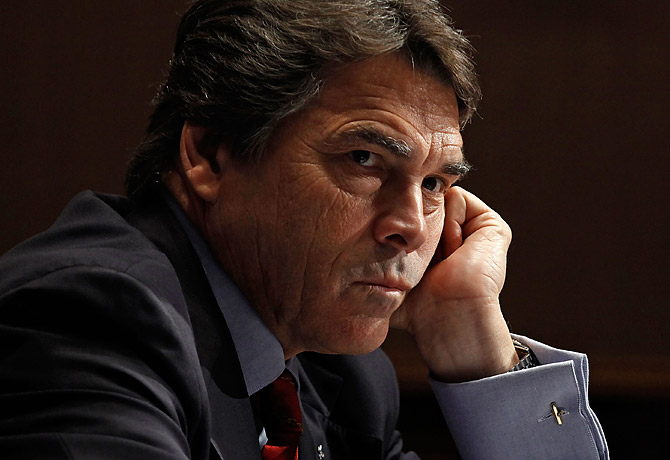
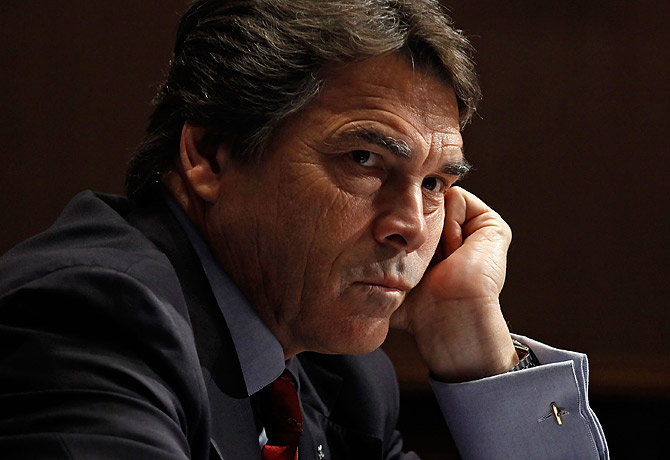
Gov. Rick Perry on why teach abstinence

Watch live video from texastribune on Justin.tv

If nothing else, watch the first minute as twice the Governor is asked why spend state dollars teaching abstinence when Texas has the 3rd highest teen pregnancy rank in the country. Over and over the governor just answers “because abstinence works.”

This will make for a fascinating election cycle between Rick Perry and Michele Bachmann simply never answering questions directly.

TX Gov. Rick Perry’s record will need some explaining

Pundits from the left and right agree on CNN that Gov. Rick Perry’s record in Texas will need some explaining.

While touting job creation accomplishments, Rick Perry hasn’t pointed to the fact that over a third of jobs created in Texas recently pay minimum wage or lower, which results in almost poverty level income.

Texas is the biggest polluter in the country, leading the nation in carbon dioxide emissions.

Rick Perry also proposed letting states opt out of Social Security and Medicare, programs very popular with a large part of the nation.

Perry is a strong proponent of Texas’s anti-sodomy law that was struck down in 2003 by the Supreme Court in Lawrence v. Texas. Calling the law “appropriate,” Perry dismissed the Court decision. Even after being struck down, Perry supports the Texas legislature’s refusal to remove the law from its books.

Last year, Perry claimed that “Texas has the best health care in the country.” In reality, Texas has the highest rate of uninsured residents of any state.

It will be interesting to hear Gov. Perry extoll those virtues as he campaigns for the GOP nomination.

Gov. Rick Perry’s ‘charitable’ contributions

Benevolent charity has long been a cornerstone of conservative social policy, whether in the form of a religious group organizing large-scale relief programs or a quiet donor giving a helping hand to an individual man or woman. But how well conservative politicians might practice what they preach varies dramatically.

Remember, many conservatives issues with public programs that help those in need come from the position that they prefer to do their own “charitable giving.”

Rick Perry has had steady work as a politician since the mid-1980s, and his income increased dramatically when he became governor of Texas in 2000. Between 2000 and 2009, he has earned $2.68 million, according to the Houston Chronicle.

Yet Perry’s money hasn’t answered many prayers. A review of his tax records from the mid-1990s through 2009 show the governor has contributed very little to charity. When he has, Perry has given mainly to charities connected to his family, and even then, his donations have sometimes been slight.

An analysis by the San Antonio Express-News in mid-June reported that of his $2.68 million, Perry “gave half a percent to churches and religious organizations, or $14,243.”

The Express-News goes on to note: “By comparison, Americans averaged gifts of nearly 1.2 percent of their incomes to churches and religious groups from 2004 to 2008, according to Empty Tomb Inc., an Illinois-based research firm specializing in U.S.-church giving trends.”

In 1996, Tax records show the Perrys reported $182,318 in adjusted gross income with just $626 in gifts. Of that, $400 was non-cash donations to Goodwill.

In 1998, according to tax records, the Perrys donated to their children’s school, O’Henry Middle School. Their handout totaled $10. The Perrys later gave larger donations to Austin High School, when their two children attended in 2002 and 2003: They gave $50 each year to the school.

In 2007, tax records report the couple donating a total of $90 to their church at the time, Tarrytown United Methodist. That year, they gave a total of $413 in cash contributions to charity. Their adjusted gross income was more than $1 million.

Read more at the HuffingtonPost

TX Gov. Rick Perry’s college transcript – a lot of “C”s and “D”s

From Huffington Post: As governor of Texas, Rick Perry has pursued an agenda that would gut Texas’ public university system in favor of something that more closely resembles a business.

As the Washington Post reported on Thursday, professors have been ranked according to how profitable they were to the university. Previous reports suggested Perry wanted to treat students as “customers” and tie teacher bonuses to anonymous student evaluations.

One reason that might explain his hostility toward the system: He didn’t do very well in it.

A source in Texas passed on Perry’s transcripts from his years at Texas A&M University. The future politician did not distinguish himself much in the classroom. While he later became a student leader, he had to get out of academic probation to do so. He rarely earned anything above a C in his courses — earning a C in U.S. History, a D in Shakespeare, and a D in the principles of economics. Perry got a C in gym.

Perry also did poorly on classes within his animal science major. In fall semester 1970, he received a D in veterinary anatomy, a F in a second course on organic chemistry and a C in animal breeding. He did get an A in world military systems and “Improv. of Learning” — his only two As while at A&M.

“A&M wasn’t exactly Harvard on the Brazos River,” recalled a Perry classmate in an interview with The Huffington Post. “This was not the brightest guy around. We always kind of laughed. He was always kind of a joke.”

I know during President George W. Bush’s time in office, a lot of people who supported him said that college grades weren’t a big deal to them.  I’m assuming the same folks will have the same opinion this time around.

Gov. Perry’s “Texas Miracle” or mirage?

With Texas’ minimal regulation and low taxes — and Gov.Perry’s cheerleading — a spike in job growth during the past few years became known as the Texas Miracle.

The rise in oil and gas prices, as well as a long-time state law protecting homeowners, helped stave off the recession for a while. And as a result, the miracle myth was created, with little exploration as to what impact Perry’s policies actually had on the economic picture.

The low-tax structure means the state is chronically short of money and, this year, saddled with a huge budget shortfall. Social services and public schools are woefully underfunded. High school graduation rate is low, dropout rate high. One in four Texans lacks health insurance, by far the highest percentage in the nation.

Much of Texas’s recent growth is the result of adding low-wage jobs. Of the 211,000 jobs added last year, 37 percent (or more than 76,000) paid at or below minimum wage, according to the Bureau of Labor Statistics. Texas now leads the nation in minimum-wage workers (550,000 in all). Despite the good economy, Texas remains a state of extreme wealth and desperate poverty.

“The important thing to do is not to just count jobs but to look at what kinds of jobs are being created in Texas,” explained Dick Lavine, a Senior Fiscal Analyst with the Center for Public Policy Priorities. “Texas is tied for last with Mississippi for the highest percentage of minimum wage jobs and Texas is by far the leader of residents who don’t have health insurance. It’s low wage jobs without any benefits.”

I’m aware sometimes a job is a job. But to hear Gov. Perry tell the tale, everyone should come to Texas to find employment and see how it’s done.

For over a third of you that might make the move to Texas, here’s what you can expect: a full time minimum wage worker in Texas working 40 hours a week, 52 weeks a year, will earn $58.00 per day, $290.00 per week, and $15,080.00 per year. The national poverty line for a family unit consisting of two people is $14,570 per year.

Welcome to the land of milk and honey. Or smoke and mirrors.

Gov. Rick Perry flip flops on gay marriage

Texas Governor Rick Perry, one of the country’s most prominent defenders of the 10th Amendment, is making an exception when it comes to gay marriage.

After initially telling reporters that it’s “fine with me” if states like New York legalize same-sex unions through their own legislature, Perry is pulling a 180 and calling for a Federal Marriage Amendment.

Perry, who is flirting with a presidential bid, clarified his position to Family Research Council president Tony Perkins in an interview.

“I probably needed to add a few words after that ‘it’s fine with me’ and that it’s fine with me that a state is using their sovereign rights to decide an issue,” he said. “Obviously gay marriage is not fine with me. My stance hasn’t changed.”

Perry said he supported changing the Constitution in order to ban gay marriage, a position that he characterized as supportive of states’ rights even as it would overrule New York’s own decision on the matter.

His latest statement represents a major about-face and may be a preview of how he might court social conservatives should he run for president. At a fundraiser in Colorado last week, Perry was extremely clear in his support for New York’s right to determine their own definition of marriage.

“Our friends in New York six weeks ago passed a statute that said marriage can be between two people of the same sex. And you know what? That’s New York, and that’s their business, and that’s fine with me,” he said at the time. “That is their call. If you believe in the 10th Amendment, stay out of their business.”

I’m a little confused by Perry here. If you believe states have the right to decide marriage laws, then why pass a Federal Marriage Amendment?

(via TalkingPointsMemo)

Rick Perry – Potential GOP Presidential run?

Currently flirting with the idea of jumping into the GOP Presidential race, Rick Perry, the longtime Texas governor would be among the GOP field’s most conservative candidates.

I’m of the opinion that Perry, who combines TV anchorman looks, a Southern preacher’s oratory and a cowboy’s swagger, could be a very real contender for not only the GOP nomination, but given the current economic outlook, a problem for President Obama’s reelection plans.

In nearly three decades as a politician, the Texas governor has never lost an election.

“Texans, God love them, have that bigger-than-life persona about politics and that doesn’t necessarily play everywhere,” said Christopher Nicholas, a Republican political consultant who has worked extensively in the Northeast and Midwest. “I haven’t heard a lot of Republicans call Social Security a disease.”

Perry has. He branded Social Security and other New Deal programs “the second big step in the march of socialism,” according to a book published last year. The “first step” was a national income tax, which he has said stands alongside the direct election of U.S. senators as a major mistake among the amendments to the U.S. Constitution.

Perry rejects the idea of global warming and the theory of evolution, arguing for natural climate variations and intelligent design of the universe.

Working with the fundamentalist American Family Association, Perry urged people to participate in a day of prayer and fasting on Aug. 6, following the example of the Bible’s book of Joel. Courting evangelical Christians always has been one of his core campaign strategies.

In the few polls that have included Perry, he ranks high among Republican primary voters in Iowa and New Hampshire.

Should he run, Perry would seek the support of a wing of the party already courted by conservatives in important states such as Iowa. Those would-be rivals include U.S. Rep. Michele Bachmann of Minnesota, a tea party favorite; former U.S. Sen. Rick Santorum of Pennsylvania, a favorite of anti-abortion activists; and former businessman Herman Cain.

In 2009, at one of the first rallies of a movement that would evolve into the tea party, he famously suggested the idea that Texas might be better off seceding from the Union if what he called “federal overreach” continued.

He’s since said that lawmakers in state capitals should decide whether to legalize gay marriage or marijuana. In 2010, he toyed with the idea of pulling Texas out of Medicaid, the state-federal program that provides health care for low-income people. He gave up on the idea when the state’s comptroller said it would bankrupt the state.

I’m not sure exactly how Americans would react to another cocky Texas governor so soon after the debacle of the George W. Bush years. However, I do believe Americans vote their pocketbooks. And should the economy not begin to turn around and/or show clear signs of improvement, Governor Goodhair could have a serious shot.

Read more on Perry’s background at the Huffington Post

Gov. Goodhair feels “called” to run for Prez

Texas Gov. Rick Perry says that he increasingly feels “called” to run for president next year.

“I’m not ready to tell you that I’m ready to announce that I’m in,” Mr. Perry told the Des Moines Register, the biggest newspaper in Iowa, which holds the nation’s first presidential nominating contest. “But I’m getting more and more comfortable every day that this is what I’ve been called to do. This is what America needs.”

The governor’s remarks are his clearest signal yet that he will join the GOP nomination fray.

Mr. Perry, who said he would announce a decision in two to three weeks, is becoming the favorite of the Christian right, an important voter bloc for the Iowa caucuses. As The Wall Street Journal reported this weekend, Christian conservatives say Mr. Perry would be the most electable nominee who supports their values. Next month, the governor is holding a day of prayer and fasting at Houston’s Reliant Stadium. Back in April, he declared three days of prayer to end the Lone Star State’s drought.

More at WallStreetJournal.com

Texas’ debt growing faster than the nation’s

Texas Gov. Rick Perry

From ThinkProgress: For all his talk of fiscal conservationism on the national stage, Texas Gov. Rick Perry hasn’t been so parsimonious at home, where his state is racking up debt at a faster rate than the national government and in greater amounts than most other states.

Perry regularly attacks President Obama for engaging in “too much spending” and running up too much debt, but as the Fort Worth Star-Telegram’s Mitchell Schnurman writes, Texas’ refusal to raise taxes has led to its own debt ballooning faster than Washington’s:

From 2001 to 2010, state debt alone grew from $13.4 billion to $37.8 billion, according to the Texas Bond Review Board. That’s an increase of 281 percent. Over the same time, the national debt rose almost 234 percent.

Still, the trend is undeniable. While Texas lawmakers have refused to raise taxes — and often criticize Washington for borrowing and spending — the state has been paying for much of its expansion with borrowed money.

While the state has had to borrow for infrastructure building to keep up with rapid population growth, as Schnurman points out, Texas didn’t have two wars, the budget-busting Bush tax cuts, recession-combating measurs, and other big-ticket national expenditures. And Texas’ “borrowing isn’t slowing.”

The state’s debt belies Perry’s boisterous rhetoric on his economic stewardship. While conservatives boast of Perry’s “Texas miracle,” California, which Perry often bashes as the antithesis of his approach, has seen faster GDP per capita growth than Texas under Perry.

Meanwhile, Texas’ obstinate refusal to raise taxes helped create the largest budget shortfall in the state’s history, leading to devastating cuts to government services — one town had to lay off its entire police force — and Perry using budget gimmicks and federal stimulus dollars to balance his budget.