Mexico: First Same-Sex Wedding In Baja California

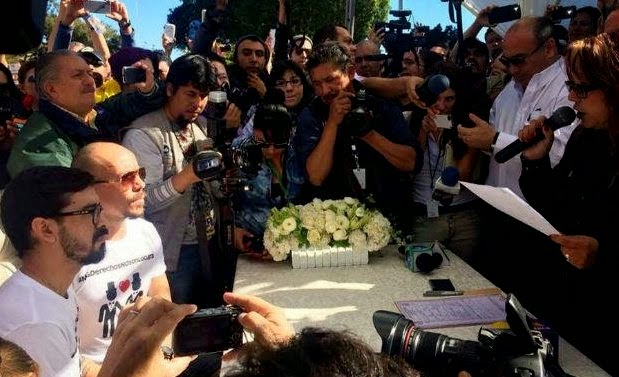
With cheers of “yes we could, yes we could” filling the air, Mexicali residents Victor Fernando Urias Amparo, 37, and Victor Manuel Aguirre Espinoza, 43, were finally able to exchange their wedding vows before an enthusiastic crowd of media and supporters outside Mexicali City Hall.

Three times before the couple had tried to marry at city hall after a court order from Mexico’s Supreme Court cleared the way last June. But time after time, bureaucratic blockades were placed in their way. The last attempt was halted after a volunteer leveled the accusation that the men “suffer from madness.”

The result was a social media campaign with the hashtag #MisDerechosNoSonLocura, or “my rights are not madness.”

However, it seem the fourth time is the charm sometimes.

On Saturday, the crowd of protesters began to gather about 9:30 a.m. at the government complex, and many in the crowd of about 500 snapped up T-shirts being sold for 50 pesos each that included the Twitter hashtag and a picture of two grooms.

The crowd marched around the plaza with a giant rainbow flag and listened to speeches.

At one point, the couple, their lawyer and a swarm of media went into City Hall. The couple and their lawyer met behind closed doors in the civil registry office, then went upstairs into the mayor’s office.

They emerged with smiles about 30 minutes later and announced the marriage was on.

The ceremony was performed under a canopy in front of City Hall, with the grooms seated on one side of a table and a gaggle of cameras surrounding them.

Their vows complete, the husbands exchanged kisses, and a bottle of Champagne was popped to cheers and applause.

Video via Rex Wockner:

Marriage equality comes to Mexican state of Cahuila

By a vote of 19-1, the state legislature of Mexico’s 15th most populous state – Coahuila, Mexico – has legalized same-sex marriage. The new law goes into effect in one week.

According to reports, the law says, “Marriage is the free union with full consent of two people, which has as its objective to realize community life where both [people] seek respect, equality and mutual aid, and make in a free, responsible, voluntary and informed way reproductive decisions that fit their life project, including the possibility of procreation or adoption.”

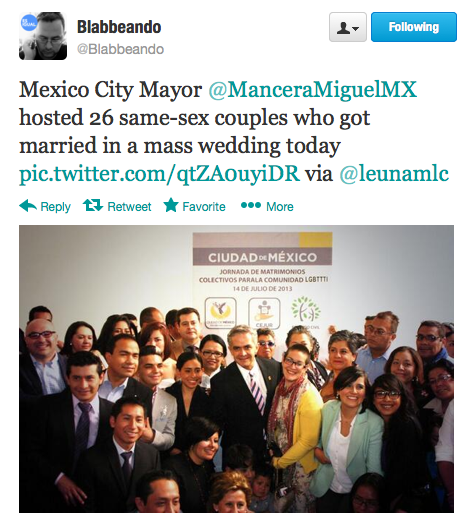
Of the 31 Mexican states, marriage equality is also celebrated in the state of Quintana Roo and the Federal District (Mexico City).

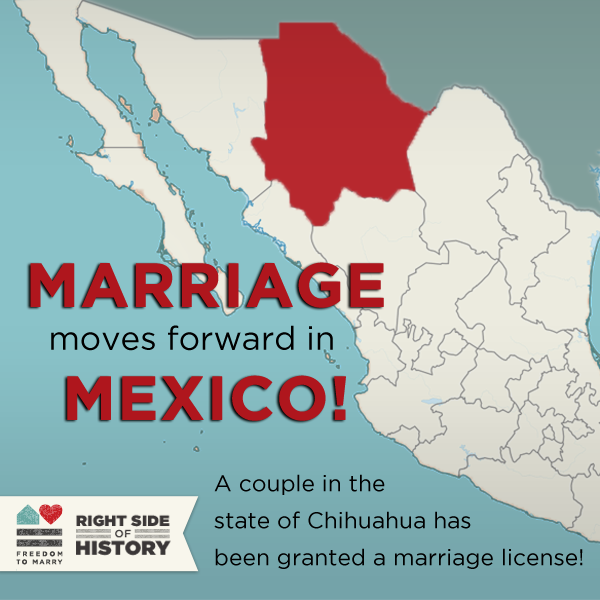
Mexico: Gay Couple Wins Right to Marry in Chihuahua

Congratulations to the happy couple – marriage equality is happening in Mexico!

A gay couple in Chihuahua, Mexico, who first filed for a marriage license in April can legally wed after the state declined to file a challenge to the petition, a local judge ruled Monday, according to Spanish-language news site El Pueblo.

Tony and Tomás tried to marry April 30 but were denied a license by the Civil Registry of the State of Chihuahua. On August 22, a district judge ruled that the state must provide marriage licenses to same-sex couples, and gave government officials ten days to file a formal objection to the order. The government made no such move, so Tuesday, the state legal adviser confirmed to press outlets that the couple can be married.

(source)

Mexican Supreme Court: Anti-gay expressions not protected by free speech

The First Chamber of the Mexican Supreme Court of Justice has ruled that anti-gay epithets are not protected speech under the Freedom of Expression.

From Blabbeando:

In this sense, the First Chamber determined that homophobic expressions or – in other words the frequent allegations that homosexuality is not a valid option but an inferior condition – constitute discriminatory statements even if they are expressed jokingly, since they can be used to encourage, promote and justify intolerance against gays.

For this reason, the Chamber determined that the terms used in this specific case – made up of the words “maricones” and “puñal” – were offensive. These are expressions which are certainly deeply rooted in the language of Mexican society but the truth is that the practices of a majority of participants of a society cannot trump violations of basic rights.