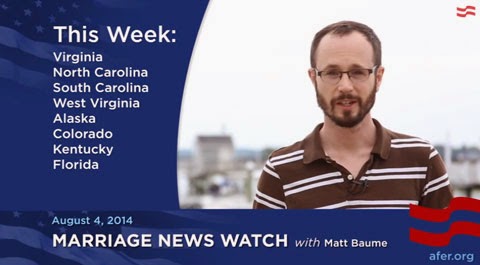
Marriage equality arguments end in 6th Circuit Court of Appeals

The big day for marriage equality in the 6th Circuit Court of Appeals has ended.

Six cases from four states looking for marriage equality – Michigan, Tennessee, Kentucky, and Ohio.

Freedom To Marry has posted the oral arguments from all of the cases. If you’ve never listened to lawyers present their cases and answer questions by the judges, it can be pretty fascinating. Plus, you might get a sense of which side the rulings will come down on. Although, law experts always make a point of saying you can’t really tell what the ruling will be based on the questions the judges ask. Sometimes, they are just playing “devil’s advocate” to see where it takes them.

Chris Geidner, legal editor for Buzzfeed, seemed to think Judge Daughtrey seemed most sympathetic to the good guys; Judge Cook, who apparently spoke the least seemed to favor the bad guys; and so it will most probably fall on Judge Sutton, who was not an easy read.

Chris Johnson of the Washington Blade wrote:

Based on their line of questioning, two judges — U.S. Circuit Judge Martha Craig Daughtry and U.S. Circuit Judge Jeffrey Sutton — seemed prepared to rule against bans on same-sex marriage. U.S. Circuit Judge Deborah Cook was relatively quiet, but appeared poised to rule in favor of the laws. Similar to other federal appeals court rulings, the panel seemed headed to make a 2-1 decision in favor of marriage equality.

Listen to the oral arguments below and see what you think:

Michigan: DeBoer v. Snyder

Tennessee:Tanco v. Haslam

Kentucky: Bourke v. Beshear and Love v. Beshear

Ohio: Obergefell v. Wymyslo and Henry v. Himes

And now, we wait. Experts say it could take several weeks to get the rulings.

Target signs on to support marriage equality in 7th Circuit Court appeal

Target announced Tuesday that it has signed an amicus, or friend of the court, brief in support of marriage equality in two cases currently before the 7th Circuit Court of Appeals.

The cases, Baskin v. Bogan, out of Indiana, and Wisconsin’s Wolf v. Walker, are both on appeal after federal district courts struck down same-sex marriage bans in those states.

Executive Vice President Jodee Kozlak explained the company’s position in this statement:

As our leadership team discussed signing on, we took time to consider the bigger questions at hand. This brief is important, as the issues it addresses have significant impact on businesses. But it is more than that and we agreed that now is the right time to more directly share our views on this issue.

It is our belief that everyone should be treated equally under the law, and that includes rights we believe individuals should have related to marriage.

Without getting into the specifics of a court case, this brief evaluates the issues created by states that both prohibit same-sex marriage and also refuse to recognize marriages that were conducted legally in other states. This position is particularly challenging for a large organization that operates nationally, such as Target. At Target, we have long offered comprehensive, competitive benefits to our LGBT team members and their families, often above what is legally required. We continue to do so today because we believe doing so is right for our team and for our business. But current laws — in places like Wisconsin and Indiana that are addressed in this brief – make it difficult to attract and retain talent. These disparate laws also create confusing and complicated benefits challenges across multiple states.

We believe that everyone – all of our team members and our guests – deserve to be treated equally. And at Target we are proud to support the LGBT community.

Florida gets fourth ruling against banning same-sex marriage

Today, a Palm Beach County Circuit judge ruled in a probate case that Florida’s ban on same-sex marriage is unconstitutional.

From the Palm Beach Post:

Circuit Judge Diana Lewis’ opinion was tied to a probate case surrounding the death of Frank Bangor, a man who owned property in Florida and married W. Jason Simpson in Delaware, where gay marriage is legal.

[snip]

Under Florida law, a spouse is recognized as a personal representative of an estate provided the out-of-state marriage is recognized as valid under state law. Simpson, through attorney Andrew Fein, petitioned Lewis to be recognized as Bangor’s personal representative despite a ban on gay marriage in Florida.

This is the fourth ruling in favor of marriage equality in Florida in less than a month.

Just yesterday a Broward County judge ruled against the ban in a divorce proceeding.

Florida State Attorney General Pam Bondi should seriously get a clue.  The future is here.

Virginia announces marriage equality appeal to SCOTUS

Just hours after Utah announced it’s intention to ask the US Supreme Court to rule on the recent overturn of that state’s ban on same-sex marriage, Virginia’s Attorney General has followed suit:

Virginia Attorney General Mark Herring says he will ask SCOTUS to review the recent ruling by the 4th Circuit Court of Appeals which upheld the state’s ban unconstitutional.

On Friday, Herring, a Democrat who has said the Virginia ban is unconstitutional, will file a petition for writ of certiorari asking the nation’s highest court to hear Virginia’s marriage equality case and definitively settle the constitutional issues it raises.

Bostic v. Schaefer was originally filed on behalf of two same-sex couples in July 2013 by the legal team that challenged California’s Proposition 8, including the American Foundation for Equal Rights (AFER) along with attorneys Ted Olson and David Boies. The American Civil Liberties Union (ACLU) and Lambda Legal joined the case in March on behalf of all of Virginia’s same-sex couples.

[snip]

“Throughout this case, I have fought for the fundamental rights of Virginians and the quickest possible resolution,” Herring said in a statement. “I believe the district and appeals courts ruled correctly in striking down Virginia’s discriminatory marriage ban, but it has long been clear that the Supreme Court will likely have the final word. I want that decision to come as soon as possible and I want the voices of Virginians to be heard. This case has moved forward at an incredibly swift pace, and I look forward to a final resolution that affirms the fundamental right of all Virginians to marry.”

Clearly, lawyers in both states (and on both sides of the issue) are looking to get to SCOTUS first in what will clearly be a historic court decision.

More at MetroWeekly.

Utah officially asks SCOTUS to rule on marriage equality

Utah Attorney General Sean Reyes has officially filed an appeal to the US Supreme Court to rule on the current ongoing same-sex marriage case.

Here’s the background so far:

• December 20, 2013 – U.S District Court Judge Robert J. Shelby ruled Utah’s same-sex marriage ban in violation of the U.S. Constitution. More than 1,000 same-sex couples to married before the U.S. Supreme Court halted marriages pending appeal

• April 10, 2014 – 10th Circuit Court of Appeals heard oral arguments in the case

• June 25, 2014 – 10th Circuit Court of Appeals ruled 2-1 to uphold a lower court’s ruling that Utah’s ban on same-sex marriage is unconstitutional

Worth noting that SCOTUS does not have to take the case.  Should SCOTUS refuse, the 10th’s ruling would stand and same-sex marriage would be legal in Utah.

Peggy Tomsic of the Salt Lake City law firm of Magleby & Greenwood, P.C. (currently representing the plaintiffs) issued this statement:

“We respect the State’s right to seek review of its own law in the highest Court in the land, but we also respectfully, and vehemently, disagree with the notion that States can deny one of the most foundational rights to the millions of same-sex couples living across this great land. We look forward to reviewing the Petition filed by Utah’s excellent lawyers, and to responding to it in due course.”

(source)

Florida: Broward County judge rules in favor of marriage equality

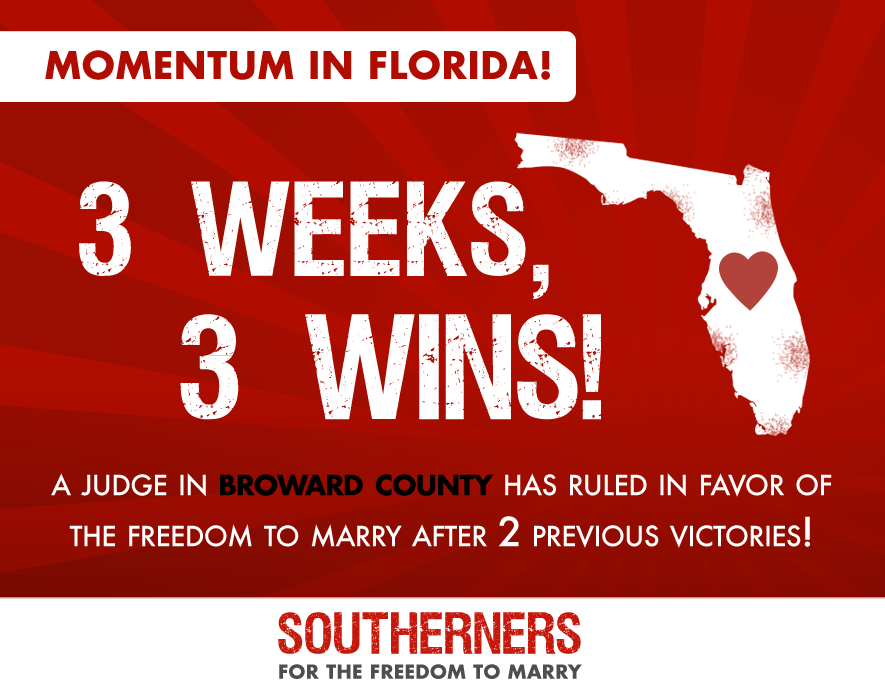
For the third time in three weeks, a Florida judge has ruled in favor of marriage equality, this time in Broward County.

From Freedom To Marry:

The ruling in today’s case, from Broward County Circuit Judge Dale Cohen, is the third marriage ruling in three weeks, following a July 17 ruling in Monroe County’s Huntsman v. Heavilin and July 25’s ruling in Miami-Dade County’s Pareto v. Ruvin.

In all 3 cases, judges ruled that banning same-sex couples from marrying is unconstitutional. All three rulings are stayed, and the two previous rulings have been appealed by Florida Attorney General Pam Bondi.

For now, today’s decision only applies to Broward County. The next step for the Miami-Dade and Monroe County decisions is review by Florida’s 3rd Circuit Court of Appeals. Last week, the plaintiffs in both cases moved to consolidate their cases and filed a motion seeking review directly by the Florida Supreme Court.

More than 30 court rulings have come down in favor of same-sex marriage since the June 2013 ruling by SCOTUS striking down the anti-gay Defense of Marriage Act.

Reading just a bit from Judge Cohen’s ruling:

“The Court is well aware of the emotionally charged environment behind this important issue. However, politics and emotionality cannot rule, it is the laws of our government that create the free society that we enjoy. The judicial role is to rule by applying the law to the facts with neutrality and impartiality.”

“This Court believes that the issue here is not whether there is a right to same-sex marriage but instead whether there is a right to marriage from which same-sex couples can be excluded. The State of Florida cannot ignore the status and dignity afforded to opposite-sex couples, who were married out-of-state, and not extend those same rights, dignities and benefits to same-sex couples similarly situated.”

Australia Parliament looks for “conscience vote” on marriage equality this spring

As support for marriage equality hits 72% (Crosby Textor poll) across Australia, elected officials in the country’s Parliament are looking towards a vote where MPs can vote their conscience as opposed to being locked in line with party position.

The Sydney Morning Herald reports:

Parliament is heading for a historic vote on same-sex marriage in which all MPs will be free to vote according to their conscience. The Coalition party rooms are likely to decide on a conscience vote during the coming spring session of Parliament, with one Liberal MP saying it is now ”almost certain” the party will dump its binding opposition to gay marriage. Prime Minister Tony Abbott, whose sister Christine Forster is in a same-sex relationship, promised before the election the Liberal Party room would be free to decide on a conscience vote.

The matter is expected to reach a crucial stage in the next two sitting fortnights of Parliament in August and September after senior Liberals asked crossbench Senator David Leyonhjelm to introduce his draft bill to legalise same-sex marriage. The government wants his proposed legislation on the notice paper so that it has time to scrutinise the exact wording before deciding which way to go. Senator Leyonhjelm has agreed, reversing his stated position when he announced the draft bill last month. At the time, he said he would not introduce it until the Liberal Party room opted for a conscience vote.

6th Circuit Court of Appeals to hear 5 marriage equality cases Wednesday

It will be a busy day in Cincinnati this Wednesday as a three-judge panel in the 6th Circuit Court of Appeals will hear appeals in 5 marriage equality cases from 4 different states.

Some of the cases address the freedom to marry directly, while some challenge states that refuse to recognize same-sex marriages performed in other states.

From the Columbus Dispatch:

All five cases will be heard by the same three-judge panel, consisting of former Ohio Supreme Court Justice Deborah L. Cook, 62; ex-state Solicitor Jeffrey Sutton, 53; and Martha Craig “Cissy” Daughtrey, 72. Daughtrey was appointed by President Bill Clinton in 1993, while Cook and Sutton were picked by President George W. Bush in 2003.

Of the five cases, two are from Ohio:

• Obergefell, et al v. Himes, et al, is an appeal from a decision by U.S. District Judge Timothy S. Black on Dec. 23, 2013, that required the state of Ohio to recognize same-sex marriages on death certificates issued by the state.

• Henry, et al v. Himes, is an appeal from another Black ruling, this one on April 14, 2014, that ordered the state to recognize valid same-sex marriages legally performed in states that allow such marriages.

The other three cases are from Michigan, Kentucky and Tennessee:

• DeBoer, et al v. Snyder, et al, is an appeal from an order by Judge Bernard A. Friedman on March 21, 2014, that struck down as unconstitutional Michigan’s ban on gay marriage.

• Bourke, et al v. Beshear, et al, stems from an order by Judge John G. Heyburn II on Feb. 12, 2014, declaring that Kentucky law violated the Equal Protection Clause of the 14th Amendment to the U.S. Constitution by refusing to recognize marriages legally performed in other states.

• Tanco, et al v. Haslam, et al, is an appeal from a decision by Judge Aleta A. Trauger ordering Tennessee to recognize marriages of three couples legally married outside the state.