Daily Dance: The Incredible Andrew On UK’s ‘The Greatest Dancer’

I post videos under the ‘Daily Dance’ banner here on The Randy Report because dance has been a huge part of my life for over 40 years.

Early on, dance – the physical expression of every possible human emotion – found a connection deep within me.

As it does for young Andrew here.

The world can be a frustrating, angry place at times. But, not in these few minutes that we get to share with Andrew.

Please – stop and watch.

You have to go to the well, sometimes, to refresh your soul. Thank you, Andrew.

Fox News Contributor Apologizes For Making Fun Of Autistic 10 Year-Old

Last Friday, Fox News contributor Tammy Bruce criticized a 10 year old boy after he approached Vice President Mike Pence and asked for an apology after Pence accidentally hit him in the face during an event at the White House.

On the air with Bill Hemmer (sitting in for an absent Tucker Carlson), Bruce mocked the boy because video seemed to show that Pence had barely made physical contact with him while he was attending an event at the White House.

“I guess we’re giving birth to snowflakes now, because that looked like that kid needed a safe space in that room,” she said during the segment.

As many know, “snowflakes” is what the far-right nut jobs call liberals today intimating that liberals are “fragile.”

What Bruce didn’t know was that the 10 year-old boy, named Michael, is from a military family and on the autism spectrum. And Bruce’s comments triggered a wave of hateful comments directed at the boy and his family on social media.

During an interview with CNN host Jake Tapper, the boy’s mother – Dr. Ingrid Herrera-Yee – shared that she was “devastated” at the way the Fox folks talked about her son. It was clear to her that they knew nothing of Michael and were attempting to make some political point using the boy’s actions.

Herrera-Yee ended her interview with this clear (and fair) request:

“Please don’t use kids. Whether they’re typically developing kids — it doesn’t matter that he’s autistic or a military kid. Forget all that. He’s a kid. And you don’t use children as examples on national television like that.”

Watch the CNN segment with Tapper and Herrera-Yee below:

After the whole episode became a viral “thing,” Bruce issued an apology today:

First of all, I am so sorry to the family. My intention was never to hurt a kid and his mom. We had absolutely no idea that Michael was on the autism spectrum and, as a gay woman and feminist, I’ve spent my adult life working to improve the lives of women and children and those who are disenfranchised. I get it and I apologize. I also appreciated the boy’s mother’s public comments and clarity on this. A main lesson here, no matter intent, is to leave kids out of our political discussions. We certainly agree on this.

I give Bruce credit: that is an actual apology. Good for her.

Normally, I find this kind of sniping to be silly. And, of course, cable news folks should not be making fun of children. Autism spectrum or not.

But I did want to post this episode here because my brother is on the autism spectrum. And my whole life I’ve watch people make fun of, and make assumptions, about my brother.

I know many of President Trump’s followers like his statements criticizing “political correctness.” They hate “political correctness.”

But what are those folks really criticizing? Being polite? Or arguing for the right to make fun of children?

We don’t really know anyone’s story. A brief incident somewhere doesn’t inform us of what someone deals with every day.

So, let’s lay off criticizing children. And perhaps be a little nicer about people we don’t know.

Watch Bruce’s apology below.

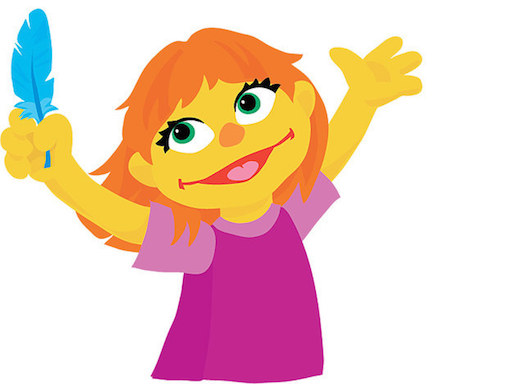
Sesame Street To Introduce First Autistic Character – Julia

Via Buzzfeed:

Her introduction came with the announcement of “Sesame Street and Autism: See Amazing in All Children.” The online initiative is designed to raise awareness of autism to reduce public stigmas and bullying in schools.

The program comes with a downloadable app featuring games, activities, stories, and videos that provide valuable resources in the care of an autistic child.

According to a Centers for Disease Control report in 2014, the prevalence of autism in the U.S. has risen to 1 in every 68 births — or nearly twice the rate of 1 in 125 in 2004.

Growing up, I always sensed “something” about my brother was not like me. It took almost 50 years for the realization (and eventual diagnosis) that my brother was mildly autistic. He was diagnosed with Aspergers Syndrome and Pervasive Developmental Disorder just a few years ago.

He functions great; takes care of himself perfectly well. But growing up, the social aspect of the condition made for some painful moments with school kids.

Good on Sesame Street for putting some spotlight on a topic kids should be exposed to at an early age so they can begin to understand the challenges kids like my brother face.

Sensitive Santas help autistic children share in holiday memories

From the AP: For many children with autism, visiting the mall to share Christmas wishes with Santa has never been part of their childhood, a sad but necessary concession to the autism that would make the noise, lights and crowds an unbearable torment.

Now, though, a growing number of “sensitive” Santas in shopping centers, at community parties and elsewhere are giving some of those children a chance to meet the big guy in autism-friendly settings – and providing families a chance to capture elusive Christmas photos and memories that families of typical children may take for granted.

For many families, those small moments captured in pictures and memories are a holiday gift of their own: a chance to go beyond the constraints of autism and experience a Christmas tradition with their children that might not otherwise be possible.

Below are some suggestions from the University of Washington Autism Center for creating a more positive and friendly Santa experience for your child:

  • Make a picture book or visual schedule to prepare your child for the event.
  • Familiarize your child with the location and setting in advance by taking photos or bringing your child to watch Santa from afar.
  • Give your child practice going through the steps of visiting Santa (e.g., waiting in line, walking up the steps to Santa’s chair, etc.) at times when the store or mall is quiet and Santa is not present.
  • Bring a toy (such as a squeeze ball) that your child can hold and play with while waiting in line.
  • Provide a “First-Then” schedule that illustrates the reward your child will get after the Santa visit.
  • Role play with your child how he or she can respond to questions that Santa might ask. Better yet, tell Santa what questions to ask your child.

Consider asking the store or mall management to designate a special time for children with autism to visit Santa. Examples of specific accommodations that might be helpful are:

  • Lower or turn off the music.
  • Dim the lights.
  • Schedule Santa at a time when the mall or store is typically closed to shoppers.
  • Provide training to Santa and his helpers about how the social, language, and behavioral features of autism might affect children’s ability to interact with Santa.
  • Use masking tape to mark the floor with arrows (to indicate the route that children will take to get to Santa) and “X”s (to indicate where children should stand or sit).
  • Create a “quiet area” where children can go if they begin to feel overwhelmed or distressed.
  • Create a “play area” where children can go to entertain themselves while waiting for their turn with Santa.
  • Use a numbering system so children do not need to stand in line while waiting for their turn.
  • Move all delicate or breakable items away from the Santa area.