Mitt Romney wants 4% unemp – Reich tells him how to do it

Speaking in Pittsburgh yesterday, Mitt Romney said that “anything over 4% [unemployment] is not cause for celebration.”

The United States last achieved a sub-4% unemployment rate in December 2000, the end of President Clinton’s term.

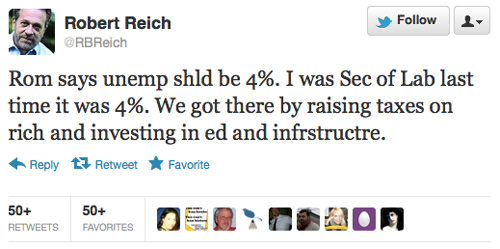
On Twitter, Robert Reich, a Secretary of Labor under President Clinton, reminded Romney how America got there:
Romney, however, has a different plan.  As a matter of fact, it’s exactly the opposite. His tax plan would give massive tax cuts to the rich. (The top 0.1% for example, would receive a $264,000 tax cut.)

Meanwhile, in a closed-door fundraiser, Romney revealed he planned to make massive reductions in education spending. He is also proposing cutting funding for infrastructure, including the possible elimination of the Department of Housing and Urban development.

Romney now says he wants to emulate former President Ronald Reagan. However, to follow in the footsteps of Reagan would be to not achieve his “4%” goals today.  The average yearly unemployment rate exceeded 7% for most of his presidency and never dropped below 5.5%.
 (via ThinkProgress)

CNN: Why Obama can’t match the Reagan recovery

CNN has an excellent piece up today regarding the differences between what economic pressures President Reagan had to cope with versus President Obama today.  Conservatives like to herald Reagan as a super-president, but comparing his situation at this point in his first term to President Obama’s is comparing apples to oranges. 

From CNN:

Reagan had an advantage over Obama: The recession of the early 1980s was caused by runaway inflation, which the Federal Reserve countered by hiking interest rates. When inflation dropped, the Fed lowered rates and a massive economic boom resulted.

The major causes of the recent recession were a banking crisis and housing bubble that exploded during President George W. Bush’s final months in office.

Another difference: With comparatively small debt loads, Reagan was able to push through a 23% across-the-board cut of individual income tax rates. Obama, meanwhile, entered the presidency with substantial budget deficits and an economy contracting at a rate of 6.7%.

Something that doesn’t come up in the CNN article but I think bears noting: politics in 1984 were not nearly as partisan as they are today.  Back in the 80s “compromise” was not a dirty word.  Politicians were more statesman-like and put country first.

From the beginning of the Obama administration, the GOP in DC has stated their main goal for four years was to make President Obama a one term president.  And they have done all they could to stop any progress in the US knowing that, even at the pain of the lower and middle classes, if they held progress to a minimum – while cashing their $170,000+ annual salaries – they would diminish President Obama’s chances at reelection.

Read the whole article at CNN.com

Economy adds 243,000 jobs in Jan; unemployment drops to 8.3%

Great news for President Obama – not so great for Mitt Romney.

The folks in the White House couldn’t have asked for a better January jobs report.

The AP: In the most impressive jump for the job market since the middle of last decade, the unemployment rate fell for the fifth-straight month after a surge of January hiring, a promising shift in the nation’s outlook for job growth. The Labor Department says employers added 243,000 jobs in January, the most in nine months. The unemployment rate dropped to 8.3% from 8.5% in December. That’s the lowest in nearly three years.

Remember, Mitt Romney’s biggest argument for being President is that President Obama “didn’t cause the recession, but he made it worse.” Check out the chart below. It shows the rise and fall of unemployment applications. The arrow shows when President Obama’s stimulus policies took affect. Now seriously, does it LOOK like President Obama’s policies “made it worse?”

In addition, the stock market is already off to its fastest start in 15 years as more investors start to believe the economic recovery is finally for real and will only get stronger. The Dow has gained 4 percent in 2012.

Some facts comparing the last GOP administration’s affect on the stock market versus President Obama:

• 60 percent: Increase in the Dow Jones Industrial average during the first three years of President Barack Obama’s term, up 4,771 points to Friday’s close of 12,720 as his fourth year begins.

• -1 percent: Decline in the Dow during President Bush’s first term from 2001 to 2005, dropping 116 points to 10,471.

• -24 percent: Decline in the Dow during President George W. Bush’s second term from 2005 to 2009, dropping 2,522 points to 7,949.

Unemployment improving, stock market improving, our military out of Iraq… And Mitt Romney says we’re heading in the WRONG direction???

Unemployment claims continue to drop

The general trend on initial unemployment claims over the last few months has been largely encouraging, though there have been setbacks. Last week, for example, was a step in the wrong direction.

This week’s report, however, was a little more heartening.

U.S. jobless claims dropped by 12,000 to a seasonally adjusted 367,000 in the week ended Jan. 28, the Labor Department said Thursday. Economists surveyed by MarketWatch had estimated claims would drop to 370,000.

When jobless claims fall below the 400,000 threshold, it’s considered evidence of an improving jobs landscape. When the number drops below 370,000, it suggests jobs are actually being created rather quickly.

And with that, here’s the chart, showing weekly, initial unemployment claims going back to the beginning of 2007. The higher the number, the more jobs being lost.

For anyone who thinks the stimulus package had no effect – as Repubs like to claim – the arrow shows the point at which President Obama’s Recovery Act began spending money.

I see unemployment claims going down once President Obama’s policies went into effect, how about you?

Private sector in 2011 added most jobs since 2005

Today’s jobs report shows that the economy ended the year on a relative strong note, with the private sector adding 212,000 jobs lats month.

And the Washington Monthly’s Steve Benen notes that “the U.S. private sector has now added 1.89 million jobs in 2011, well ahead of last year’s private-sector total of 1.2 million, and the best year for businesses since 2005.”

The chart above shows monthly private sector job losses or gains under the Bush (red) and Obama administrations (blue). Clearly things have gotten much better since President Obama took office.

We keep hearing the country is going in the “wrong direction.” Since jobs are steadily being created, does that mean the critics would rather see more jobs LOST?
(source)

Unemployment applications drop to 3 year low

Fewer people are seeking unemployment benefits than just three months ago — a sign that layoffs are falling sharply.

The number of people applying for benefits fell last week to 366,000, the fewest since May 2008. If the number stayed that low consistently, it would likely signal that hiring is strong enough to lower unemployment.

The unemployment rate is now 8.6 percent. The last time applications were this low, the rate was 5.4 percent.

The four-week average of weekly unemployment applications, which smooths out fluctuations, dropped last week to 387,750. That’s the lowest four-week since July 2008. The four-week average has declined in 10 of the past 12 weeks.

“Labor market conditions have taken a turn for the better in recent weeks,” Michael Gapen, an economist at Barclays Capital, said in a note to clients. “Payroll growth should improve in the coming months.”

Applications for unemployment benefits are a measure of the pace of layoffs. Job cuts have fallen sharply since the recession. Employers have been hiring at only a modest pace. But when applications fall below 375,000 — consistently — that usually signals that hiring is strong enough to lower the unemployment rate.

Read more at WashingtonPost.com

Unemployment drops to 8.6 from 9%

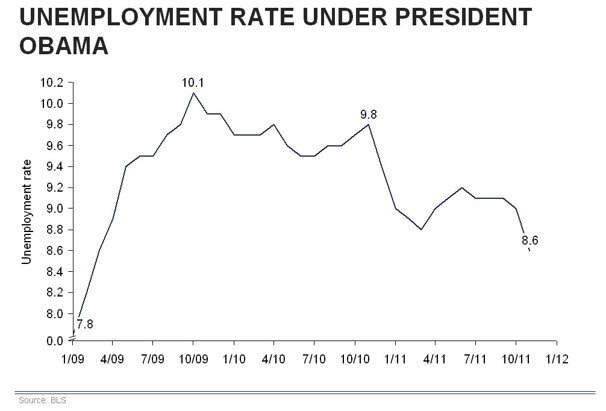
The good news is the Labor Department reported Friday that the unemployment rate dropped to 8.6% in November, the lowest since March 2009 and a sharp improvement from 9.0% in October.  As you can see from the chart above showing the unemployment rate under President Obama, while unemployment shot up in the first several months of his presidency – before his policies could affect any change – the rate has been dropping.

The bad news is part of this month’s drop in the unemployment rate comes from long term unemployed folks who are discouraged from looking and stop. Those people aren’t factored into the “unemployed” number.

And employers added only 120,000 jobs in October — well off the number that economists say is needed just to keep pace with population growth.

But the drop in the unemployment number is at least a good psychological boost to many, who need to feel things are at least moving in the right direction.

I think the important thing isn’t one month’s report. What needs to happen is America needs to see several months of steady improvement, so that folks can wrap their heads around the idea that things are improving AND small business owners – who we are told over and over need to see something stable before they begin hiring again – get their “stabilization cue” and actual start creating jobs again.

And then, Americans might start feeling better about the economy. Right now, that’s not happening.

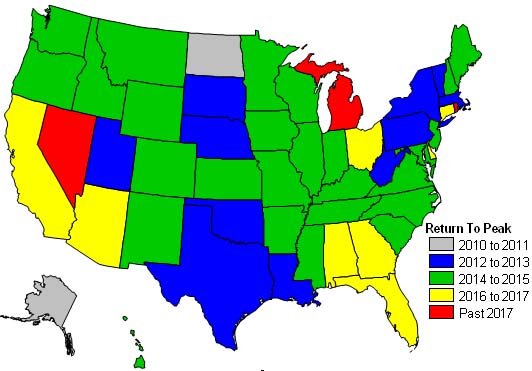
Economists estimate number of years before jobs return to states

Click pic for larger view

Across the country, there are 4.7 percent fewer jobs today than there were when the recession began in December 2007.

And remember that the United States population has grown in the last five years, so if the economy were healthy there would be more jobs today than there were then. This analysis only models when we’ll be back to square one.
(via NYTimes)

Employment numbers get slightly better

These are the Labor Department statistics that encouraged economists and investors today:

— In September, employers added 103,000 jobs.
— In August, employers added 57,000 jobs; previously the department said no net jobs were created that month.
— July’s job total also was revised upward, to an increase of 127,000 from 85,000.
— After a long, brutal slump, the construction sector added 26,000 jobs.
— The workweek got a little longer.
— Average hourly earnings rose 0.2 percent after dipping in August.

Not super-duper news, but at this point, I’ll take whatever means we are moving forward.

Unemployment drops to lowest rate in nearly 2 years

Unemployment

Unemployment in the U.S dropped to 9% last month – the lowest rate since April 2009.

The last two months have seen a steep decline in the unemployment rate, dropping from 9.8 to 9.0 in just two months – the steepest two-month fall since 1953.

Economists had expected a better number in light of recent upticks in retail sales, consumers spending more and factories churning out more goods. However, bad weather across the country was blamed in part as the weather conditions in much of the country made for difficult working conditions. The construction industry shed 32,000 jobs, the most since May. Transportation and warehousing firms also reported large cuts. All three sectors were affected by the snowstorms much of the country experienced last month.

Many economists expect the unemployment rate to fluctuate throughout 2011, but eventually end below 9%.