Colton Haynes: “No One To Blame But Myself” For Social Media Spinning His Life

Actor Colton Haynes covers the latest issue of The Advocate and shares that he only blames himself for his personal life spiraling out in public due to his own social media over-sharing
Colton Haynes covers ‘The Advocate’
For many LGBTQ people, Pride Month is not only a celebration of who we are, but how we got here.

Teen Wolf/Arrow star Colton Haynes covers the latest issue of The Advocate and shares a candid look-back on his road to ‘here,’ and how being gay factored in to the highs and lows of stardom.

At the age of 14, Haynes experience two life-changing events: coming out to his family and he was discovered by a modeling agency talent scout.

By the time he was 20, he’d appeared in ad campaigns for Abercrombie & Fitch, JC Penney and Ralph Lauren. He’d also begun making appearances in films (Transformers), TV series (CSI: Miami, The Hills, Pushing Daisies) and music videos (Chemical Romance’s “I Don’t Love You”).

Along the way there were some disappointments like two TV series (Showtime’s Look, ABC’s The Gates) that were both quickly cancelled.

But then came MTV’s Teen Wolf which cast the hunky actor as high school lacrosse player “Jackson Whittemore.” Life soon went into hyperdrive as the series had nearly 2.5 million viewers tuning in each week.

Haynes tells The Advocate the series “just exploded because we went from shooting the pilot to presenting at the MTV Movie Awards, which was insane.”

But amid the heady success, there was the inevitable dark side.

Haynes was still closeted, and he recalls being explicitly told to stay in the closet or it would “jeopardize the show.”

He also found out that, during casting, some teenage pics of him kissing a guy had begun circulating around the internet and one MTV executive was against hiring Haynes.

But the show’s creator, Jeff Davis, became Haynes’ champion telling the network, “If you’re not going to hire this person because they’re gay, then we’re going to remove this character completely.”

Obviously, Haynes got the job but felt he was trapped in the closet.

“Despite the fact that I was gay, I hid my sexuality throughout being on Teen Wolf,” says Haynes. “Everyone knew, obviously, when we were filming but I definitely butched it up and kind of hid it while I was filming.”

Looking back at those early 20-something, closeted years today from the perspective of an out 30-year old (he publicly came out three years ago), Haynes still feels like the ‘Hollywood system’ didn’t give him a choice if he wanted to be successful.

“In order to be seen as being able to play a leading man or being able to play the roles I’ve played thus far, I really did need to create this persona,” he told The Advocate. “Unfortunately, Hollywood can be very limiting with their choices.”

He added that, while things aregetting better, since coming out the only auditions he’s being called for are gay roles.

In the middle of Haynes’ professional successes, though, there were personal, private challenges like living with drug/alcohol abuse and anxiety issues, and the passing of his mother in 2018.

Even while visiting his mother in the hospital (who was there due to a failing liver from her own drinking issues, he told Attitude he drank tequila from a water bottle.

Just months later he found himself in a media storm as he filed for divorce after being married less than a year to florist Jeff Leatham.

He’s since shared publicly that there had been episodes where he would check into hotels and go on weeklong benders of drugs and alcohol.

In March, Haynes told Attitude that when one ‘hotel stay’ left him bruised, partially blind in his left eye and nearly ruptured his kidney, the actor checked into rehab. It was then he took a cold, sober look at himself.

Today, he says he has “no one to blame but myself” in terms of how the press and social media spun his life out to the masses.

Taking full responsibility for the wild ride, Haynes admits, “I was posting every second of my life online. Every positive, every negative.”

“Eventually I became click bait, eventually everything that we all joke about — how I could literally say something online and the trolls will pick it up and spin it into something, that ‘I’m spiraling out of control,” he added. “I did make myself [look] that way, not knowing I was doing that.”

Haynes hopes that, even with possible ‘over-sharing’ on social media, his struggles might help other people.

“I’m still hearing from certain people that have gone through what I’ve gone through,” he explains. “Even though a lot of it isn’t as in-depth as the way that I’ve shared, it helps me to be able to share a lot more because I’m like, ‘Oh, I’m not alone. I’m not crazy. My struggles aren’t just my own. A lot of people go through this.’”

And even though his super-hero days appear to be coming to an end as Arrow producers have announced its upcoming 8th season will be the last, Haynes still believes we all can be heroes – folks who are “true and authentic” and “really stand up for something they believe in.”

There’s a positive message for Pride, and definitely a hopeful perspective as Haynes looks to his next chapter.

“It’s totally in all of us, and it’s really special. Everyone just needs to tap into it.”

The Advocate Names Heroes Of Pulse Nightclub “People Of The Year”

For it’s annual Year In Review issue, The Advocate dedicates the title of “People of the Year” to the heroes of Pulse and features Angel Colon, one of the survivors, on the cover of the December/January issue.

From the issue’s feature article:

Three hours, 13 minutes. That’s how long the Pulse nightclub shooting lasted—from 2:02 a.m., when Orlando police received the first reports of shots fired, to 5:15 a.m., when a SWAT team killed shooter Omar Mateen.

During that time—the time it takes to watch a movie or sit down to dinner—49 people were killed and an additional 53 were injured.

Most of the clubgoers were killed or wounded in the first 20 minutes—including Angel Colon, who was shot multiple times in his leg and side.

“The first shots,” he says, “they were super loud—and super hot. We dropped our drinks, and all we could hear was pop pop pop pop.”

Colon evacuated the club early in the standoff between Mateen and Orlando police—but only after Mateen came out to the dance floor and fired once again on the rows of bodies. Colon called over an officer who was 15 feet away. “Please come get me,” he said.

That night changed not only Colon’s life but the lives of LGBTs everywhere. The survivors of Pulse have become unlikely advocates for a community grappling with this tragedy—the worst single-person mass shooting and the deadliest violent act against LGBT people in U.S. history.

[snip]

As 2016 ends, the victims of the Pulse shooting face the same danger that faces survivors of every other mass shooting in America: being forgotten. But queer people do not forget. The vigils may wane, the debates may fizzle, the rainbow filters on profile pics may be swapped out, but the survivors of Pulse will not stop fighting for a better, safer community.

Pulse is not a footnote in America’s struggle with gun violence; it’s the opening of a new chapter, one where enters the fire and resolve of the LGBT community. In the past few generations, our communities have galvanized to battle a plague and to secure marriage equality, and fight even now to secure full civil rights—all steps forward that few in earlier generations had expected until they happened.

America will invariably move on to the next gun-related tragedy, but the survivors of Pulse are here. And they will be heard for years to come.

The Advocate Endorses Hillary Clinton For President

The Advocate endorses Hillary Clinton for president

For only the second time, The Advocate has endorsed a presidential candidate, and unsurprisingly, the noted LGBT news outlet voices strong support for former Secretary of State Hillary Clinton.

From The Advocate:

Clinton is a calm, deliberative leader with decades of public service experience and an impressive command of policy, detail, and the concerns of overlapping minority communities. Whereas Trump alienates women, Muslims, immigrants, and LGBT people, Clinton’s record as a U.S. senator is marked by bipartisanship, and her campaign is marked by inclusivity.

To imagine that the election result is a foregone conclusion — that Clinton will handily and easily defeat Trump in November without serious effort on the part of an engaged electorate — is a mistake. The U.K.’s Brexit vote is an example of left-leaning activists and voters wrongly assuming that voters will exercise “common sense.”

There is no foregone conclusion. There is no obvious outcome. But there is only one capable candidate in this election, and only one candidate who is a champion of LGBT causes. That clear and necessary choice is Hillary Clinton.

The Advocate Names SCOTUS “People Of The Year” For Historic Marriage Ruling

The Advocate has named the United States Supreme Court Justices “People of the Year” for their historic ruling this past June which brought marriage equality to the entire country:

At 10:02 a.m. Eastern on June 26, 2015, the U.S. Supreme Court changed America forever.

In handing down its decision in Obergefell v. Hodges — declaring marriage to be a constitutionally protected right for same-sex couples — the court immediately made the lives of millions better. That doesn’t happen often: Most progress in a obstreperous country like the United States happens incrementally. But with Obergefell, the Supreme Court wiped out dozens of discriminatory measures, scrubbing away decades of antigay prejudice. Suddenly, anti-LGBT states had no excuse to degrade same-sex couples, no legal rationale to deny them marriage licenses. The worldwide push for marriage equality was given an inestimable boost, as marriage equality rights advocates in countries like Australia looked to the Supreme Court for inspiration. And here in America, in an instant, gays and lesbians made an enormous step toward becoming equal citizens under the law.

[snip]

In the days following Obergefell, Kennedy was lionized as a gay rights luminary. He is — but it was really the court itself that was the hero of the moment. Without its independence, its position as the ultimate arbiter of the law, gays and lesbians in America would still be denied access to the fundamental institution of marriage. Supreme Court decision-making involves a certain kind of sorcery which transforms an individual voice into binding legal precedent. The power of that voice lends each ruling legitimacy, and the prestige of the institution makes each ruling enforceable. It may have been Kennedy who wrote that the Constitution grants gay couples “equal dignity in the eyes of the law.” But it is the Supreme Court of the United States that made that judgment a constitutional command.

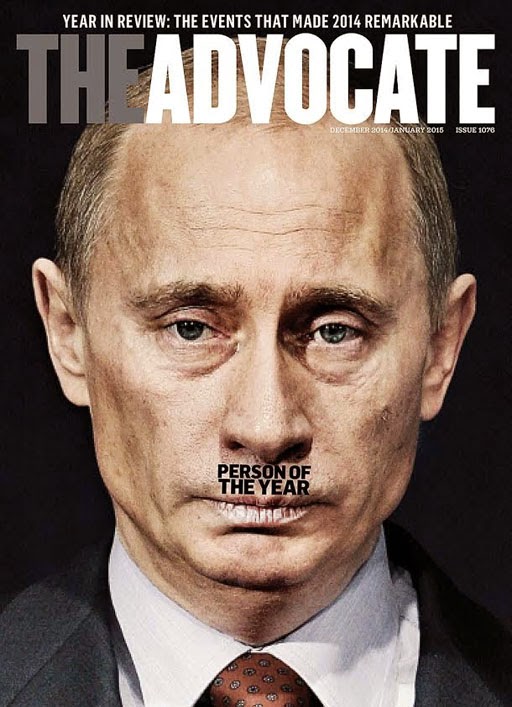
The Advocate Names Russian President Vladimir Putin “Person Of The Year”

The Advocate has named Russian president Vladimir Putin its “Person of the Year.”

From the article:

“Driving the governmental, religious, and popular disdain for gays and lesbians the Russian president became the single greatest threat to LGBTs in the world in 2014.”

Read the entire piece at Advocate.com.