Reuters correspondent David Ingram reports from the live oral arguments for same-sex marriage at the Supreme Court.
Assumed “swing-vote” Justice Kennedy mentioned the idea that marriage has been the same for “millenia:”
Kennedy: “This definition has been with us for millenia, and I think it’s very difficult for this court to say we know better.” #SCOTUS — David Ingram (@David_Ingram) April 28, 2015
Kennedy multiple times talked about marriage being the same for “millenia.” He said he “kept coming back” to that thought. #ReutersSCOTUS — David Ingram (@David_Ingram) April 28, 2015
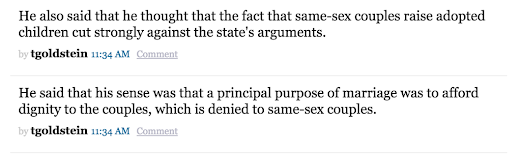
Later, Kennedy offered a couple of encouraging signs as he noted that a principal purpose of marriage was to afford dignity, which is denied to same-sex couples. He also said the fact that same-sex couples raise children hurt state’s arguments against marriage equality. Via SCOTUSblog:
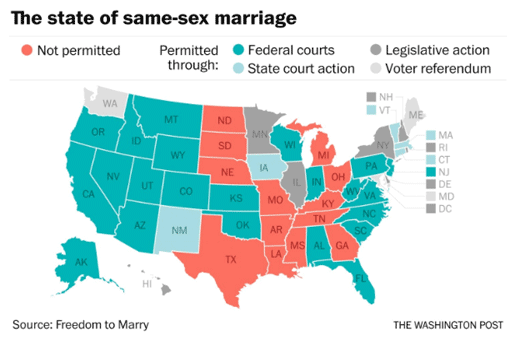
The dark green indicates states where marriage equality is permitted via federal court rulings. Should we lose at SCOTUS, these could be thrown into disarray.
I’m cautiously hopeful today as oral arguments take place at the U.S. Supreme Court over marriage equality.
Most observers, even haters, have a measured expectation that SCOTUS will rule in favor of same-sex marriage. Mainly because they seemed to have indicated a leaning in our favor by allowing states to permit same-sex marriage last fall while the appeals were flying fast and furious.
Surely the court wouldn’t allow tens of thousands of marriages to take place if they didn’t think they would rule in favor? The results of ruling against same-sex marriage now would be a mess of catastrophic proportions.
The Washington Post today imagines the worst case scenario should we – horrors! – not prevail.
“It would be a mess,” said Dale Carpenter, a professor of constitutional law at the University of Minnesota, noting that marriage confers 1,100 rights and benefits at the federal level and hundreds more from the states, from filing taxes jointly to inheriting hunting licenses. “There would be great uncertainty in the aftermath of such a ruling. All kinds of possibilities we can’t even think of would arise.”
The effect would be explosive in the 21 states where same-sex-marriage bans were struck down by federal courts. Groups for and against these unions say such a decision would set off a cascade of fresh litigation and spark dramatic new fights in state capitals, with each side jockeying to have its version of marriage enshrined in state law.
Some legal experts say the old laws in those states would snap back into place, immediately shutting the door on future marriages, while others contend that would require another round of litigation. Some believe the thousands of marriages that have taken place in those states would be deemed valid, though others think the matter would need to be settled by the courts — perhaps even the Supreme Court.
In states such as Oregon, where the political climate has become more favorable to gay marriage in recent years, there probably would be a scramble to enact legislation to allow same-sex marriages.
But the process could be more drawn out in places such as California, whose prohibition on same-sex marriage was part of the state constitution. If that ban was reinstated as a result of a Supreme Court decision, a voter referendum would be needed to get rid of it.
Elsewhere, the battles could be more pitched. In Virginia and Pennsylvania, for instance, freshly minted Democratic governors may resist attempts to revert to old laws, potentially clashing with conservative state lawmakers.
Steven Hotze speaks at Janet Porter’s “Restrain the Judges” press conference in front of the Supreme Court where they delivered “restraining orders” to the Supreme Court demanding that the justices not hear arguments on the constitutionality of same-sex marriage bans.
The activists, including Scott Lively, Peter LaBarbera and Bill Owens, also announced that they were filing a motion asking Justices Ruth Bader Ginsburg and Elena Kagan to recuse themselves from the case because they, in Lively’s words, “deliberately officiated at so-called homosexual wedding ceremonies.”
Steven Hotze of Conservative Republicans of Texas, a Roy Moore acolyte who has been advocating for a bill in his state barring the use of funds to issue marriage licenses to gay and lesbian couples if the state’s marriage ban is struck down, declared that gay marriage is “not a marriage, it’s a mirage, because it’s counterfeit, it’s a lie, it’s untrue.”
A decision in favor of marriage equality, he warned, “would force individuals to have to condone, accept, even celebrate sexual immorality among certain elements of the population and teach it to the children.”
“It would criminalize Christianity,” he added. “The pastors would be forced to have to marry those of the same-sex.”
They are literally making lies up now. Bald-faced lies. Not one LGBT activist has ever said pastors should be forced to officiate a same-sex wedding. Nor has anyone raised the idea of “criminalizing Christianity.”
But they just keep lying and lying and lying.
Ignore them, please. Just be aware of this kind of negativity and hate exists.
As the Supreme Court prepares to hear oral arguments on the freedom to marry on April 28, Freedom to Marry is running this ad nationally on TV and online showing that “It’s time. America is ready for the freedom to marry.”
The new ad will run in the Washington, D.C., market during the Sunday morning news shows: Meet the Press, This Week, CBS Sunday Morning, and Fox News Sunday.
The ad also will run in the D.C. market during 60 Minutes on Sunday evening, according to the group, and nationwide this week on cable news channels CNN, MSNBC, and Fox News.
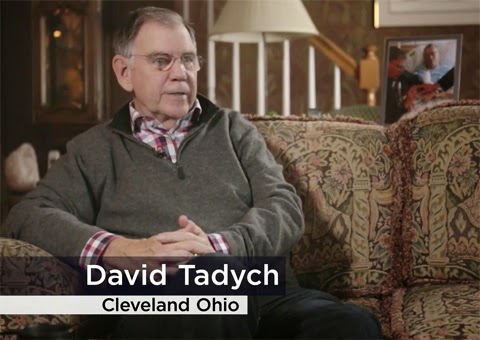
Heart-breaking video from the Liberty Education Forum shares the story of David, who lost Mike — his partner of more than 40 years — to cancer earlier this year.
The couple married in the hospital room shortly before Mike’s death, a union not legally recognized in their home state of Ohio.
David explains that if he could speak to the Supreme Court, he would: “…ask one favor of them, and that’s to allow me to be on [Mike’s] death certificate as his spouse or husband. I would bend a knee to them and, seriously, say make an exception: Let it be that we are together on that death certificate.”
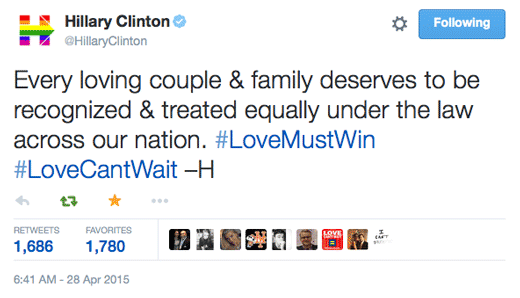
While many argue that state-by-state rulings on marriage are sufficient, David’s story is a painful reminder that nationwide marriage equality can’t wait.