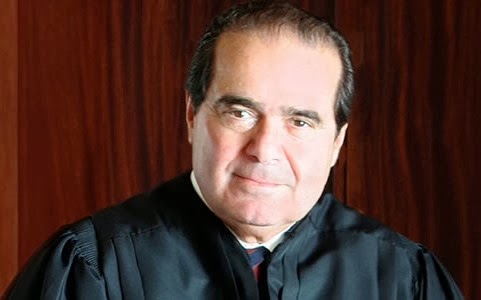
Supreme Court Justice Scalia: “I haven’t expressed my view about gay marriage”

Supreme Court Justice Antonin Scalia said on Thursday he has not given his views on the constitutionality of gay marriage itself.

“I haven’t expressed my view about gay marriage,” Scalia, a noted conservative said, adding that the decision itself only applied to a narrow piece of the 1996 Defense of Marriage Act.

“The issue in the DOMA case was not whether the Constitution requires states to allow gay marriage. That was not the question at all,” Scalia said at Tufts University in Medford, Massachusetts, outside Boston. “The question is whether Congress can define marriage in all of the statues that Congress enacted to mean only marriage between a man and a woman.”

In his dissenting opinion on that ruling, Scalia, who was appointed to the court by President Ronald Reagan in 1986, wrote that the majority ignored procedural obstacles he said should have prevented the court from taking up the matter in the first place.

Scalia does expect to see the issue back before SCOTUS.

“I’m waiting for the second shoe to drop,” said Scalia, the longest-serving member of the U.S. Supreme Court

(via Reuters)
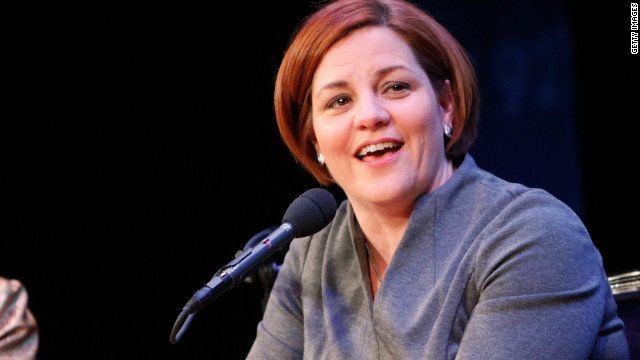
Christine Quinn says Justice Scalia should apologize for comparing being gay to murder

New York City Council Speaker Christine Quinn wants Supreme Court Justice Antonin Scalia to apologize for remarks he made comparing anti-sodomy bans to laws against bestiality and murder.

“The justice should apologize,” Quinn told Chris Matthews in an appearance on Hardball on MSNBC, reports Azi Paybarah at Capital New York. “It’s offensive. Sexual orientation is who we are as people. It’s how we’re created,” she said.

Scalia made the comments Monday in an appearance at Princeton University. A gay freshman asked the conservative justice about his stance, exemplified in his dissent in the 2003 Lawrence v. Texas case that struck down anti-sodomy laws.

“I don’t think it’s necessary, but I think it’s effective,” said Scalia. He added that he was not comparing the acts of homosexuality and murder, but drawing a parallel between the prohibitions against them.

“It’s a form of argument that I thought you would have known, which is called the ‘reduction to the absurd’…If we cannot have moral feelings against homosexuality, can we have it against murder?” he asked. “Can we have it against other things?”

More at the Advocate.