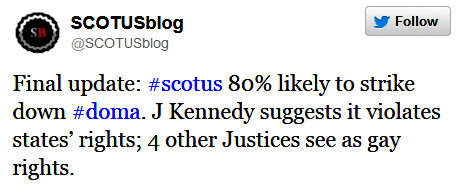
SCOTUSblog: 80% chance DOMA will be struck down
LGBTQ news and entertainment
From TalkingPointsMemo: Emerging from Wednesday’s Supreme Court oral arguments on the Defense of Marriage Act, CNN’s reporter Jeffrey Toobin said the Court was likely to overturn the 1996 law based on the skepticism of crucial swing vote Justice Anthony Kennedy.
“I think DOMA’s in trouble and I think it’s in trouble because Anthony Kennedy was repeatedly concerned that the Defense of Marriage Act violates states’ rights,” Toobin said on CNN.
“Anthony Kennedy as we all know the swing vote on this Court is someone who is concerned about gay rights although he said very little, I think nothing about the issue of whether the Defense of Marriage Act violated gay people’s constitutional rights. He was clearly very concerned that the Defense of Marriage Act was invading the province of the state to define marriage. That’s a state function, usually. And that would certainly be suggesting that he was going to strike down the law. And certainly the other liberals, the four Democratic appointees looked like they were going to vote to strike it down.”
In addition, NBC News Justice Correspondent Pete Williams reported that there seemed to be five votes to invalidate the law.
Williams said comments from Justice Anthony Kennedy indicated that he had problems with law: whether Congress had the right to say what marriage is, as well as the lack of narrow focus in the 1996 law which may make it unconstitutionally over-broad.
Bill O’Reilly: “The compelling argument is on the side of homosexuals. That’s where the compelling argument is. ‘We’re Americans. We just want to be treated like everybody else.’ That’s a compelling argument, and to deny that, you have got to have a very strong argument on the other side. The argument on the other side hasn’t been able to do anything but thump the Bible.”

Sen. Kay Hagen of North Carolina has come out in favor of marriage equality:
“I know there are strong feelings on both sides, and I have a great deal of respect for their opinions, but after much thought and prayer on my part this is where I am today.
“I know all our families do not look alike. We all want the same thing for our families. We want happiness, we want health, prosperity, a bright future for our children and grandchildren. After conversations I’ve had with family members, with people I go to church with and with North Carolinians from all walks of life, I’ve come to my own personal conclusion that we should not tell people who they can love, or who they can marry. It’s time to move forward with this issue.”

The Kentucky legislature last night voted to override Gov. Steve Beshear’s veto of the Religious Freedom Act, which allows state residents to disobey civil rights laws on the basis of “sincerely held religious beliefs.”
The state House’s 79-15 vote sent HB279 to the Senate, which voted 32-6 to override the measure.
Gov. Beshear released the following statement: “As I explained in my veto message, I have significant concerns that this bill will cause serious unintentional consequences that could threaten public safety, health care, and individuals’ civil rights.”
Activists are concerned that the law will be used to challenge LGBT rights ordinances in Louisville, Lexington, Covington. and Vicco.
The text of the bill:
Government shall not burden a person’s or religious organization’s freedom of religion. The right to act or refuse to act in a manner motivated by a sincerely held religious belief may not be burdened unless the government proves by clear and convincing evidence that it has a compelling governmental interest in infringing the specific act or refusal to act and has used the least restrictive means to further that interest. A “burden” shall include indirect burdens such as withholding benefits,assessing penalties, or an exclusion from programs or access to facilities.
From a just-released Quinnipiac Poll:
• By a 64 – 30 percent margin, voters support a law allowing same sex couples to marry
• Men support same-sex marriage 60 – 32 percent
• Women support 68 – 28 percent
• Voters over 55 years old – 56 – 38 percent
• Voters 18 – 34 years – 80 – 17 percent among

Montana Sen. Jon Tester on Tuesday endorsed same-sex marriage, joining the party’s new public consensus on the issue.
I’ve admired the manner and directness that Sen. Tester has represented his state for a long time. I’ve feel he is a true representative of the independent spirit of his home state.
Sen. Tester joins Sens. Claire McCaskill of Missouri and Mark Warner of Virginia in endorsing same-sex nuptials, and Jay Rockefeller of West Virginia who on Monday pushed the courts to repeal the Defense of Marriage Act.
“Montanans believe in the right to make a good life for their families,” Tester wrote on Facebook. “How they define a family should be their business and their business alone. I’m proud to support marriage equality because no one should be able to tell a Montanan or any American who they can love and who they can marry.”
Like McCaskill, Tester just won reelection easily, and won’t face voters until 2018.
Congratulations, Montana. You have a Senator to be proud of.
(via Politico)
In May 2004, the Supreme Judicial Court of Massachusetts ruled that the state’s prohibition on same-sex marriage was unconstitutional.
In that time, the number of states legalizing marriage equality has risen to 9 states plus Washington, DC.
ThinkProgress asked opponents of equal rights for gays and lesbians today how 9 years of same-sex marriage has impacted their own marriages.
Want to take a guess what the answers were…?
During today’s Supreme Court case on marriage equality, the justices pressed Charles Cooper, the lawyer defending discrimination, on how exactly same-sex marriage somehow undermines marriage between straight people. He was unable to give a cogent response.
(via ThinkProgress)
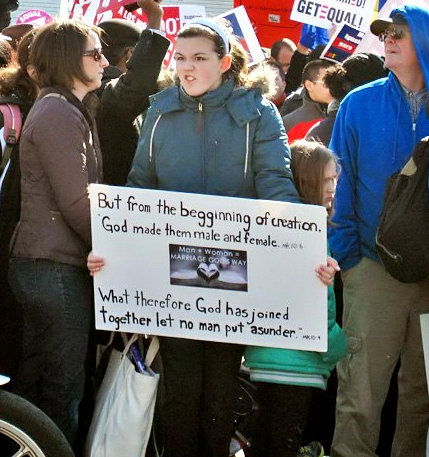
THIS, folks, is who and what is standing against equal rights for gays and lesbians.
The woman is possibly a fan of home schooling, too. But that’s just a guess…
(via AmericaBlog)
Via AFER