 The poll and data crunchers at FiveThirtyEight most recent predictions for the November elections show a bit of
 good better news for Democrats in one chamber of Congress. Continue reading “FiveThirtyEight: Democrats Slightly Favored To Win Senate”
Donald Trump Lags Behind Previous GOP Presidential Candidates
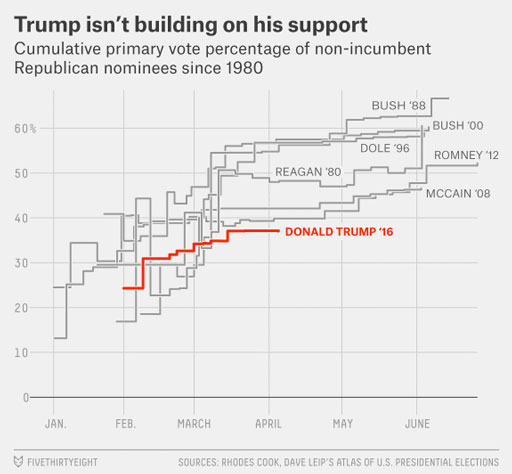
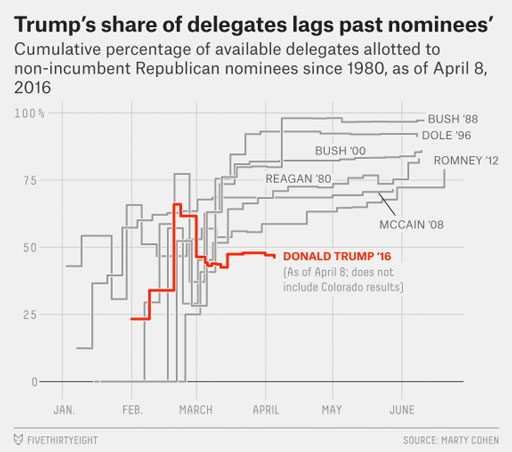
Harry Enten at FiveThirthEight.com has compared past performances of non-incumbent Republican presidential nominees and found that current front-runner Donald Trump is way behind his predecessors at this point in the primary season.
Trump’s 37 percent of the cumulative primary vote and 46 percent of delegates won so far may sound impressive, but his percentages make him the weakest Republican front-runner, at this point in the process, in decades.
Past GOP nominees such as George H.W. Bush in 1988, George W. Bush in 2000, Bob Dole in 1996 and Ronald Reagan in 1980 had bigger shares of the vote at this point, even if they started out slowly. You’ll also note, however, that the two most recent Republican nominees, John McCain and Mitt Romney, weren’t doing too much better than Trump is now.
McCain and Romney, though, were far ahead of Trump at this point in the delegate race. All the eventual nominees studied here won a majority of the delegates allotted1 by this date. Trump remains short of a majority.
Unless something radically changes, Trump will finish the primary season with the lowest percentage of the primary vote and the lowest share of delegates of any Republican presidential primary vote leader since caucuses and primaries became the main method for selecting nominees.
If Facebook ‘Likes’ Were Votes, Who Would Be Winning Presidential Primary?
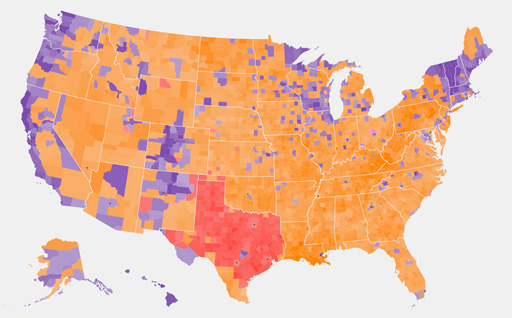
The stats geniuses at FiveThirtyEight have published an interactive map showing which presidential primary candidates have the most Facebook likes in each county in the U.S.
From FiveThirtyEight:
If Facebook likes were votes, Bernie Sanders would be on pace to beat Hillary Clinton nationwide by a nearly 3-to-1 margin and Donald Trump to garner more support than Ted Cruz and Marco Rubio combined. Anything seems possible this year, but, still, be careful how you interpret these numbers: Facebook likes are not votes.
According to the Pew Research Center, 58 percent of American adults use Facebook. But this share is not a representative sample of the country — Facebook users are disproportionately young (although not as young as users of other social media networks), low-income and female. And the sample may be even more skewed because only some people on Facebook have liked a presidential candidate’s page and because those pages haven’t existed for the same amount of time.